

SEARCH WHAT YOU WANT
Industrial RO for Electroplating Rinse Water
Time:2026-09-21
Water quality has a direct impact on electroplating appearance, coating adhesion and corrosion resistance. Minerals and dissolved salts in ordinary tap or borehole water can remain on metal surfaces after rinsing, causing stains, deposits and inconsistent plating quality.
An industrial RO system for electroplating rinse water removes most dissolved salts, hardness and other ionic contaminants. It provides stable purified water for intermediate rinsing, final rinsing and chemical-bath preparation.
Why Does Electroplating Rinse Water Quality Matter?
After electroplating, metal components pass through one or more rinsing stages to remove residual process chemicals. If the rinse water contains high levels of calcium, magnesium, chloride, silica or other dissolved substances, these impurities may remain on the product after drying.
Poor rinse-water quality can cause:
- • Water spots and visible stains
- • Uneven surface appearance
- • Salt deposits after drying
- • Reduced coating adhesion
- • Corrosion of plated components
- • Contamination of downstream rinse tanks
- • Inconsistent product quality
- • Higher rejection and rework rates
Using RO permeate helps control these problems by providing rinse water with lower and more stable conductivity.
Common Contaminants in Raw Rinse Water
The quality of municipal water, groundwater and borehole water varies by location. Common contaminants include:
| Contaminant | Possible effect on electroplating |
|---|---|
| Hardness | White deposits, scaling and bath contamination |
| Chloride | Corrosion and surface defects |
| Silica | Difficult-to-remove spots and deposits |
| Iron and manganese | Staining and discoloration |
| Sulfate | Increased conductivity and salt residues |
| Suspended solids | Particle deposits and surface defects |
| Organic matter | Bath contamination and unstable finishing |
| High TDS | Water spots and inconsistent final-rinse quality |
A complete water analysis is required before selecting the RO process and pretreatment equipment.
Where Is RO Water Used in Electroplating?
RO-treated water can be used in several parts of an electroplating line.
Chemical-Bath Preparation
Using purified water to prepare process chemicals reduces unwanted ions entering the plating bath and improves solution consistency.
Intermediate Rinsing
Intermediate rinses remove chemicals carried over from one treatment stage to another. RO water helps reduce cross-contamination between baths.
Final Rinsing
Final rinsing is particularly important because any minerals remaining on the product may become visible after drying.
RO water is commonly used for the final rinse of:
- • Decorative plated parts
- • Electronic components
- • Automotive components
- • Precision metal parts
- • Aerospace components
- • Hardware and sanitary products
For highly sensitive finishes, double-pass RO or RO followed by EDI may be required.
Typical RO Process for Electroplating Rinse Water
A common treatment process for producing rinse water is:
Raw-Water Tank → Multimedia Filter → Activated Carbon Filter → Water Softener or Antiscalant Dosing → Cartridge Filter → High-Pressure Pump → RO System → Purified-Water Tank → Electroplating Rinse Line
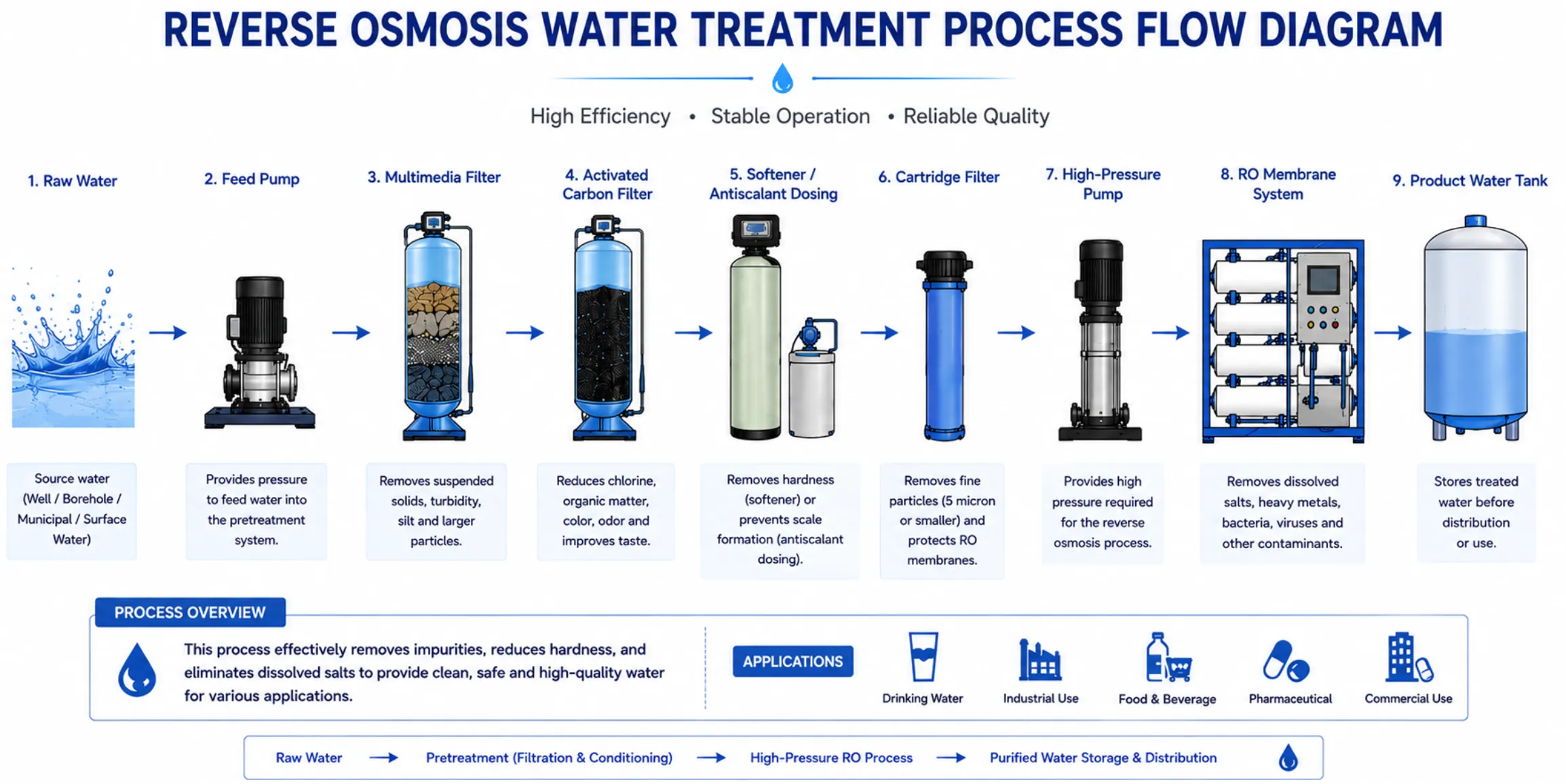
The final configuration depends on the raw-water quality and required rinse-water conductivity.
Multimedia Filtration
Multimedia filtration removes suspended solids, rust and turbidity. This protects the cartridge filters and RO membranes from particle fouling.
Activated Carbon Filtration
Activated carbon removes chlorine and reduces some organic contaminants. Dechlorination is especially important because free chlorine can damage many polyamide RO membranes.
Water Softening
A water softener removes calcium and magnesium hardness, helping prevent membrane scaling.
For larger systems, antiscalant dosing may be used instead of or together with softening, depending on the feedwater chemistry and design recovery.
Cartridge Filtration
A cartridge filter captures fine particles before the high-pressure pump and membrane system.
Reverse Osmosis
The RO membrane removes most:
- • Dissolved salts
- • Hardness
- • Chloride
- • Sulfate
- • Silica
- • Heavy-metal ions
- • Other ionic contaminants
Actual removal performance depends on membrane selection, operating pressure, temperature and feedwater composition.
Single-Pass RO or Double-Pass RO?
The required system depends on the electroplating process and target water quality.
| Treatment system | Suitable applications |
|---|---|
| Single-pass RO | General electroplating rinsing and bath preparation |
| Double-pass RO | Lower-conductivity final rinse and precision plating |
| Double-pass RO + EDI | Electronics, semiconductor components and highly sensitive surface finishing |
A single-pass system is often sufficient for general rinsing. However, industries requiring very low conductivity and minimal ionic residue may need additional purification.
Water-quality specifications should be provided numerically rather than described only as “pure water.”
How to Determine the Required RO Capacity
The RO system must supply enough water for all rinse tanks and production shifts.
Required capacity depends on:
- • Number of plating lines
- • Number and volume of rinse tanks
- • Continuous or batch rinsing
- • Product throughput
- • Rinse-water replacement frequency
- • Daily operating hours
- • Peak water demand
- • Required reserve capacity
A simplified calculation is:
RO Capacity = Daily Purified-Water Demand ÷ Effective Operating Hours
For example, if a factory requires 80 m³ of purified rinse water per day and the RO system operates for 16 hours:
80 m³ ÷ 16 hours = 5 m³/h
The design should also include a reasonable allowance for flushing, maintenance and production peaks.
Counter-Current Rinsing Can Reduce Water Consumption
A counter-current rinsing arrangement moves clean water in the opposite direction to product movement. The cleanest water enters the final rinse tank, while overflow water moves toward earlier rinse stages.
This arrangement can:
- • Reduce total rinse-water consumption
- • Improve final-rinse quality
- • Lower RO system capacity requirements
- • Reduce wastewater volume
- • Improve water-use efficiency
The RO plant and rinse-tank arrangement should therefore be designed together whenever possible.
Product-Water Storage and Distribution
Electroplating lines often have variable water demand. A purified-water tank provides a buffer between continuous RO production and peak rinse-water consumption.
The distribution system may include:
- • Purified-water storage tank
- • Delivery pump
- • Level-control system
- • Conductivity monitoring
- • Circulation loop
- • UV sterilization, if necessary
- • Final cartridge filter
Tank and piping materials should be compatible with the required water quality. Poorly designed storage and distribution can reintroduce particles, metals or microorganisms.
Recommended Monitoring Parameters
An industrial RO plant for electroplating should monitor:
- • Feedwater pressure
- • RO inlet pressure
- • Permeate flow
- • Concentrate flow
- • System recovery
- • Feedwater conductivity
- • Permeate conductivity
- • Differential pressure
- • Product-tank level
Monitoring conductivity at the RO outlet and final rinse point helps operators detect water-quality changes before they affect production.
Can Electroplating Rinse Wastewater Be Reused?
Used electroplating rinse water may contain heavy metals, acids, alkalis, cyanides or other process chemicals. It cannot normally be sent directly into a standard RO system.
Wastewater reuse may require upstream treatment such as:
- • pH adjustment
- • Chemical precipitation
- • Heavy-metal removal
- • Coagulation and clarification
- • Multimedia filtration
- • Ultrafiltration
- • Activated carbon treatment
- • Specialized membrane pretreatment
After the wastewater has been properly treated and confirmed suitable for membrane processing, RO may be used as a polishing or desalination step.
The wastewater-treatment section should be designed by a qualified specialist according to its actual composition and local discharge requirements. A conventional pure-water RO system should not be treated as a substitute for heavy-metal wastewater treatment.
Key Design Considerations
Raw-Water Analysis
Test the feedwater for:
- • TDS and conductivity
- • Hardness
- • Alkalinity
- • Chloride
- • Sulfate
- • Silica
- • Iron and manganese
- • pH
- • Turbidity
- • Free chlorine
Required Rinse-Water Quality
Confirm the maximum acceptable:
- • Conductivity
- • TDS
- • Hardness
- • Silica
- • Chloride
- • Specific metal ions
Materials of Construction
Stainless steel, UPVC, FRP and other materials may be selected according to the water quality, pressure and installation environment.
Automation
A PLC-controlled industrial RO system can provide:
- • Automatic startup and shutdown
- • Low-pressure protection
- • High-pressure protection
- • Automatic membrane flushing
- • Tank-level control
- • Conductivity alarms
- • Chemical-dosing interlocks
Future Expansion
If additional plating lines may be installed, reserve space and utility capacity for additional membranes, pumps or RO trains.
Common Design Mistakes
Avoid the following problems:
- • Selecting equipment without a water analysis
- • Using tap water directly for sensitive final rinsing
- • Choosing capacity based only on average consumption
- • Ignoring peak rinse-water demand
- • Using RO directly on untreated electroplating wastewater
- • Failing to monitor final-rinse conductivity
- • Installing an undersized purified-water tank
- • Ignoring chlorine damage to RO membranes
- • Increasing recovery without checking scaling risk
- • Selecting double-pass RO when single-pass RO already meets the process requirement
Frequently Asked Questions
Is RO Water Suitable for Electroplating?
Yes. RO water is widely used for chemical preparation, intermediate rinsing and final rinsing because it contains fewer dissolved salts than untreated water.
What Conductivity Is Required for Electroplating Rinse Water?
There is no single value suitable for every process. The requirement depends on the plating material, finish, product specification and rinse stage.
Does Every Electroplating Plant Need Double-Pass RO?
No. Many general electroplating applications can use single-pass RO. Double-pass RO is appropriate when lower conductivity or more consistent final-rinse quality is required.
Can RO Remove Heavy Metals from Used Rinse Water?
RO can reject many dissolved metal ions, but it should not normally receive untreated electroplating wastewater. Heavy metals and chemicals must be reduced through suitable upstream treatment.
How Can an Electroplating Plant Reduce Rinse-Water Costs?
Possible methods include counter-current rinsing, flow control, optimized tank design, conductivity-based water replacement and suitable reuse after professional wastewater treatment.
Conclusion
An industrial RO system can improve electroplating quality by providing stable, low-conductivity water for bath preparation and rinsing. This helps reduce water spots, salt residues, bath contamination and inconsistent surface finishes.
The correct system may use single-pass RO, double-pass RO or RO+EDI, depending on the raw-water quality and final-rinse requirements. Before selecting equipment, provide a complete feedwater report, required capacity, daily operating hours and target conductivity.
For wastewater-reuse projects, electroplating rinse wastewater must first receive specialized pretreatment. RO can then be evaluated as a downstream purification step after the water is suitable for membrane treatment.
Water quality has a direct impact on electroplating appearance, coating adhesion and corrosion resistance. Minerals and dissolved salts in ordinary tap or borehole water can remain on metal surfaces after rinsing, causing stains, deposits and inconsistent plating quality.
An industrial RO system for electroplating rinse water removes most dissolved salts, hardness and other ionic contaminants. It provides stable purified water for intermediate rinsing, final rinsing and chemical-bath preparation.
Why Does Electroplating Rinse Water Quality Matter?
After electroplating, metal components pass through one or more rinsing stages to remove residual process chemicals. If the rinse water contains high levels of calcium, magnesium, chloride, silica or other dissolved substances, these impurities may remain on the product after drying.
Poor rinse-water quality can cause:
- • Water spots and visible stains
- • Uneven surface appearance
- • Salt deposits after drying
- • Reduced coating adhesion
- • Corrosion of plated components
- • Contamination of downstream rinse tanks
- • Inconsistent product quality
- • Higher rejection and rework rates
Using RO permeate helps control these problems by providing rinse water with lower and more stable conductivity.
Common Contaminants in Raw Rinse Water
The quality of municipal water, groundwater and borehole water varies by location. Common contaminants include:
| Contaminant | Possible effect on electroplating |
|---|---|
| Hardness | White deposits, scaling and bath contamination |
| Chloride | Corrosion and surface defects |
| Silica | Difficult-to-remove spots and deposits |
| Iron and manganese | Staining and discoloration |
| Sulfate | Increased conductivity and salt residues |
| Suspended solids | Particle deposits and surface defects |
| Organic matter | Bath contamination and unstable finishing |
| High TDS | Water spots and inconsistent final-rinse quality |
A complete water analysis is required before selecting the RO process and pretreatment equipment.
Where Is RO Water Used in Electroplating?
RO-treated water can be used in several parts of an electroplating line.
Chemical-Bath Preparation
Using purified water to prepare process chemicals reduces unwanted ions entering the plating bath and improves solution consistency.
Intermediate Rinsing
Intermediate rinses remove chemicals carried over from one treatment stage to another. RO water helps reduce cross-contamination between baths.
Final Rinsing
Final rinsing is particularly important because any minerals remaining on the product may become visible after drying.
RO water is commonly used for the final rinse of:
- • Decorative plated parts
- • Electronic components
- • Automotive components
- • Precision metal parts
- • Aerospace components
- • Hardware and sanitary products
For highly sensitive finishes, double-pass RO or RO followed by EDI may be required.
Typical RO Process for Electroplating Rinse Water
A common treatment process for producing rinse water is:
Raw-Water Tank → Multimedia Filter → Activated Carbon Filter → Water Softener or Antiscalant Dosing → Cartridge Filter → High-Pressure Pump → RO System → Purified-Water Tank → Electroplating Rinse Line
The final configuration depends on the raw-water quality and required rinse-water conductivity.
Multimedia Filtration
Multimedia filtration removes suspended solids, rust and turbidity. This protects the cartridge filters and RO membranes from particle fouling.
Activated Carbon Filtration
Activated carbon removes chlorine and reduces some organic contaminants. Dechlorination is especially important because free chlorine can damage many polyamide RO membranes.
Water Softening
A water softener removes calcium and magnesium hardness, helping prevent membrane scaling.
For larger systems, antiscalant dosing may be used instead of or together with softening, depending on the feedwater chemistry and design recovery.
Cartridge Filtration
A cartridge filter captures fine particles before the high-pressure pump and membrane system.
Reverse Osmosis
The RO membrane removes most:
- • Dissolved salts
- • Hardness
- • Chloride
- • Sulfate
- • Silica
- • Heavy-metal ions
- • Other ionic contaminants
Actual removal performance depends on membrane selection, operating pressure, temperature and feedwater composition.
Single-Pass RO or Double-Pass RO?
The required system depends on the electroplating process and target water quality.
| Treatment system | Suitable applications |
|---|---|
| Single-pass RO | General electroplating rinsing and bath preparation |
| Double-pass RO | Lower-conductivity final rinse and precision plating |
| Double-pass RO + EDI | Electronics, semiconductor components and highly sensitive surface finishing |
A single-pass system is often sufficient for general rinsing. However, industries requiring very low conductivity and minimal ionic residue may need additional purification.
Water-quality specifications should be provided numerically rather than described only as “pure water.”
How to Determine the Required RO Capacity
The RO system must supply enough water for all rinse tanks and production shifts.
Required capacity depends on:
- • Number of plating lines
- • Number and volume of rinse tanks
- • Continuous or batch rinsing
- • Product throughput
- • Rinse-water replacement frequency
- • Daily operating hours
- • Peak water demand
- • Required reserve capacity
A simplified calculation is:
RO Capacity = Daily Purified-Water Demand ÷ Effective Operating Hours
For example, if a factory requires 80 m³ of purified rinse water per day and the RO system operates for 16 hours:
80 m³ ÷ 16 hours = 5 m³/h
The design should also include a reasonable allowance for flushing, maintenance and production peaks.
Counter-Current Rinsing Can Reduce Water Consumption
A counter-current rinsing arrangement moves clean water in the opposite direction to product movement. The cleanest water enters the final rinse tank, while overflow water moves toward earlier rinse stages.
This arrangement can:
- • Reduce total rinse-water consumption
- • Improve final-rinse quality
- • Lower RO system capacity requirements
- • Reduce wastewater volume
- • Improve water-use efficiency
The RO plant and rinse-tank arrangement should therefore be designed together whenever possible.
Product-Water Storage and Distribution
Electroplating lines often have variable water demand. A purified-water tank provides a buffer between continuous RO production and peak rinse-water consumption.
The distribution system may include:
- • Purified-water storage tank
- • Delivery pump
- • Level-control system
- • Conductivity monitoring
- • Circulation loop
- • UV sterilization, if necessary
- • Final cartridge filter
Tank and piping materials should be compatible with the required water quality. Poorly designed storage and distribution can reintroduce particles, metals or microorganisms.
Recommended Monitoring Parameters
An industrial RO plant for electroplating should monitor:
- • Feedwater pressure
- • RO inlet pressure
- • Permeate flow
- • Concentrate flow
- • System recovery
- • Feedwater conductivity
- • Permeate conductivity
- • Differential pressure
- • Product-tank level
Monitoring conductivity at the RO outlet and final rinse point helps operators detect water-quality changes before they affect production.
Can Electroplating Rinse Wastewater Be Reused?
Used electroplating rinse water may contain heavy metals, acids, alkalis, cyanides or other process chemicals. It cannot normally be sent directly into a standard RO system.
Wastewater reuse may require upstream treatment such as:
- • pH adjustment
- • Chemical precipitation
- • Heavy-metal removal
- • Coagulation and clarification
- • Multimedia filtration
- • Ultrafiltration
- • Activated carbon treatment
- • Specialized membrane pretreatment
After the wastewater has been properly treated and confirmed suitable for membrane processing, RO may be used as a polishing or desalination step.
The wastewater-treatment section should be designed by a qualified specialist according to its actual composition and local discharge requirements. A conventional pure-water RO system should not be treated as a substitute for heavy-metal wastewater treatment.
Key Design Considerations
Raw-Water Analysis
Test the feedwater for:
- • TDS and conductivity
- • Hardness
- • Alkalinity
- • Chloride
- • Sulfate
- • Silica
- • Iron and manganese
- • pH
- • Turbidity
- • Free chlorine
Required Rinse-Water Quality
Confirm the maximum acceptable:
- • Conductivity
- • TDS
- • Hardness
- • Silica
- • Chloride
- • Specific metal ions
Materials of Construction
Stainless steel, UPVC, FRP and other materials may be selected according to the water quality, pressure and installation environment.
Automation
A PLC-controlled industrial RO system can provide:
- • Automatic startup and shutdown
- • Low-pressure protection
- • High-pressure protection
- • Automatic membrane flushing
- • Tank-level control
- • Conductivity alarms
- • Chemical-dosing interlocks
Future Expansion
If additional plating lines may be installed, reserve space and utility capacity for additional membranes, pumps or RO trains.
Common Design Mistakes
Avoid the following problems:
- • Selecting equipment without a water analysis
- • Using tap water directly for sensitive final rinsing
- • Choosing capacity based only on average consumption
- • Ignoring peak rinse-water demand
- • Using RO directly on untreated electroplating wastewater
- • Failing to monitor final-rinse conductivity
- • Installing an undersized purified-water tank
- • Ignoring chlorine damage to RO membranes
- • Increasing recovery without checking scaling risk
- • Selecting double-pass RO when single-pass RO already meets the process requirement
Frequently Asked Questions
Is RO Water Suitable for Electroplating?
Yes. RO water is widely used for chemical preparation, intermediate rinsing and final rinsing because it contains fewer dissolved salts than untreated water.
What Conductivity Is Required for Electroplating Rinse Water?
There is no single value suitable for every process. The requirement depends on the plating material, finish, product specification and rinse stage.
Does Every Electroplating Plant Need Double-Pass RO?
No. Many general electroplating applications can use single-pass RO. Double-pass RO is appropriate when lower conductivity or more consistent final-rinse quality is required.
Can RO Remove Heavy Metals from Used Rinse Water?
RO can reject many dissolved metal ions, but it should not normally receive untreated electroplating wastewater. Heavy metals and chemicals must be reduced through suitable upstream treatment.
How Can an Electroplating Plant Reduce Rinse-Water Costs?
Possible methods include counter-current rinsing, flow control, optimized tank design, conductivity-based water replacement and suitable reuse after professional wastewater treatment.
Conclusion
An industrial RO system can improve electroplating quality by providing stable, low-conductivity water for bath preparation and rinsing. This helps reduce water spots, salt residues, bath contamination and inconsistent surface finishes.
The correct system may use single-pass RO, double-pass RO or RO+EDI, depending on the raw-water quality and final-rinse requirements. Before selecting equipment, provide a complete feedwater report, required capacity, daily operating hours and target conductivity.
For wastewater-reuse projects, electroplating rinse wastewater must first receive specialized pretreatment. RO can then be evaluated as a downstream purification step after the water is suitable for membrane treatment.
Previous: No more data
Get a Quote for Free
Submit this form and our sales representative will contact you soon.


ONLINE MESSAGE
Copyright © 2026 Zhongnuo Water Treatment Co., Ltd.