
Pretreatment Upgrades
- Automatic multimedia and carbon filters
- Softener or antiscalant dosing
- pH adjustment and membrane degassing
- Automatic double-pass RO flushing
The 1m³/h EDI ultrapure water system from Zhongnuo integrates double-pass reverse osmosis (RO) and continuous electrodeionization (EDI) technology to produce stable high-purity deionized water without routine chemical regeneration. With a rated output of 1,000 L/h, this industrial EDI water plant delivers exceptionally consistent water quality and is ideal for electronics, pharmaceutical, laboratory and precision manufacturing applications requiring reliable ultrapure process water.
The 1m³/h EDI ultrapure water system from Zhongnuo integrates double-pass reverse osmosis (RO) and continuous electrodeionization (EDI) technology to produce stable high-purity deionized water without routine chemical regeneration. With a rated output of 1,000 L/h, this industrial EDI water plant delivers exceptionally consistent water quality and is ideal for electronics, pharmaceutical, laboratory and precision manufacturing applications requiring reliable ultrapure process water.
A fully automatic double-pass RO and continuous electrodeionization plant engineered to deliver stable high-purity deionized water without routine acid or alkali regeneration.
The Zhongnuo 1m³/h EDI system combines pretreatment, double-pass reverse osmosis and EDI polishing to supply consistent deionized water for electronics, pharmaceutical, laboratory and precision-manufacturing processes.
Unlike a conventional mixed bed, EDI removes residual ions continuously without routine chemical regeneration, reducing chemical handling, downtime and waste discharge.
Explore additional EDI ultrapure water equipment capacities.
| Item | Specification |
|---|---|
| Product name | 1m³/h EDI Ultrapure Water System |
| Rated capacity | 1 m³/h (1,000 L/h) |
| Operating range | 0.8–1.2 m³/h |
| Maximum daily output | Up to 24 m³/day |
| Core process | Pretreatment + double-pass RO + EDI |
| Operation | Fully automatic continuous operation |
| Installation | Integrated skid-mounted |
EDI cannot be fed directly with tap water or groundwater. Low-conductivity RO permeate is required to prevent scaling or irreversible module damage and to maintain stable outlet resistivity.
Final limits must follow the selected EDI module manufacturer's specification and the project water analysis.
| Parameter | Recommended Inlet Limit |
|---|---|
| Conductivity | ≤10 μS/cm |
| Hardness | ≤1 mg/L as CaCO₃ |
| Silica | ≤0.5 mg/L |
| Free chlorine | Controlled to non-damaging levels |
| Carbon dioxide | Controlled by pH adjustment or degassing |
Equivalent conductivity is ≤0.067 μS/cm under the specified feedwater and operating conditions.
Microbial and TOC limits must be defined separately according to the final application and distribution-loop design.
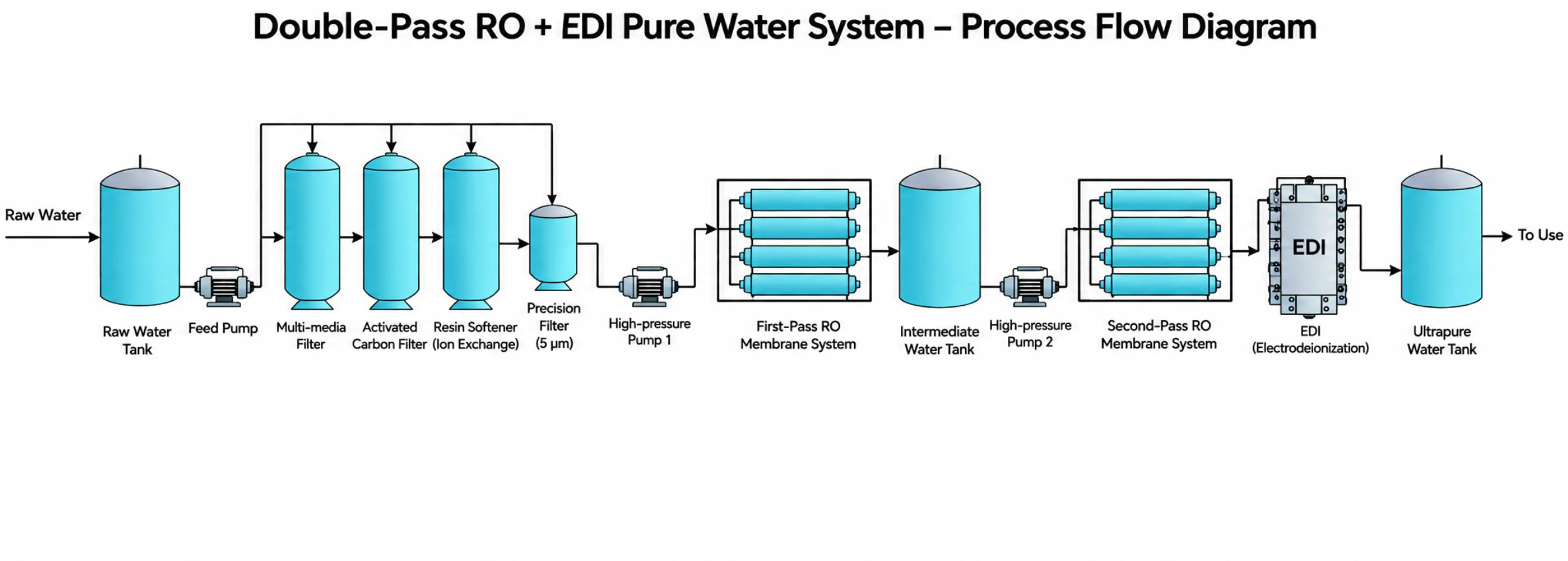
Pretreatment and RO configuration are customized according to the raw-water analysis and target resistivity. Learn more about our reverse osmosis systems.
| Parameter | Typical Specification |
|---|---|
| Rated product-water capacity | 1 m³/h (1,000 L/h) |
| Operating range | 0.8–1.2 m³/h |
| Maximum daily production | 24 m³/day |
| Core configuration | Double-pass RO + EDI polishing |
| First-pass RO rejection | Typically ≥98% |
| Combined double-pass RO rejection | Typically ≥99.5% |
| EDI outlet resistivity | ≥15 MΩ·cm at 25°C |
| Product-water conductivity | ≤0.067 μS/cm |
| Optional polished resistivity | Up to 18.2 MΩ·cm |
| EDI-stage recovery | Typically 90%–95% |
| Overall recovery | Based on feedwater and RO design |
| RO membrane | Industrial 4040 membranes |
| Cartridge filter | 5 μm |
| Control system | Automatic PLC + HMI |
| Product-water piping | SS316L, sanitary UPVC or PVDF |
| Frame material | SS304 or SS316L |
| Power supply | Customized to local standard |
| Installation | Integrated skid-mounted |
| Warranty | One year |
Final performance depends on feedwater, temperature, EDI module selection, sanitization and distribution-loop design.
| Aspect | RO + EDI System | Conventional Mixed Bed |
|---|---|---|
| Regeneration | Continuous electrical regeneration | Periodic acid/alkali regeneration |
| Operation | Automatic continuous output | Downtime during regeneration |
| Operating cost | Lower chemical and labor demand | Higher chemical and handling cost |
| Water quality | Stable consistent resistivity | Declines between regenerations |
| Waste | Minimal regeneration chemical waste | Regular acid/alkali waste |
| Footprint | Compact integrated skid | Separate chemical storage required |
No. EDI requires low-conductivity RO permeate. Double-pass RO is normally used to protect the module and maintain stable resistivity.
No. It uses electricity, ion-exchange resin and ion-selective membranes for continuous deionization without routine acid/alkali regeneration.
Usually not. Stable 18.2 MΩ·cm water normally requires polishing treatment and a properly designed ultrapure-water recirculation loop.
Dissolved CO₂ increases EDI ionic load and can reduce outlet resistivity. Degassing or pH adjustment may be required.
Yes. EDI performs best under stable continuous operation. Storage and recirculation are recommended for variable point-of-use demand.
Yes. Factory testing, installation guidance, commissioning and operator training are available for overseas projects.
Provide the information below so our engineers can confirm pretreatment, membrane projection, EDI sizing, sanitary materials and distribution-loop requirements.
Send your water analysis and target water standard for a customized RO + EDI proposal.
A fully automatic double-pass RO and continuous electrodeionization plant engineered to deliver stable high-purity deionized water without routine acid or alkali regeneration.
The Zhongnuo 1m³/h EDI system combines pretreatment, double-pass reverse osmosis and EDI polishing to supply consistent deionized water for electronics, pharmaceutical, laboratory and precision-manufacturing processes.
Unlike a conventional mixed bed, EDI removes residual ions continuously without routine chemical regeneration, reducing chemical handling, downtime and waste discharge.
Explore additional EDI ultrapure water equipment capacities.
| Item | Specification |
|---|---|
| Product name | 1m³/h EDI Ultrapure Water System |
| Rated capacity | 1 m³/h (1,000 L/h) |
| Operating range | 0.8–1.2 m³/h |
| Maximum daily output | Up to 24 m³/day |
| Core process | Pretreatment + double-pass RO + EDI |
| Operation | Fully automatic continuous operation |
| Installation | Integrated skid-mounted |
EDI cannot be fed directly with tap water or groundwater. Low-conductivity RO permeate is required to prevent scaling or irreversible module damage and to maintain stable outlet resistivity.
Final limits must follow the selected EDI module manufacturer's specification and the project water analysis.
| Parameter | Recommended Inlet Limit |
|---|---|
| Conductivity | ≤10 μS/cm |
| Hardness | ≤1 mg/L as CaCO₃ |
| Silica | ≤0.5 mg/L |
| Free chlorine | Controlled to non-damaging levels |
| Carbon dioxide | Controlled by pH adjustment or degassing |
Equivalent conductivity is ≤0.067 μS/cm under the specified feedwater and operating conditions.
Microbial and TOC limits must be defined separately according to the final application and distribution-loop design.
Pretreatment and RO configuration are customized according to the raw-water analysis and target resistivity. Learn more about our reverse osmosis systems.
| Parameter | Typical Specification |
|---|---|
| Rated product-water capacity | 1 m³/h (1,000 L/h) |
| Operating range | 0.8–1.2 m³/h |
| Maximum daily production | 24 m³/day |
| Core configuration | Double-pass RO + EDI polishing |
| First-pass RO rejection | Typically ≥98% |
| Combined double-pass RO rejection | Typically ≥99.5% |
| EDI outlet resistivity | ≥15 MΩ·cm at 25°C |
| Product-water conductivity | ≤0.067 μS/cm |
| Optional polished resistivity | Up to 18.2 MΩ·cm |
| EDI-stage recovery | Typically 90%–95% |
| Overall recovery | Based on feedwater and RO design |
| RO membrane | Industrial 4040 membranes |
| Cartridge filter | 5 μm |
| Control system | Automatic PLC + HMI |
| Product-water piping | SS316L, sanitary UPVC or PVDF |
| Frame material | SS304 or SS316L |
| Power supply | Customized to local standard |
| Installation | Integrated skid-mounted |
| Warranty | One year |
Final performance depends on feedwater, temperature, EDI module selection, sanitization and distribution-loop design.
| Aspect | RO + EDI System | Conventional Mixed Bed |
|---|---|---|
| Regeneration | Continuous electrical regeneration | Periodic acid/alkali regeneration |
| Operation | Automatic continuous output | Downtime during regeneration |
| Operating cost | Lower chemical and labor demand | Higher chemical and handling cost |
| Water quality | Stable consistent resistivity | Declines between regenerations |
| Waste | Minimal regeneration chemical waste | Regular acid/alkali waste |
| Footprint | Compact integrated skid | Separate chemical storage required |
No. EDI requires low-conductivity RO permeate. Double-pass RO is normally used to protect the module and maintain stable resistivity.
No. It uses electricity, ion-exchange resin and ion-selective membranes for continuous deionization without routine acid/alkali regeneration.
Usually not. Stable 18.2 MΩ·cm water normally requires polishing treatment and a properly designed ultrapure-water recirculation loop.
Dissolved CO₂ increases EDI ionic load and can reduce outlet resistivity. Degassing or pH adjustment may be required.
Yes. EDI performs best under stable continuous operation. Storage and recirculation are recommended for variable point-of-use demand.
Yes. Factory testing, installation guidance, commissioning and operator training are available for overseas projects.
Provide the information below so our engineers can confirm pretreatment, membrane projection, EDI sizing, sanitary materials and distribution-loop requirements.
Send your water analysis and target water standard for a customized RO + EDI proposal.