Large-Flow Industrial Brackish Water Treatment
48 T/H Brackish Water Desalination System
A modular industrial BWRO plant designed for high-TDS groundwater and brackish well water. The fully automatic system continuously reduces salinity, hardness and dissolved impurities for large-scale industrial and commercial water projects.
48m³/hRated permeate capacity
1,152m³/dayMaximum daily output
97–99%Typical salt rejection
60–75%Typical system recovery
Key Features & Advantages
Industrial BWRO Performance
01
Large 48m³/h Capacity
Provides continuous purified-water production for high-demand industrial projects.
02
High Salt Rejection
Industrial BWRO membranes typically achieve 97%–99% rejection under design conditions.
03
Modular Construction
Factory-assembled membrane trains simplify transportation, installation and expansion.
04
Automatic PLC Control
Automatic operation, flushing, dosing, alarms and protection support unattended operation.
05
24/7 Water Supply
Industrial components support continuous operation when storage and utilities are adequate.
06
Flexible Engineering
Pretreatment, materials, recovery and post-treatment are customized to the project.
Suitable Raw Water
Feedwater Applications
The standard design targets brackish-water sources with TDS from approximately 1,000 to 10,000mg/L. Final engineering must be based on a complete water analysis.
Brackish Well Water
Underground water containing elevated salinity, hardness and dissolved minerals.
High-TDS Groundwater
Groundwater requiring conductivity, chloride and sulfate reduction.
Inland Brackish Water
Non-marine saline water within the confirmed BWRO operating range.
Industrial Source Water
Pre-treated water requiring further desalination for process applications.
Variable-Quality Groundwater
Seasonal water sources requiring enhanced monitoring and pretreatment.
Medium-Salinity Surface Water
Surface water treated only after suitable clarification or UF pretreatment.
Important: This system is not designed for seawater. High-salinity seawater requires a dedicated SWRO system with different membranes, pressure vessels and operating pressure.
Product-Water Quality
Typical Design Targets
| Salt rejection |
Typically 97%–99% under design conditions |
| Product-water TDS |
≤500mg/L or customized to the required application |
| Hardness |
Significantly reduced |
| Chloride and sulfate |
Substantially reduced through BWRO separation |
| Water appearance |
Clear, low-salinity product water |
| Typical use |
Industrial process water, commercial supply or further drinking-water treatment |
Drinking-water applications require suitable disinfection, possible remineralization and final laboratory verification according to local standards.
Standard Treatment Process
Multi-Stage Pretreatment + BWRO
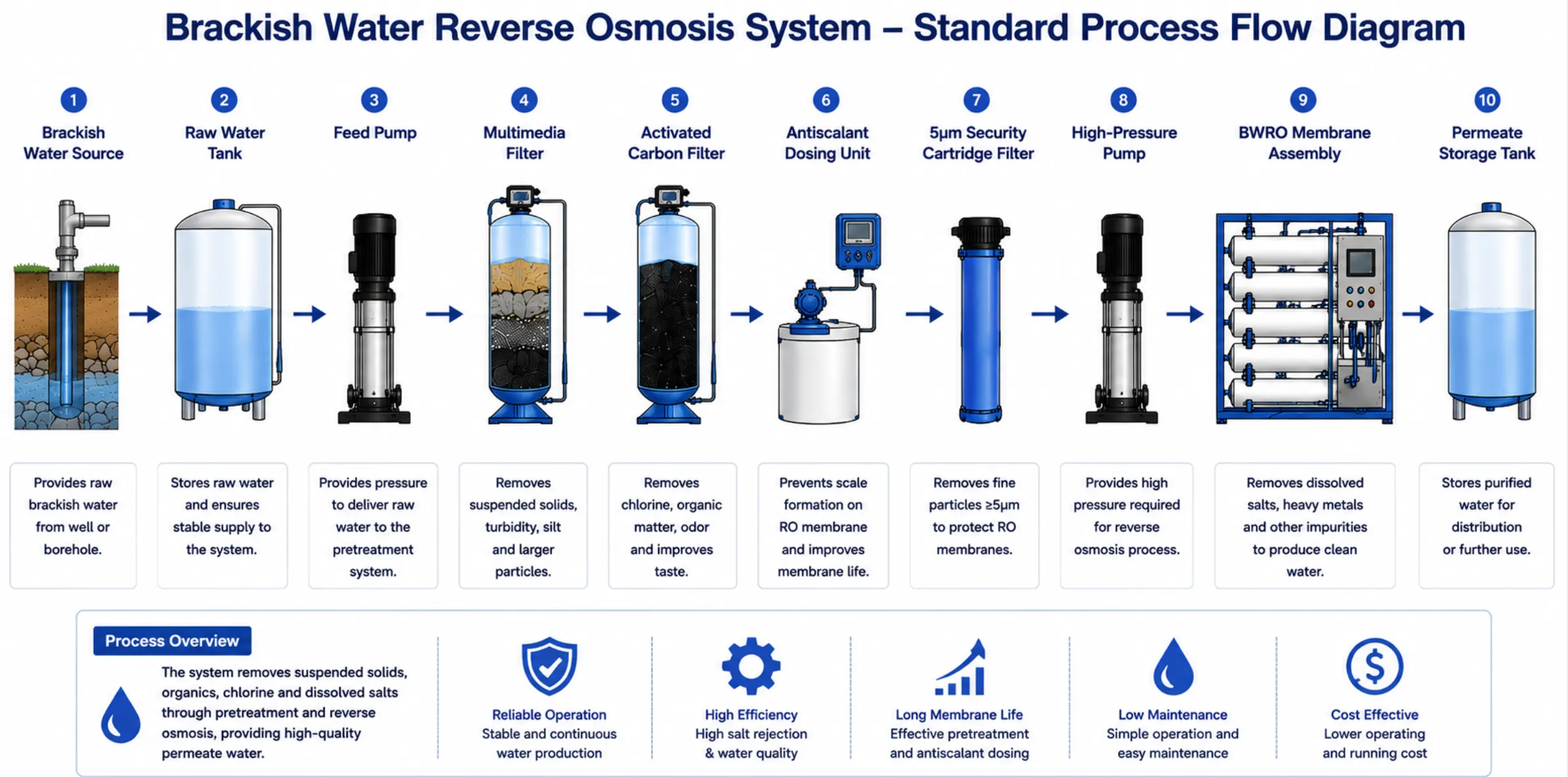
Feedwater→Raw-Water Tank→Feed Pump→Pretreatment Dosing→Multimedia Filter→Activated Carbon→Antiscalant Dosing→5μm Cartridge Filter→High-Pressure Pump→BWRO Membranes→Permeate Tank
For high or fluctuating turbidity, coagulation and clarification or an ultrafiltration system should be installed before BWRO to control membrane fouling.
Optional Configurations
Modular Upgrades
Ultrafiltration Pretreatment
Improves suspended-solids and colloid control for difficult feedwater.
Iron & Manganese Removal
Oxidation and filtration for metal-bearing groundwater.
Automatic Water Softener
Additional hardness control for high-scaling water.
Automatic Chemical Dosing
Antiscalant, dechlorination and pH adjustment according to design needs.
Independent CIP Skid
Dedicated chemical-cleaning tank, pump and cartridge filter.
Disinfection & Remineralization
UV, ozone and mineral adjustment for domestic-water projects.
PLC + HMI Monitoring
Touchscreen control with TDS, conductivity, pH, pressure and flow data.
High-Pressure Pump VFD
Variable-frequency control supports efficient pressure adjustment.
Skid or Container Design
SS304/SS316 piping and protected container installation are optional.
Technical Specifications
Typical Engineering Data
| Rated permeate capacity |
48m³/h |
| Maximum daily production |
1,152m³/day at 24-hour operation |
| Optional capacity range |
40–60m³/h, project-dependent |
| Typical feedwater TDS |
1,000–10,000mg/L |
| Typical salt rejection |
97%–99% |
| Typical recovery rate |
60%–75% |
| Feedwater at 70% recovery |
Approximately 68.6m³/h |
| RO membrane |
Industrial 8040 high-rejection BWRO elements |
| Cartridge filtration |
5μm melt-blown or wound cartridges |
| High-pressure pump |
Stainless-steel pump; VFD optional |
| Control system |
PLC + HMI automatic control |
| Monitoring |
Pressure, flow and conductivity; pH/TDS optional |
| Installation |
Modular skid-mounted or containerized |
| Operation |
Fully automatic continuous operation |
| Warranty |
One year |
All final specifications must be confirmed through membrane calculation and complete feedwater analysis.
Core Equipment
Industrial Components
8040 BWRO Membranes
High-rejection industrial membrane elements selected for the confirmed salinity.
5μm Security Filtration
Fine cartridge filtration protects pumps, pressure vessels and membranes.
Stainless-Steel High-Pressure Pump
Provides the pressure required for stable brackish-water desalination.
PLC + HMI Control
Centralized automatic operation, monitoring, alarms and equipment protection.
Online Instruments
Real-time pressure, flow and conductivity monitoring supports operating control.
Factory-Assembled Modules
Prefabricated skids reduce on-site installation time and facilitate transportation.
Applications
Industries & Projects
Industrial Parks
Centralized low-TDS water supply for multiple production facilities.
Power & Boiler Water
Desalination before boiler-feed and cooling-water treatment.
Chemical & Textile Plants
Stable process and cleaning water for continuous manufacturing.
Food & Beverage
Purified water for processing after suitable hygienic post-treatment.
Mining Operations
Large-flow groundwater treatment for processing and camp supply.
Community Water Plants
Brackish-water purification with final disinfection and compliance testing.
Frequently Asked Questions
BWRO System FAQ
How much feedwater does a 48m³/h system require?
At 70% recovery, approximately 68.6m³/h of feedwater is required. The final requirement depends on water chemistry and the approved recovery rate.
Can this equipment desalinate seawater?
No. Seawater requires a dedicated SWRO system designed for much higher salinity and operating pressure.
How should high-turbidity feedwater be treated?
Coagulation and clarification or ultrafiltration should be added before BWRO when turbidity and suspended-solids loading are high.
When should RO membranes undergo CIP cleaning?
Cleaning is normally considered when normalized permeate flow declines, differential pressure rises or normalized salt rejection deteriorates. Decisions should follow membrane-manufacturer guidance and operating trends.
Can the system operate continuously?
Yes. The industrial configuration supports 24/7 operation when raw-water storage, permeate storage, utilities and routine maintenance are properly planned.
Information Required for Quotation
Customized Proposal
- Complete raw-water analysis
- TDS, hardness, chloride and sulfate
- Silica, iron, manganese and turbidity
- Raw-water temperature and seasonal variation
- Required permeate TDS or conductivity
- Final water application and standard
- Daily operating hours and peak demand
- Local voltage and frequency
- Installation area and environmental conditions
- Skid-mounted or containerized preference
- Preferred membrane, pump and control brands
- Project location and destination port
Need a 48T/H BWRO Solution?
Send us your water analysis and project conditions for membrane calculation, customized process design and an accurate quotation.
Large-Flow Industrial Brackish Water Treatment
48 T/H Brackish Water Desalination System
A modular industrial BWRO plant designed for high-TDS groundwater and brackish well water. The fully automatic system continuously reduces salinity, hardness and dissolved impurities for large-scale industrial and commercial water projects.
48m³/hRated permeate capacity
1,152m³/dayMaximum daily output
97–99%Typical salt rejection
60–75%Typical system recovery
Key Features & Advantages
Industrial BWRO Performance
01
Large 48m³/h Capacity
Provides continuous purified-water production for high-demand industrial projects.
02
High Salt Rejection
Industrial BWRO membranes typically achieve 97%–99% rejection under design conditions.
03
Modular Construction
Factory-assembled membrane trains simplify transportation, installation and expansion.
04
Automatic PLC Control
Automatic operation, flushing, dosing, alarms and protection support unattended operation.
05
24/7 Water Supply
Industrial components support continuous operation when storage and utilities are adequate.
06
Flexible Engineering
Pretreatment, materials, recovery and post-treatment are customized to the project.
Suitable Raw Water
Feedwater Applications
The standard design targets brackish-water sources with TDS from approximately 1,000 to 10,000mg/L. Final engineering must be based on a complete water analysis.
Brackish Well Water
Underground water containing elevated salinity, hardness and dissolved minerals.
High-TDS Groundwater
Groundwater requiring conductivity, chloride and sulfate reduction.
Inland Brackish Water
Non-marine saline water within the confirmed BWRO operating range.
Industrial Source Water
Pre-treated water requiring further desalination for process applications.
Variable-Quality Groundwater
Seasonal water sources requiring enhanced monitoring and pretreatment.
Medium-Salinity Surface Water
Surface water treated only after suitable clarification or UF pretreatment.
Important: This system is not designed for seawater. High-salinity seawater requires a dedicated SWRO system with different membranes, pressure vessels and operating pressure.
Product-Water Quality
Typical Design Targets
| Salt rejection |
Typically 97%–99% under design conditions |
| Product-water TDS |
≤500mg/L or customized to the required application |
| Hardness |
Significantly reduced |
| Chloride and sulfate |
Substantially reduced through BWRO separation |
| Water appearance |
Clear, low-salinity product water |
| Typical use |
Industrial process water, commercial supply or further drinking-water treatment |
Drinking-water applications require suitable disinfection, possible remineralization and final laboratory verification according to local standards.
Standard Treatment Process
Multi-Stage Pretreatment + BWRO
Feedwater→Raw-Water Tank→Feed Pump→Pretreatment Dosing→Multimedia Filter→Activated Carbon→Antiscalant Dosing→5μm Cartridge Filter→High-Pressure Pump→BWRO Membranes→Permeate Tank
For high or fluctuating turbidity, coagulation and clarification or an ultrafiltration system should be installed before BWRO to control membrane fouling.
Optional Configurations
Modular Upgrades
Ultrafiltration Pretreatment
Improves suspended-solids and colloid control for difficult feedwater.
Iron & Manganese Removal
Oxidation and filtration for metal-bearing groundwater.
Automatic Water Softener
Additional hardness control for high-scaling water.
Automatic Chemical Dosing
Antiscalant, dechlorination and pH adjustment according to design needs.
Independent CIP Skid
Dedicated chemical-cleaning tank, pump and cartridge filter.
Disinfection & Remineralization
UV, ozone and mineral adjustment for domestic-water projects.
PLC + HMI Monitoring
Touchscreen control with TDS, conductivity, pH, pressure and flow data.
High-Pressure Pump VFD
Variable-frequency control supports efficient pressure adjustment.
Skid or Container Design
SS304/SS316 piping and protected container installation are optional.
Technical Specifications
Typical Engineering Data
| Rated permeate capacity |
48m³/h |
| Maximum daily production |
1,152m³/day at 24-hour operation |
| Optional capacity range |
40–60m³/h, project-dependent |
| Typical feedwater TDS |
1,000–10,000mg/L |
| Typical salt rejection |
97%–99% |
| Typical recovery rate |
60%–75% |
| Feedwater at 70% recovery |
Approximately 68.6m³/h |
| RO membrane |
Industrial 8040 high-rejection BWRO elements |
| Cartridge filtration |
5μm melt-blown or wound cartridges |
| High-pressure pump |
Stainless-steel pump; VFD optional |
| Control system |
PLC + HMI automatic control |
| Monitoring |
Pressure, flow and conductivity; pH/TDS optional |
| Installation |
Modular skid-mounted or containerized |
| Operation |
Fully automatic continuous operation |
| Warranty |
One year |
All final specifications must be confirmed through membrane calculation and complete feedwater analysis.
Core Equipment
Industrial Components
8040 BWRO Membranes
High-rejection industrial membrane elements selected for the confirmed salinity.
5μm Security Filtration
Fine cartridge filtration protects pumps, pressure vessels and membranes.
Stainless-Steel High-Pressure Pump
Provides the pressure required for stable brackish-water desalination.
PLC + HMI Control
Centralized automatic operation, monitoring, alarms and equipment protection.
Online Instruments
Real-time pressure, flow and conductivity monitoring supports operating control.
Factory-Assembled Modules
Prefabricated skids reduce on-site installation time and facilitate transportation.
Applications
Industries & Projects
Industrial Parks
Centralized low-TDS water supply for multiple production facilities.
Power & Boiler Water
Desalination before boiler-feed and cooling-water treatment.
Chemical & Textile Plants
Stable process and cleaning water for continuous manufacturing.
Food & Beverage
Purified water for processing after suitable hygienic post-treatment.
Mining Operations
Large-flow groundwater treatment for processing and camp supply.
Community Water Plants
Brackish-water purification with final disinfection and compliance testing.
Frequently Asked Questions
BWRO System FAQ
How much feedwater does a 48m³/h system require?
At 70% recovery, approximately 68.6m³/h of feedwater is required. The final requirement depends on water chemistry and the approved recovery rate.
Can this equipment desalinate seawater?
No. Seawater requires a dedicated SWRO system designed for much higher salinity and operating pressure.
How should high-turbidity feedwater be treated?
Coagulation and clarification or ultrafiltration should be added before BWRO when turbidity and suspended-solids loading are high.
When should RO membranes undergo CIP cleaning?
Cleaning is normally considered when normalized permeate flow declines, differential pressure rises or normalized salt rejection deteriorates. Decisions should follow membrane-manufacturer guidance and operating trends.
Can the system operate continuously?
Yes. The industrial configuration supports 24/7 operation when raw-water storage, permeate storage, utilities and routine maintenance are properly planned.
Information Required for Quotation
Customized Proposal
- Complete raw-water analysis
- TDS, hardness, chloride and sulfate
- Silica, iron, manganese and turbidity
- Raw-water temperature and seasonal variation
- Required permeate TDS or conductivity
- Final water application and standard
- Daily operating hours and peak demand
- Local voltage and frequency
- Installation area and environmental conditions
- Skid-mounted or containerized preference
- Preferred membrane, pump and control brands
- Project location and destination port
Need a 48T/H BWRO Solution?
Send us your water analysis and project conditions for membrane calculation, customized process design and an accurate quotation.