
SEARCH WHAT YOU WANT

English
- English
- Español
- عربي
- Français
- Indonesia
Purified Water Systems for Medical Device Manufacturing
Purified Water Systems for Medical Device Manufacturing
Water quality is essential in medical device manufacturing. Purified water is commonly used for component cleaning, final rinsing, solution preparation and production equipment washing.
Untreated water may contain salts, particles, microorganisms and organic contaminants that can leave residues on medical device surfaces. A properly designed purified water system for medical device manufacturing helps maintain stable water quality, reduce contamination risks and improve production consistency.
The appropriate system should be selected according to the raw water quality, manufacturing process and required product-water standard.
Why Is Water Quality Important in Medical Device Manufacturing?
Tap water and borehole water may contain:
- Dissolved salts and hardness
- Suspended particles
- Iron and manganese
- Residual chlorine
- Organic matter
- Microorganisms
- Silica and other contaminants
These substances may cause mineral deposits, visible stains, corrosion or inconsistent cleaning results.
A reliable medical device water treatment system removes or controls these contaminants and delivers water that meets the manufacturer’s process requirements.
ISO 13485 provides quality-management-system requirements for medical device manufacturers. However, the required water quality should still be determined according to the device, production process and applicable regulations.
Where Is Purified Water Used?
1. Component Cleaning
Purified water removes dust, processing residues and water-soluble contaminants from plastic, stainless-steel, glass and silicone components.
2. Intermediate and Final Rinsing
Treated water reduces mineral residue after rinsing. Double-pass RO or higher-purity water may be used for more sensitive final-rinse applications.
3. Cleaning-Solution Preparation
Purified water can be used to dilute detergents and process chemicals, helping maintain consistent solution concentration.
4. Production Equipment Cleaning
Tanks, pipelines, filling machines and manufacturing tools require regular cleaning. Purified water helps reduce scale and deposits.
5. Laboratory Testing
Laboratories may require purified or ultrapure water for reagent preparation, sample testing and instrument rinsing.
What Water Quality Is Required?
There is no single water standard suitable for every medical device factory. Requirements depend on:
- Medical device type
- Intended application
- Product-contact level
- Cleaning and rinsing process
- Microbial-control requirements
- Applicable regulations
Important parameters may include:
| Parameter | Purpose |
|---|---|
| Conductivity | Indicates dissolved ionic contaminants |
| Hardness | Evaluates scaling risk |
| Total organic carbon | Indicates organic contamination |
| Microbial count | Evaluates microbiological quality |
| Silica | Helps control deposits after drying |
| Particles | Affects product surface cleanliness |
| pH | Influences cleaning and material compatibility |
The final water specification should be established through risk assessment and process validation.
Recommended Purified Water Treatment Process
A typical system may use the following process:
Raw Water Tank → Feed Water Pump → Multimedia Filter → Activated Carbon Filter → Water Softener → Cartridge Filter → Reverse Osmosis System → EDI System → UV Sterilizer → Final Filter → Purified Water Tank → Distribution Loop
The actual process should be adjusted according to the raw-water report and required water quality.
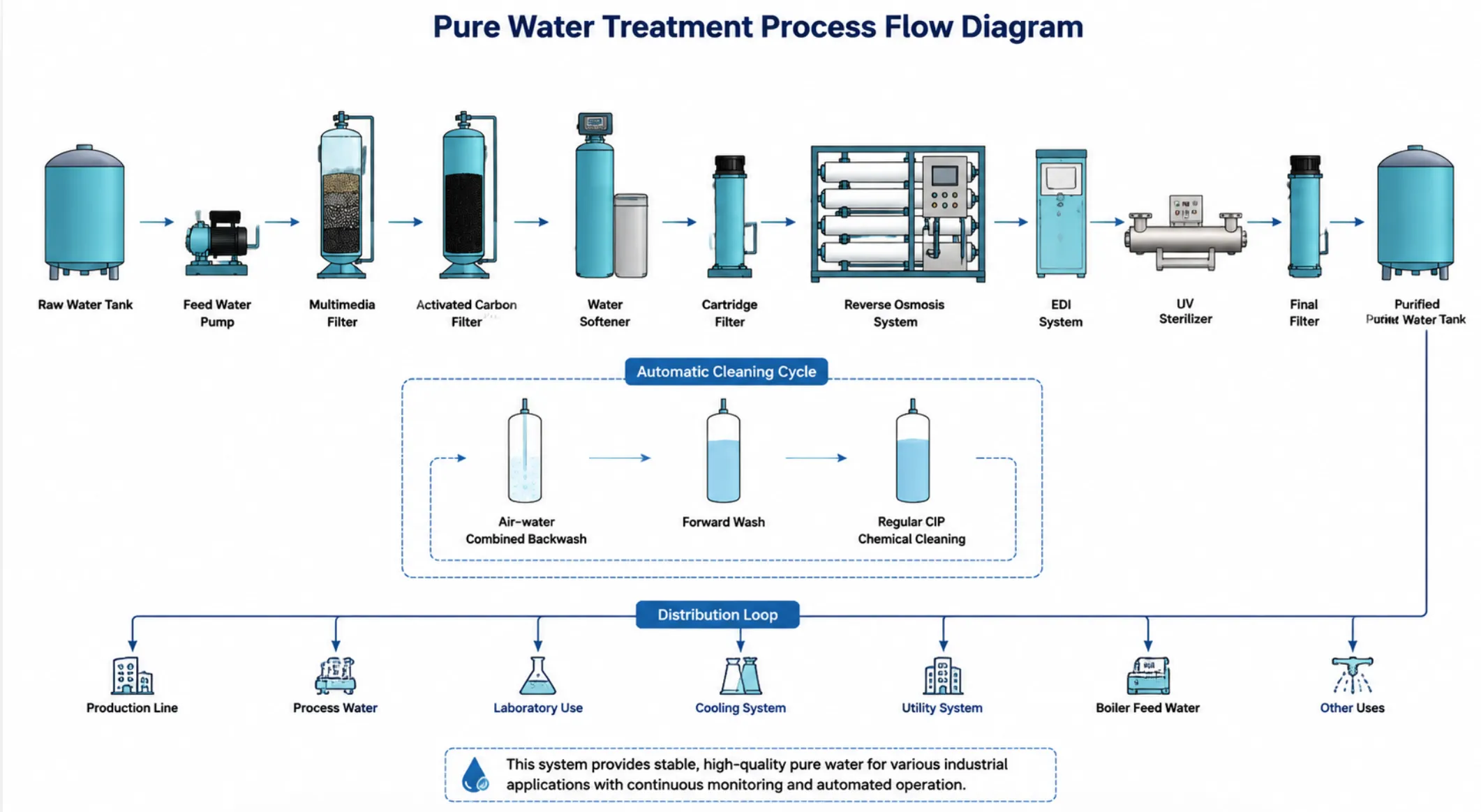
Main Treatment Stages
Pretreatment System
Pretreatment removes suspended solids, chlorine, hardness and other contaminants that may damage RO membranes.
Common equipment includes:
- Multimedia filter
- Activated carbon filter
- Water softener
- Ultrafiltration system
- Antiscalant dosing system
- Cartridge filter
Reverse Osmosis System
Reverse osmosis removes dissolved salts, hardness, heavy metals, organics and microorganisms.
A single-pass RO system may be suitable for general cleaning and utility water. A double-pass RO system provides lower conductivity for more demanding production or final-rinse applications.
EDI Ultrapure Water System
EDI further removes residual ions after RO and continuously produces high-purity water without routine chemical regeneration.
An RO+EDI system may be selected when stable low-conductivity or high-resistivity water is required.
UV Sterilization and Final Filtration
UV sterilization supports microbial control, while final filtration provides an additional barrier before the water reaches production.
Storage and Distribution System
Purified water must remain controlled after treatment. A suitable storage and distribution system may include:
- Stainless-steel water tank
- Hydrophobic vent filter
- Continuous circulation loop
- Sanitary pumps and valves
- UV sterilization
- Conductivity monitoring
- Cleaning and sanitization functions
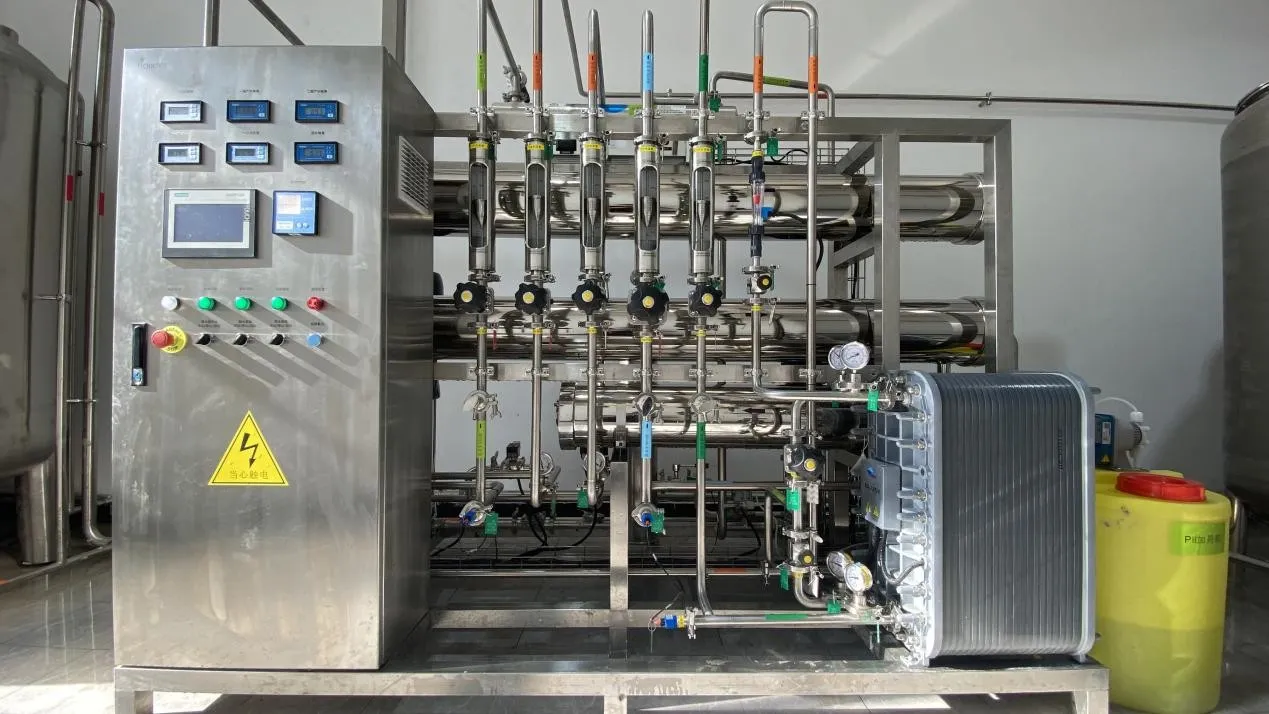
Single-Pass RO, Double-Pass RO or RO+EDI?
| System | Typical application |
|---|---|
| Single-pass RO | General cleaning and equipment washing |
| Double-pass RO | Final rinsing and sensitive production |
| Double-pass RO + EDI | High-purity production and laboratory applications |
| UF + RO + EDI | Raw water with high turbidity or unstable quality |
The final configuration should be based on the actual production requirements.
Key Design Considerations
Raw-Water Quality
A complete water analysis helps engineers select the correct pretreatment and membrane configuration.
Water Capacity
Capacity should be calculated according to hourly demand, operating time, cleaning schedules and future expansion.
Equipment Materials
UPVC, SS304 or SS316L may be selected according to the required water quality and hygienic level.
Automation and Monitoring
A PLC control system can monitor:
- Pressure and flow
- Product-water conductivity
- Tank level
- EDI resistivity
- UV operating status
- System alarms
Sanitization
Storage tanks and circulation pipelines should support a suitable chemical or thermal sanitization method.
Benefits of a Purified Water System
A properly designed system can help manufacturers:
- Maintain stable production-water quality
- Improve product cleaning and rinsing
- Reduce mineral residues and scaling
- Support microbial control
- Improve production consistency
- Reduce equipment maintenance
- Monitor and record operating data
How to Select a Supplier
Before selecting a purified water equipment manufacturer, confirm whether the supplier can:
- Design the system based on a water analysis
- Meet the required water capacity and quality
- Provide suitable tanks and pipeline materials
- Supply technical drawings and specifications
- Support installation and commissioning
- Provide replacement parts and after-sales service
- Support system qualification and validation documents
The supplier should explain the purpose of each treatment stage instead of offering a standard configuration without analysis.
Information Required for System Design
To prepare a suitable technical proposal, manufacturers should provide:
- Raw-water source and water analysis
- Required product-water quality
- Hourly and daily water consumption
- Intended application
- Operating hours
- Installation space
- Local voltage and frequency
- Preferred equipment materials
- Required automation level
Conclusion
A purified water system for medical device manufacturing helps provide stable water for cleaning, rinsing, solution preparation and other production processes.
Pretreatment, RO, EDI, UV sterilization and the distribution loop should be selected according to the raw-water quality and production requirements.
Zhongnuo Water Treatment provides customized single-pass RO, double-pass RO and RO+EDI systems for medical device manufacturing. Contact us for a customized process design and technical proposal.
Frequently Asked Questions
Is RO water suitable for medical device manufacturing?
RO water may be suitable for general cleaning and production. More sensitive applications may require double-pass RO or RO+EDI.
Why is EDI installed after RO?
EDI removes residual ions after RO and provides stable high-purity water without routine chemical regeneration.
Which material is suitable for purified-water piping?
UPVC, SS304 and SS316L can be selected according to water quality, hygienic requirements and project budget.
Can one system supply multiple production lines?
Yes. The system must have sufficient production capacity, storage volume and circulation flow.
How often should the system be sanitized?
Sanitization frequency should be determined according to microbial monitoring, operating conditions and the manufacturer’s validated procedures.
Purified Water Systems for Medical Device Manufacturing
Water quality is essential in medical device manufacturing. Purified water is commonly used for component cleaning, final rinsing, solution preparation and production equipment washing.
Untreated water may contain salts, particles, microorganisms and organic contaminants that can leave residues on medical device surfaces. A properly designed purified water system for medical device manufacturing helps maintain stable water quality, reduce contamination risks and improve production consistency.
The appropriate system should be selected according to the raw water quality, manufacturing process and required product-water standard.
Why Is Water Quality Important in Medical Device Manufacturing?
Tap water and borehole water may contain:
- Dissolved salts and hardness
- Suspended particles
- Iron and manganese
- Residual chlorine
- Organic matter
- Microorganisms
- Silica and other contaminants
These substances may cause mineral deposits, visible stains, corrosion or inconsistent cleaning results.
A reliable medical device water treatment system removes or controls these contaminants and delivers water that meets the manufacturer’s process requirements.
ISO 13485 provides quality-management-system requirements for medical device manufacturers. However, the required water quality should still be determined according to the device, production process and applicable regulations.
Where Is Purified Water Used?
1. Component Cleaning
Purified water removes dust, processing residues and water-soluble contaminants from plastic, stainless-steel, glass and silicone components.
2. Intermediate and Final Rinsing
Treated water reduces mineral residue after rinsing. Double-pass RO or higher-purity water may be used for more sensitive final-rinse applications.
3. Cleaning-Solution Preparation
Purified water can be used to dilute detergents and process chemicals, helping maintain consistent solution concentration.
4. Production Equipment Cleaning
Tanks, pipelines, filling machines and manufacturing tools require regular cleaning. Purified water helps reduce scale and deposits.
5. Laboratory Testing
Laboratories may require purified or ultrapure water for reagent preparation, sample testing and instrument rinsing.
What Water Quality Is Required?
There is no single water standard suitable for every medical device factory. Requirements depend on:
- Medical device type
- Intended application
- Product-contact level
- Cleaning and rinsing process
- Microbial-control requirements
- Applicable regulations
Important parameters may include:
| Parameter | Purpose |
|---|---|
| Conductivity | Indicates dissolved ionic contaminants |
| Hardness | Evaluates scaling risk |
| Total organic carbon | Indicates organic contamination |
| Microbial count | Evaluates microbiological quality |
| Silica | Helps control deposits after drying |
| Particles | Affects product surface cleanliness |
| pH | Influences cleaning and material compatibility |
The final water specification should be established through risk assessment and process validation.
Recommended Purified Water Treatment Process
A typical system may use the following process:
Raw Water Tank → Feed Water Pump → Multimedia Filter → Activated Carbon Filter → Water Softener → Cartridge Filter → Reverse Osmosis System → EDI System → UV Sterilizer → Final Filter → Purified Water Tank → Distribution Loop
The actual process should be adjusted according to the raw-water report and required water quality.
Main Treatment Stages
Pretreatment System
Pretreatment removes suspended solids, chlorine, hardness and other contaminants that may damage RO membranes.
Common equipment includes:
- Multimedia filter
- Activated carbon filter
- Water softener
- Ultrafiltration system
- Antiscalant dosing system
- Cartridge filter
Reverse Osmosis System
Reverse osmosis removes dissolved salts, hardness, heavy metals, organics and microorganisms.
A single-pass RO system may be suitable for general cleaning and utility water. A double-pass RO system provides lower conductivity for more demanding production or final-rinse applications.
EDI Ultrapure Water System
EDI further removes residual ions after RO and continuously produces high-purity water without routine chemical regeneration.
An RO+EDI system may be selected when stable low-conductivity or high-resistivity water is required.
UV Sterilization and Final Filtration
UV sterilization supports microbial control, while final filtration provides an additional barrier before the water reaches production.
Storage and Distribution System
Purified water must remain controlled after treatment. A suitable storage and distribution system may include:
- Stainless-steel water tank
- Hydrophobic vent filter
- Continuous circulation loop
- Sanitary pumps and valves
- UV sterilization
- Conductivity monitoring
- Cleaning and sanitization functions
Single-Pass RO, Double-Pass RO or RO+EDI?
| System | Typical application |
|---|---|
| Single-pass RO | General cleaning and equipment washing |
| Double-pass RO | Final rinsing and sensitive production |
| Double-pass RO + EDI | High-purity production and laboratory applications |
| UF + RO + EDI | Raw water with high turbidity or unstable quality |
The final configuration should be based on the actual production requirements.
Key Design Considerations
Raw-Water Quality
A complete water analysis helps engineers select the correct pretreatment and membrane configuration.
Water Capacity
Capacity should be calculated according to hourly demand, operating time, cleaning schedules and future expansion.
Equipment Materials
UPVC, SS304 or SS316L may be selected according to the required water quality and hygienic level.
Automation and Monitoring
A PLC control system can monitor:
- Pressure and flow
- Product-water conductivity
- Tank level
- EDI resistivity
- UV operating status
- System alarms
Sanitization
Storage tanks and circulation pipelines should support a suitable chemical or thermal sanitization method.
Benefits of a Purified Water System
A properly designed system can help manufacturers:
- Maintain stable production-water quality
- Improve product cleaning and rinsing
- Reduce mineral residues and scaling
- Support microbial control
- Improve production consistency
- Reduce equipment maintenance
- Monitor and record operating data
How to Select a Supplier
Before selecting a purified water equipment manufacturer, confirm whether the supplier can:
- Design the system based on a water analysis
- Meet the required water capacity and quality
- Provide suitable tanks and pipeline materials
- Supply technical drawings and specifications
- Support installation and commissioning
- Provide replacement parts and after-sales service
- Support system qualification and validation documents
The supplier should explain the purpose of each treatment stage instead of offering a standard configuration without analysis.
Information Required for System Design
To prepare a suitable technical proposal, manufacturers should provide:
- Raw-water source and water analysis
- Required product-water quality
- Hourly and daily water consumption
- Intended application
- Operating hours
- Installation space
- Local voltage and frequency
- Preferred equipment materials
- Required automation level
Conclusion
A purified water system for medical device manufacturing helps provide stable water for cleaning, rinsing, solution preparation and other production processes.
Pretreatment, RO, EDI, UV sterilization and the distribution loop should be selected according to the raw-water quality and production requirements.
Zhongnuo Water Treatment provides customized single-pass RO, double-pass RO and RO+EDI systems for medical device manufacturing. Contact us for a customized process design and technical proposal.
Frequently Asked Questions
Is RO water suitable for medical device manufacturing?
RO water may be suitable for general cleaning and production. More sensitive applications may require double-pass RO or RO+EDI.
Why is EDI installed after RO?
EDI removes residual ions after RO and provides stable high-purity water without routine chemical regeneration.
Which material is suitable for purified-water piping?
UPVC, SS304 and SS316L can be selected according to water quality, hygienic requirements and project budget.
Can one system supply multiple production lines?
Yes. The system must have sufficient production capacity, storage volume and circulation flow.
How often should the system be sanitized?
Sanitization frequency should be determined according to microbial monitoring, operating conditions and the manufacturer’s validated procedures.


ONLINE MESSAGE
Copyright © 2026 Zhongnuo Water Treatment Co., Ltd.