

SEARCH WHAT YOU WANT
Borehole Water Treatment System Design: Complete Industrial Guide
Time:2026-08-07
Introduction
Borehole water is a primary alternative water source for industrial facilities, especially in regions with insufficient or unstable municipal water supplies. However, groundwater quality varies significantly due to underground geological conditions.
Untreated borehole water commonly contains sediment, suspended solids, water hardness, iron, manganese, bacteria, and high total dissolved solids (TDS). These contaminants cause equipment damage, production failures, and substandard water quality for industrial use. A professionally designed industrial borehole water treatment system effectively removes impurities and delivers consistent, standard-compliant water for production, processing, and potable water applications.
Why Industrial Borehole Water Treatment Is Necessary
Raw borehole water without purification triggers multiple operational and maintenance issues for industrial plants:
1. Sediment and Suspended Solids Contamination
Groundwater mixed with sand, mud and fine particles easily blocks pipelines, wears out water pumps, and damages precision production equipment. A complete pre-filtration system is mandatory to eliminate suspended solids and protect downstream units.
2. Water Hardness and Scale Formation
High calcium and magnesium levels in borehole water lead to severe scaling in boilers and heat exchangers. This reduces thermal efficiency, increases energy consumption, and raises frequent equipment maintenance costs. Water softeners or RO systems are the standard solutions for hardness control.
3. High TDS and Dissolved Mineral Impurities
Excessive dissolved salts and minerals in high-TDS groundwater compromise final product quality, hinder equipment normal operation, and fail drinking water safety standards. A dedicated borehole water RO system is the optimal solution for high-TDS groundwater purification.
Industrial Borehole Water Treatment System Design Criteria
All industrial groundwater purification systems are custom-designed based on four core factors to ensure optimal performance and cost efficiency:
-
Raw borehole water quality test report
-
Industrial water flow capacity requirements
-
End water application scenarios
-
Target outlet water quality standards
Standard Borehole Water Treatment Process Flow
This mature, widely adopted industrial treatment flow covers conventional groundwater contaminants and meets most industrial water standards:
Borehole Raw Water → Raw Water Storage Tank → Feed Pump → Multimedia Filter → Activated Carbon Filter → Water Softener / Antiscalant Dosing System → Precision Cartridge Filter → Reverse Osmosis (RO) System → Optional UV Sterilizer → Pure Water Tank
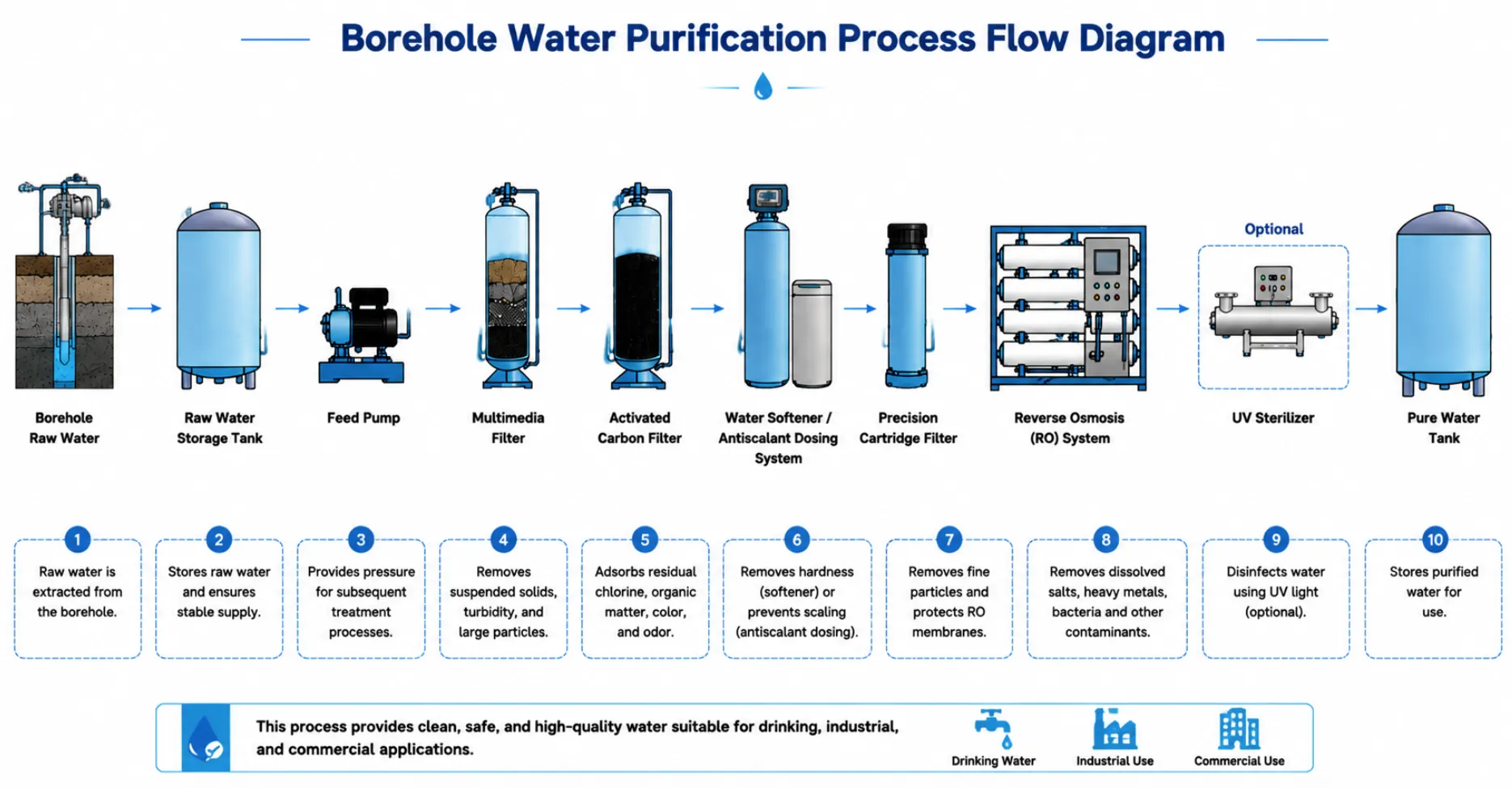
Core Treatment Equipment Functions
1. Multimedia Filter
The primary pretreatment equipment for borehole water. It effectively removes sand, silt, suspended solids and reduces water turbidity, stabilizing raw water quality and protecting all downstream treatment equipment from particle abrasion and blockage.
2. Activated Carbon Filter
Specialized in removing organic pollutants, residual odor, and partial heavy metals from groundwater. It significantly improves water taste and clarity, solving common odor and organic contamination problems in borehole water.
3. Water Softener / Antiscalant Dosing System
Key equipment for preventing RO membrane scaling. It reduces water hardness by removing calcium and magnesium ions or inhibits scale formation via chemical dosing, ensuring the long-term stable service life of the RO system.
4. Reverse Osmosis (RO) System
The core purification unit for high-quality industrial water. It removes up to 99% of TDS, dissolved salts, heavy metals and mineral impurities, perfectly treating high-salinity and contaminated borehole water to produce standard industrial process water.
5. UV Sterilizer (Optional)
Used for bacterial and microbial sterilization, applicable for potable water and high hygienic standard production scenarios.
Key Industrial Applications
Borehole water treatment systems serve a wide range of industrial sectors with customized purification solutions:
Electronics Manufacturing
Supplies ultra-pure water for component cleaning and precision equipment operation, usually matched with RO+EDI combined systems.
Food & Beverage Industry
Provides qualified production water, ingredient preparation water and equipment cleaning water that meets food safety standards.
Pharmaceutical Industry
Delivers high-purity sterile water via integrated RO, EDI and UV sterilization systems to meet strict pharmaceutical water standards.
Boiler & General Manufacturing Plants
Reduces equipment scaling, lowers abrasion damage, and cuts daily maintenance and operational costs.
How to Select a Suitable Borehole Water Treatment System
To avoid over-design or insufficient treatment, confirm three core parameters before equipment selection:
1. Complete Water Quality Report
Key testing indicators: TDS, pH value, water hardness, iron, manganese, turbidity and microbial content.
2. Required Water Capacity
Customizable industrial flow rates: 1m³/h, 5m³/h, 10m³/h, 50m³/h and 100m³/h+, matching daily industrial water consumption.
3. End Water Application Standards
|
Application Scenario
|
Recommended Treatment System
|
|---|---|
|
General factory process water
|
Single RO System
|
|
Industrial drinking water projects
|
RO + UV Sterilization System
|
|
Boiler feed water
|
Water Softener + RO System
|
|
Electronics ultra-pure water
|
RO + EDI System
|
|
Ordinary equipment cleaning water
|
Multi-stage Filtration System
|
Advantages of Automatic Industrial Borehole Water Treatment Plants
Modern PLC-controlled automatic water treatment systems are the mainstream for industrial projects, with core benefits:
-
Stable and consistent outlet water quality
-
Fully automatic operation, minimal manual intervention
-
Reduced long-term maintenance and labor costs
-
Extended service life of water treatment equipment
-
Safe and efficient groundwater resource utilization
-
Automatic backwashing, chemical dosing, membrane flushing and fault alarm functions
Conclusion
A customized industrial borehole water treatment system converts raw groundwater into reliable, standard-compliant water for all types of industrial and commercial projects. The optimal treatment solution is determined by raw water quality, water consumption volume and specific industry requirements.
For high-TDS, hard or contaminated borehole water, a pretreatment + RO integrated system provides a cost-effective, long-term stable purification solution. Always conduct a professional water quality analysis before system procurement to ensure fully customized and compliant equipment design.
Introduction
Borehole water is a primary alternative water source for industrial facilities, especially in regions with insufficient or unstable municipal water supplies. However, groundwater quality varies significantly due to underground geological conditions.
Untreated borehole water commonly contains sediment, suspended solids, water hardness, iron, manganese, bacteria, and high total dissolved solids (TDS). These contaminants cause equipment damage, production failures, and substandard water quality for industrial use. A professionally designed industrial borehole water treatment system effectively removes impurities and delivers consistent, standard-compliant water for production, processing, and potable water applications.
Why Industrial Borehole Water Treatment Is Necessary
Raw borehole water without purification triggers multiple operational and maintenance issues for industrial plants:
1. Sediment and Suspended Solids Contamination
Groundwater mixed with sand, mud and fine particles easily blocks pipelines, wears out water pumps, and damages precision production equipment. A complete pre-filtration system is mandatory to eliminate suspended solids and protect downstream units.
2. Water Hardness and Scale Formation
High calcium and magnesium levels in borehole water lead to severe scaling in boilers and heat exchangers. This reduces thermal efficiency, increases energy consumption, and raises frequent equipment maintenance costs. Water softeners or RO systems are the standard solutions for hardness control.
3. High TDS and Dissolved Mineral Impurities
Excessive dissolved salts and minerals in high-TDS groundwater compromise final product quality, hinder equipment normal operation, and fail drinking water safety standards. A dedicated borehole water RO system is the optimal solution for high-TDS groundwater purification.
Industrial Borehole Water Treatment System Design Criteria
All industrial groundwater purification systems are custom-designed based on four core factors to ensure optimal performance and cost efficiency:
-
Raw borehole water quality test report
-
Industrial water flow capacity requirements
-
End water application scenarios
-
Target outlet water quality standards
Standard Borehole Water Treatment Process Flow
This mature, widely adopted industrial treatment flow covers conventional groundwater contaminants and meets most industrial water standards:
Borehole Raw Water → Raw Water Storage Tank → Feed Pump → Multimedia Filter → Activated Carbon Filter → Water Softener / Antiscalant Dosing System → Precision Cartridge Filter → Reverse Osmosis (RO) System → Optional UV Sterilizer → Pure Water Tank
Core Treatment Equipment Functions
1. Multimedia Filter
The primary pretreatment equipment for borehole water. It effectively removes sand, silt, suspended solids and reduces water turbidity, stabilizing raw water quality and protecting all downstream treatment equipment from particle abrasion and blockage.
2. Activated Carbon Filter
Specialized in removing organic pollutants, residual odor, and partial heavy metals from groundwater. It significantly improves water taste and clarity, solving common odor and organic contamination problems in borehole water.
3. Water Softener / Antiscalant Dosing System
Key equipment for preventing RO membrane scaling. It reduces water hardness by removing calcium and magnesium ions or inhibits scale formation via chemical dosing, ensuring the long-term stable service life of the RO system.
4. Reverse Osmosis (RO) System
The core purification unit for high-quality industrial water. It removes up to 99% of TDS, dissolved salts, heavy metals and mineral impurities, perfectly treating high-salinity and contaminated borehole water to produce standard industrial process water.
5. UV Sterilizer (Optional)
Used for bacterial and microbial sterilization, applicable for potable water and high hygienic standard production scenarios.
Key Industrial Applications
Borehole water treatment systems serve a wide range of industrial sectors with customized purification solutions:
Electronics Manufacturing
Supplies ultra-pure water for component cleaning and precision equipment operation, usually matched with RO+EDI combined systems.
Food & Beverage Industry
Provides qualified production water, ingredient preparation water and equipment cleaning water that meets food safety standards.
Pharmaceutical Industry
Delivers high-purity sterile water via integrated RO, EDI and UV sterilization systems to meet strict pharmaceutical water standards.
Boiler & General Manufacturing Plants
Reduces equipment scaling, lowers abrasion damage, and cuts daily maintenance and operational costs.
How to Select a Suitable Borehole Water Treatment System
To avoid over-design or insufficient treatment, confirm three core parameters before equipment selection:
1. Complete Water Quality Report
Key testing indicators: TDS, pH value, water hardness, iron, manganese, turbidity and microbial content.
2. Required Water Capacity
Customizable industrial flow rates: 1m³/h, 5m³/h, 10m³/h, 50m³/h and 100m³/h+, matching daily industrial water consumption.
3. End Water Application Standards
|
Application Scenario
|
Recommended Treatment System
|
|---|---|
|
General factory process water
|
Single RO System
|
|
Industrial drinking water projects
|
RO + UV Sterilization System
|
|
Boiler feed water
|
Water Softener + RO System
|
|
Electronics ultra-pure water
|
RO + EDI System
|
|
Ordinary equipment cleaning water
|
Multi-stage Filtration System
|
Advantages of Automatic Industrial Borehole Water Treatment Plants
Modern PLC-controlled automatic water treatment systems are the mainstream for industrial projects, with core benefits:
-
Stable and consistent outlet water quality
-
Fully automatic operation, minimal manual intervention
-
Reduced long-term maintenance and labor costs
-
Extended service life of water treatment equipment
-
Safe and efficient groundwater resource utilization
-
Automatic backwashing, chemical dosing, membrane flushing and fault alarm functions
Conclusion
A customized industrial borehole water treatment system converts raw groundwater into reliable, standard-compliant water for all types of industrial and commercial projects. The optimal treatment solution is determined by raw water quality, water consumption volume and specific industry requirements.
For high-TDS, hard or contaminated borehole water, a pretreatment + RO integrated system provides a cost-effective, long-term stable purification solution. Always conduct a professional water quality analysis before system procurement to ensure fully customized and compliant equipment design.
Get a Quote for Free
Submit this form and our sales representative will contact you soon.


ONLINE MESSAGE
Copyright © 2026 Zhongnuo Water Treatment Co., Ltd.