

SEARCH WHAT YOU WANT
Boiler Feedwater Treatment Systems for Industrial Plants | Complete Guide
Time:2026-08-10
1. Introduction
Industrial boiler feedwater treatment systems purify raw water for safe, efficient and stable boiler operation. Untreated water containing hardness, dissolved salts, silica, suspended solids and dissolved gases easily causes boiler scaling, corrosion, heat efficiency reduction and frequent maintenance. Professional boiler water treatment removes these contaminants to extend boiler service life and lower operational costs.
2. Why Industrial Boiler Feedwater Treatment Is Necessary
Raw water from boreholes, rivers and municipal water cannot be directly used for industrial boilers. Common water quality problems lead to serious equipment risks:
-
Water hardness: Forms calcium and magnesium scale on boiler inner walls
-
High TDS & silica: Causes stubborn deposits and increases boiler blowdown frequency
-
Suspended solids & iron: Leads to equipment fouling and pipeline blockage
-
Dissolved oxygen & CO2: Accelerates internal boiler corrosion
3. Common Boiler Feedwater Treatment Methods
3.1 Multimedia Filtration
As the first-stage pretreatment, it removes sand, sediment, suspended solids and turbidity, effectively protecting downstream water treatment equipment.
3.2 Activated Carbon Filtration
Eliminates residual chlorine, organic matter and odor, improving overall water quality and preventing membrane pollution.
3.3 Water Softening
Industrial water softeners remove calcium and magnesium ions to reduce water hardness, widely used for low-pressure boiler feedwater pretreatment to prevent scaling.
3.4 Reverse Osmosis (RO)
RO boiler feedwater systems deeply remove TDS, hardness, silica, chloride and various dissolved minerals. It greatly reduces mineral load for medium and high-pressure boilers and is the core purification process for high-standard feedwater.
3.5 EDI / Mixed Bed Polishing
For high-purity and high-pressure boiler scenarios, RO is matched with EDI or mixed bed ion exchange to further reduce water conductivity and meet strict industrial feedwater standards.
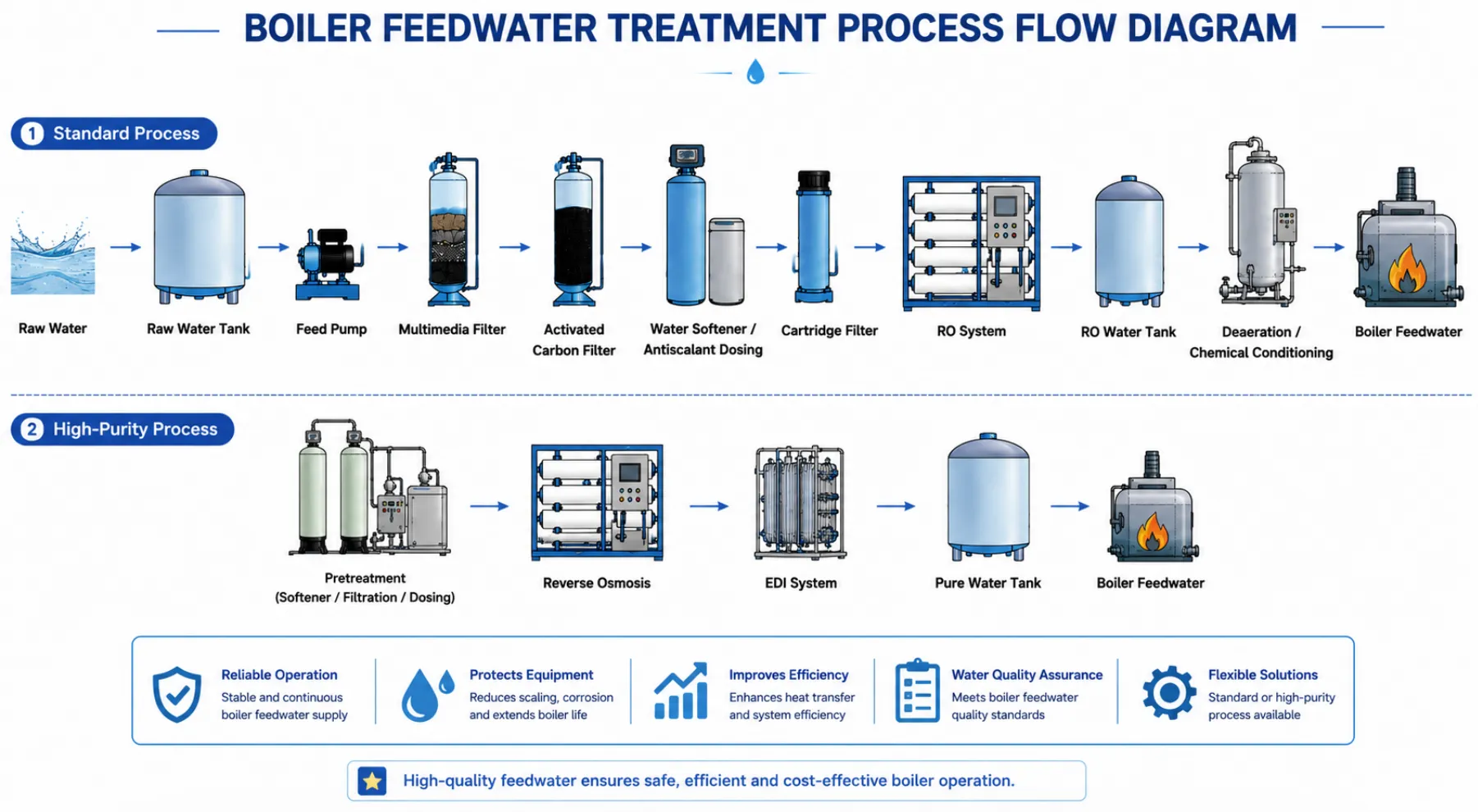
4. Typical Boiler Feedwater Treatment Process Flow
Standard Process: Raw Water → Raw Water Tank → Feed Pump → Multimedia Filter → Activated Carbon Filter → Water Softener / Antiscalant Dosing → Cartridge Filter → RO System → RO Water Tank → Deaeration / Chemical Conditioning → Boiler Feedwater
High-Purity Process: Pretreatment → Reverse Osmosis → EDI System → Pure Water Tank → Boiler Feedwater
5. Water Softener vs RO System for Boiler Water
|
Function
|
Water Softener
|
RO System
|
|
Hardness Removal
|
Yes
|
Yes
|
|
TDS & Salt Reduction
|
No
|
Yes
|
|
Silica Removal
|
Limited
|
Yes
|
|
Application
|
Low-pressure boiler
|
Medium & high-pressure boiler
|
6. Applicable Industries
Industrial boiler feedwater treatment systems serve multiple industries that require stable steam and heating supply:
-
→Food & beverage processing
-
→Pharmaceutical factories
-
→Chemical & textile manufacturing
-
→Paper mills and power plants
-
→Oil, gas and general industrial plants
7. Key Benefits of Boiler Feedwater Treatment
-
♦Effectively prevent boiler scaling and internal corrosion
-
♦Improve heat transfer efficiency and save energy consumption
-
♦Reduce boiler blowdown rate and water waste
-
♦Lower equipment maintenance frequency and repair costs
-
♦Prolong boiler and pipeline service life
-
♦Ensure continuous and safe industrial production
8. FAQ
Q: Do all industrial boilers need RO systems?
A: No. Low-pressure boilers can use only water softeners. RO or RO+EDI is required for high-pressure boilers and high-purity feedwater demands.
Q: Why use RO for boiler feedwater treatment?
A: RO thoroughly removes dissolved salts, silica and hardness that softeners cannot eliminate, avoiding stubborn scaling and corrosion.
Q: Can borehole water be used for boiler feedwater?
A: Yes, but borehole water with high hardness, iron and TDS must go through pretreatment, softening and RO purification before use.
9. Conclusion
A customized industrial boiler feedwater treatment system is essential for boiler safety and efficiency. According to raw water quality, boiler pressure and production requirements, a matched solution of filtration, softening, RO and EDI can eliminate scaling and corrosion risks, helping factories achieve stable and low-cost boiler operation.
1. Introduction
Industrial boiler feedwater treatment systems purify raw water for safe, efficient and stable boiler operation. Untreated water containing hardness, dissolved salts, silica, suspended solids and dissolved gases easily causes boiler scaling, corrosion, heat efficiency reduction and frequent maintenance. Professional boiler water treatment removes these contaminants to extend boiler service life and lower operational costs.
2. Why Industrial Boiler Feedwater Treatment Is Necessary
Raw water from boreholes, rivers and municipal water cannot be directly used for industrial boilers. Common water quality problems lead to serious equipment risks:
-
Water hardness: Forms calcium and magnesium scale on boiler inner walls
-
High TDS & silica: Causes stubborn deposits and increases boiler blowdown frequency
-
Suspended solids & iron: Leads to equipment fouling and pipeline blockage
-
Dissolved oxygen & CO2: Accelerates internal boiler corrosion
3. Common Boiler Feedwater Treatment Methods
3.1 Multimedia Filtration
As the first-stage pretreatment, it removes sand, sediment, suspended solids and turbidity, effectively protecting downstream water treatment equipment.
3.2 Activated Carbon Filtration
Eliminates residual chlorine, organic matter and odor, improving overall water quality and preventing membrane pollution.
3.3 Water Softening
Industrial water softeners remove calcium and magnesium ions to reduce water hardness, widely used for low-pressure boiler feedwater pretreatment to prevent scaling.
3.4 Reverse Osmosis (RO)
RO boiler feedwater systems deeply remove TDS, hardness, silica, chloride and various dissolved minerals. It greatly reduces mineral load for medium and high-pressure boilers and is the core purification process for high-standard feedwater.
3.5 EDI / Mixed Bed Polishing
For high-purity and high-pressure boiler scenarios, RO is matched with EDI or mixed bed ion exchange to further reduce water conductivity and meet strict industrial feedwater standards.
4. Typical Boiler Feedwater Treatment Process Flow
Standard Process: Raw Water → Raw Water Tank → Feed Pump → Multimedia Filter → Activated Carbon Filter → Water Softener / Antiscalant Dosing → Cartridge Filter → RO System → RO Water Tank → Deaeration / Chemical Conditioning → Boiler Feedwater
High-Purity Process: Pretreatment → Reverse Osmosis → EDI System → Pure Water Tank → Boiler Feedwater
5. Water Softener vs RO System for Boiler Water
|
Function
|
Water Softener
|
RO System
|
|
Hardness Removal
|
Yes
|
Yes
|
|
TDS & Salt Reduction
|
No
|
Yes
|
|
Silica Removal
|
Limited
|
Yes
|
|
Application
|
Low-pressure boiler
|
Medium & high-pressure boiler
|
6. Applicable Industries
Industrial boiler feedwater treatment systems serve multiple industries that require stable steam and heating supply:
-
→Food & beverage processing
-
→Pharmaceutical factories
-
→Chemical & textile manufacturing
-
→Paper mills and power plants
-
→Oil, gas and general industrial plants
7. Key Benefits of Boiler Feedwater Treatment
-
♦Effectively prevent boiler scaling and internal corrosion
-
♦Improve heat transfer efficiency and save energy consumption
-
♦Reduce boiler blowdown rate and water waste
-
♦Lower equipment maintenance frequency and repair costs
-
♦Prolong boiler and pipeline service life
-
♦Ensure continuous and safe industrial production
8. FAQ
Q: Do all industrial boilers need RO systems?
A: No. Low-pressure boilers can use only water softeners. RO or RO+EDI is required for high-pressure boilers and high-purity feedwater demands.
Q: Why use RO for boiler feedwater treatment?
A: RO thoroughly removes dissolved salts, silica and hardness that softeners cannot eliminate, avoiding stubborn scaling and corrosion.
Q: Can borehole water be used for boiler feedwater?
A: Yes, but borehole water with high hardness, iron and TDS must go through pretreatment, softening and RO purification before use.
9. Conclusion
A customized industrial boiler feedwater treatment system is essential for boiler safety and efficiency. According to raw water quality, boiler pressure and production requirements, a matched solution of filtration, softening, RO and EDI can eliminate scaling and corrosion risks, helping factories achieve stable and low-cost boiler operation.
Get a Quote for Free
Submit this form and our sales representative will contact you soon.


ONLINE MESSAGE
Copyright © 2026 Zhongnuo Water Treatment Co., Ltd.