

SEARCH WHAT YOU WANT
Brackish Groundwater Desalination System for Industrial Water Supply
Time:2026-08-11
Introduction
Brackish groundwater is an important water source for factories located in areas with limited municipal or surface water. However, high TDS, hardness, chloride, iron and other dissolved contaminants can make untreated groundwater unsuitable for production.
An industrial brackish groundwater desalination system uses pretreatment and reverse osmosis technology to reduce dissolved salts and produce stable water for manufacturing, food processing, boilers, cooling systems, mining and other industrial applications.
The right system capacity and process must be selected according to the raw water analysis, required output quality and daily water demand.
What Is Brackish Groundwater?
Brackish groundwater contains more dissolved salts than freshwater but less than seawater. Its quality varies significantly according to location and underground geology.
Common problems include:
- High total dissolved solids
- Calcium and magnesium hardness
- Chloride and sulfate
- Iron and manganese
- Silica
- Suspended solids
- Bacteria and organic matter
High-TDS groundwater can cause scaling, corrosion, unstable product quality and frequent equipment maintenance. Simple sand filtration cannot remove dissolved salts. In most cases, reverse osmosis is required.
How Does a Brackish Water RO System Work?
A typical industrial brackish water treatment process is:
Brackish Groundwater → Raw Water Tank → Feed Pump → Multimedia Filter → Activated Carbon Filter → Softener or Antiscalant Dosing → Cartridge Filter → High-Pressure Pump → RO System → Product Water Tank → Optional UV Sterilizer
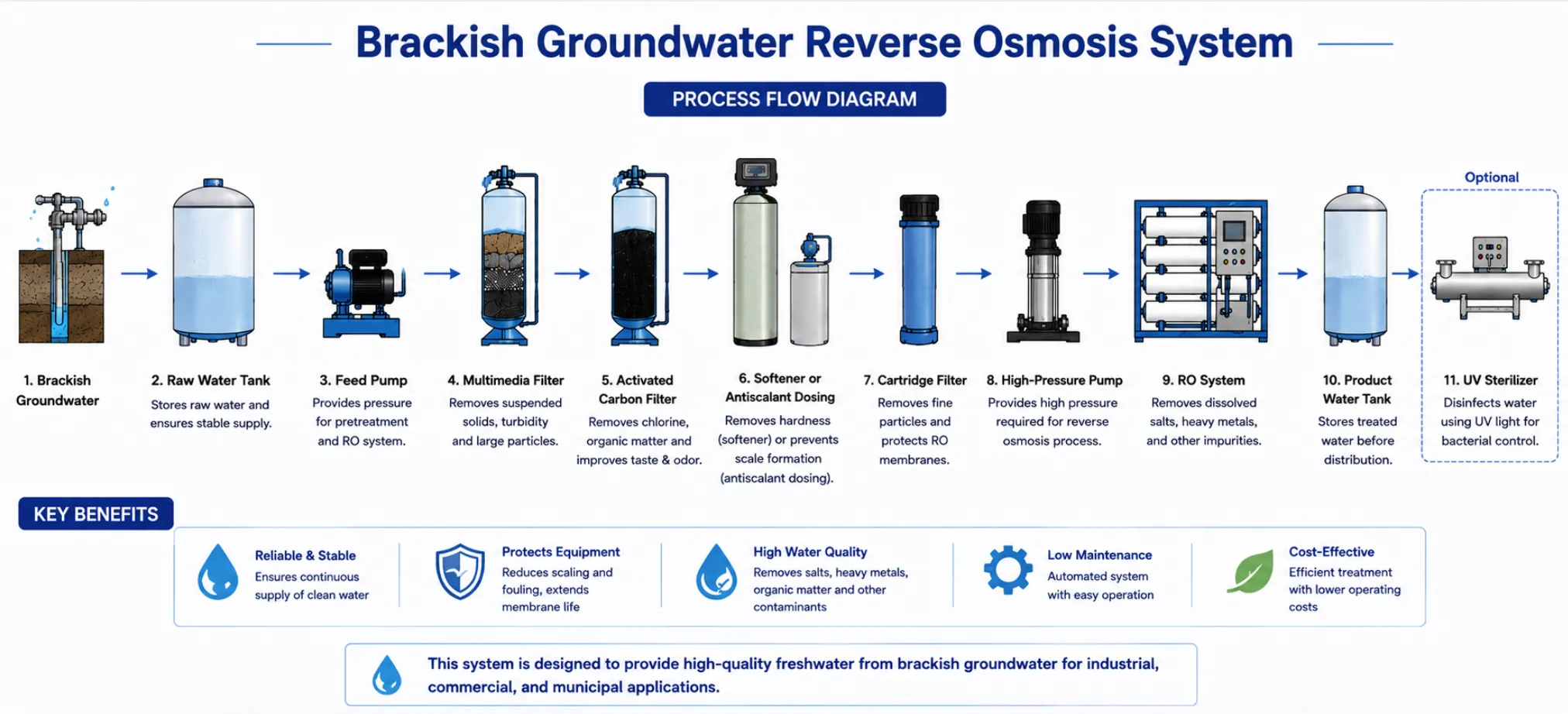
The exact process depends on the water analysis.
For example:
- High turbidity requires stronger multimedia or ultrafiltration pretreatment.
- High hardness may require a water softener or antiscalant dosing.
- High iron and manganese require oxidation and specialized filtration.
- Drinking-water projects may require UV sterilization and final disinfection.
- High-purity industrial applications may require double-pass RO or RO+EDI.
Customers can review the complete Brackish Water Desalination System for available capacities and configurations.
What System Capacity Does an Industrial Plant Need?
Brackish water RO systems can be customized from small commercial units to large industrial plants. Common capacities include:
| System capacity | Typical application |
|---|---|
| 1–2 m³/h | Small factories, farms and commercial facilities |
| 5 m³/h | Food processing and small production plants |
| 10 m³/h | Medium-sized industrial factories |
| 20–50 m³/h | Manufacturing, mining and centralized water supply |
| 50–200 m³/h | Large factories and municipal projects |
The required capacity should not be selected only according to hourly consumption. Buyers should also consider:
- Daily operating hours
- Peak water demand
- RO recovery rate
- Storage-tank capacity
- Future production expansion
- Water used for RO flushing and maintenance
For example, if a factory needs 80 m³ of purified water per day and the system operates for 10 hours, the minimum production capacity is approximately 8 m³/h. A 10 m³/h industrial brackish water RO system may provide a more practical safety margin.
What Water Quality Can the System Produce?
A properly designed brackish groundwater desalination plant can typically remove most dissolved salts, hardness and other contaminants. However, actual output quality depends on the feed-water TDS, temperature, membrane selection, recovery rate and system design.
Typical design ranges include:
| Parameter | Typical range |
|---|---|
| Feed-water TDS | 1,000–15,000 mg/L |
| System capacity | 0.5–200 m³/h |
| RO salt rejection | Usually 97%–99% |
| Recovery rate | Approximately 60%–80% |
| Product-water TDS | Designed according to the required standard |
| Operation | Manual, semi-automatic or fully automatic |
These values are for preliminary reference only. The final performance must be confirmed after reviewing the customer’s water analysis.
If the water will be used for food ingredients, pharmaceuticals, boilers or electronics manufacturing, the required output standard should be specified before system design.
Industrial Applications
An industrial brackish groundwater treatment system can provide water for:
- Food and beverage processing
- Bottled-water production
- Boiler feedwater
- Cooling-tower makeup water
- Chemical manufacturing
- Mining operations
- Textile production
- Agriculture and irrigation
- Hotels and resorts
- Community drinking-water projects
Different industries require different water qualities. A food factory may require hygienic materials and final disinfection, while a boiler plant may focus on hardness, silica and conductivity.
Customers in process manufacturing can also review our Chemical Industry Water Treatment Solutions to understand how water-treatment processes are matched to industrial requirements.
How to Select the Right Brackish Water Desalination System
Before purchasing a system, buyers should confirm five key factors.
1. Feed-Water Quality
Provide a recent laboratory report containing:
- TDS or conductivity
- Total hardness
- pH
- Chloride and sulfate
- Iron and manganese
- Silica
- Turbidity
- Microbiological indicators, if applicable
A TDS reading alone is not sufficient for a reliable system design.
2. Required Production Capacity
Specify the required purified-water capacity in liters per hour or cubic meters per hour, together with daily operating time.
Examples of useful purchasing keywords include:
- 5 m³/h brackish groundwater RO system
- 10 m³/h industrial brackish water desalination plant
- 20 m³/h brackish water treatment system for factory use
3. Required Product-Water Standard
Explain whether the water will be used for drinking, food production, boilers, cooling, equipment cleaning or high-purity manufacturing.
4. Installation Conditions
The manufacturer needs to know:
- Indoor or outdoor installation
- Ambient temperature
- Available installation space
- Local voltage and frequency
- Containerized or skid-mounted design
- Available drainage and concentrate-water disposal
5. Automation and Component Requirements
Optional configurations may include:
- PLC and touchscreen control
- Remote monitoring
- Automatic chemical dosing
- CIP membrane-cleaning system
- Stainless-steel piping
- UV sterilizer
- Product-water remineralization
- Containerized installation
- Specific membrane, pump or electrical brands
Project Reference: Brackish Water Treatment in Tanzania
For a water plant in Tanzania, Zhongnuo supplied a 1,500 L/H brackish water desalination system to treat saline borehole water. The project required stable freshwater production, automatic operation and simple maintenance for local operators.
The project demonstrates how a compact brackish water RO plant can support drinking-water production in areas where groundwater has high TDS.
Read the complete 1,500 L/H Brackish Water Desalination Project in Tanzania.
For a larger industrial application, see the 8 m³/h Brackish Water Desalination System for an Algerian Food Factory.
What Information Is Required for a Quotation?
To obtain an accurate technical proposal and quotation, please provide:
- Raw-water source
- Water-analysis report
- Required capacity in L/H or m³/h
- Required product-water quality
- Water application and industry
- Daily operating hours
- Local voltage and frequency
- Installation location
- Destination port
- Preferred component brands, if any
Without a water-analysis report, only a preliminary configuration and budget estimate can be provided.
Contact Zhongnuo Water Treatment to receive a customized process design, equipment configuration and quotation for your industrial brackish groundwater project.
Frequently Asked Questions
Can a sand filter remove salt from brackish groundwater?
No. Sand filtration removes suspended solids but cannot remove dissolved salts. Reverse osmosis is normally required for desalination.
What is the difference between brackish water RO and seawater RO?
Brackish water has lower salinity and normally requires lower operating pressure. Seawater RO requires higher-pressure pumps, seawater membranes and more corrosion-resistant materials.
How much does an industrial brackish water RO system cost?
The price depends on capacity, feed-water TDS, pretreatment, membrane quantity, material, automation level and optional equipment. A water report is required for an accurate quotation.
Can the system produce drinking water?
Yes, but the process must be designed according to the raw-water quality and applicable local drinking-water standard. Post-treatment, remineralization or disinfection may also be required.
Can the system operate automatically?
Yes. Industrial systems can include PLC control, automatic flushing, low-pressure and high-pressure protection, conductivity monitoring and fault alarms.
Introduction
Brackish groundwater is an important water source for factories located in areas with limited municipal or surface water. However, high TDS, hardness, chloride, iron and other dissolved contaminants can make untreated groundwater unsuitable for production.
An industrial brackish groundwater desalination system uses pretreatment and reverse osmosis technology to reduce dissolved salts and produce stable water for manufacturing, food processing, boilers, cooling systems, mining and other industrial applications.
The right system capacity and process must be selected according to the raw water analysis, required output quality and daily water demand.
What Is Brackish Groundwater?
Brackish groundwater contains more dissolved salts than freshwater but less than seawater. Its quality varies significantly according to location and underground geology.
Common problems include:
- High total dissolved solids
- Calcium and magnesium hardness
- Chloride and sulfate
- Iron and manganese
- Silica
- Suspended solids
- Bacteria and organic matter
High-TDS groundwater can cause scaling, corrosion, unstable product quality and frequent equipment maintenance. Simple sand filtration cannot remove dissolved salts. In most cases, reverse osmosis is required.
How Does a Brackish Water RO System Work?
A typical industrial brackish water treatment process is:
Brackish Groundwater → Raw Water Tank → Feed Pump → Multimedia Filter → Activated Carbon Filter → Softener or Antiscalant Dosing → Cartridge Filter → High-Pressure Pump → RO System → Product Water Tank → Optional UV Sterilizer
The exact process depends on the water analysis.
For example:
- High turbidity requires stronger multimedia or ultrafiltration pretreatment.
- High hardness may require a water softener or antiscalant dosing.
- High iron and manganese require oxidation and specialized filtration.
- Drinking-water projects may require UV sterilization and final disinfection.
- High-purity industrial applications may require double-pass RO or RO+EDI.
Customers can review the complete Brackish Water Desalination System for available capacities and configurations.
What System Capacity Does an Industrial Plant Need?
Brackish water RO systems can be customized from small commercial units to large industrial plants. Common capacities include:
| System capacity | Typical application |
|---|---|
| 1–2 m³/h | Small factories, farms and commercial facilities |
| 5 m³/h | Food processing and small production plants |
| 10 m³/h | Medium-sized industrial factories |
| 20–50 m³/h | Manufacturing, mining and centralized water supply |
| 50–200 m³/h | Large factories and municipal projects |
The required capacity should not be selected only according to hourly consumption. Buyers should also consider:
- Daily operating hours
- Peak water demand
- RO recovery rate
- Storage-tank capacity
- Future production expansion
- Water used for RO flushing and maintenance
For example, if a factory needs 80 m³ of purified water per day and the system operates for 10 hours, the minimum production capacity is approximately 8 m³/h. A 10 m³/h industrial brackish water RO system may provide a more practical safety margin.
What Water Quality Can the System Produce?
A properly designed brackish groundwater desalination plant can typically remove most dissolved salts, hardness and other contaminants. However, actual output quality depends on the feed-water TDS, temperature, membrane selection, recovery rate and system design.
Typical design ranges include:
| Parameter | Typical range |
|---|---|
| Feed-water TDS | 1,000–15,000 mg/L |
| System capacity | 0.5–200 m³/h |
| RO salt rejection | Usually 97%–99% |
| Recovery rate | Approximately 60%–80% |
| Product-water TDS | Designed according to the required standard |
| Operation | Manual, semi-automatic or fully automatic |
These values are for preliminary reference only. The final performance must be confirmed after reviewing the customer’s water analysis.
If the water will be used for food ingredients, pharmaceuticals, boilers or electronics manufacturing, the required output standard should be specified before system design.
Industrial Applications
An industrial brackish groundwater treatment system can provide water for:
- Food and beverage processing
- Bottled-water production
- Boiler feedwater
- Cooling-tower makeup water
- Chemical manufacturing
- Mining operations
- Textile production
- Agriculture and irrigation
- Hotels and resorts
- Community drinking-water projects
Different industries require different water qualities. A food factory may require hygienic materials and final disinfection, while a boiler plant may focus on hardness, silica and conductivity.
Customers in process manufacturing can also review our Chemical Industry Water Treatment Solutions to understand how water-treatment processes are matched to industrial requirements.
How to Select the Right Brackish Water Desalination System
Before purchasing a system, buyers should confirm five key factors.
1. Feed-Water Quality
Provide a recent laboratory report containing:
- TDS or conductivity
- Total hardness
- pH
- Chloride and sulfate
- Iron and manganese
- Silica
- Turbidity
- Microbiological indicators, if applicable
A TDS reading alone is not sufficient for a reliable system design.
2. Required Production Capacity
Specify the required purified-water capacity in liters per hour or cubic meters per hour, together with daily operating time.
Examples of useful purchasing keywords include:
- 5 m³/h brackish groundwater RO system
- 10 m³/h industrial brackish water desalination plant
- 20 m³/h brackish water treatment system for factory use
3. Required Product-Water Standard
Explain whether the water will be used for drinking, food production, boilers, cooling, equipment cleaning or high-purity manufacturing.
4. Installation Conditions
The manufacturer needs to know:
- Indoor or outdoor installation
- Ambient temperature
- Available installation space
- Local voltage and frequency
- Containerized or skid-mounted design
- Available drainage and concentrate-water disposal
5. Automation and Component Requirements
Optional configurations may include:
- PLC and touchscreen control
- Remote monitoring
- Automatic chemical dosing
- CIP membrane-cleaning system
- Stainless-steel piping
- UV sterilizer
- Product-water remineralization
- Containerized installation
- Specific membrane, pump or electrical brands
Project Reference: Brackish Water Treatment in Tanzania
For a water plant in Tanzania, Zhongnuo supplied a 1,500 L/H brackish water desalination system to treat saline borehole water. The project required stable freshwater production, automatic operation and simple maintenance for local operators.
The project demonstrates how a compact brackish water RO plant can support drinking-water production in areas where groundwater has high TDS.
Read the complete 1,500 L/H Brackish Water Desalination Project in Tanzania.
For a larger industrial application, see the 8 m³/h Brackish Water Desalination System for an Algerian Food Factory.
What Information Is Required for a Quotation?
To obtain an accurate technical proposal and quotation, please provide:
- Raw-water source
- Water-analysis report
- Required capacity in L/H or m³/h
- Required product-water quality
- Water application and industry
- Daily operating hours
- Local voltage and frequency
- Installation location
- Destination port
- Preferred component brands, if any
Without a water-analysis report, only a preliminary configuration and budget estimate can be provided.
Contact Zhongnuo Water Treatment to receive a customized process design, equipment configuration and quotation for your industrial brackish groundwater project.
Frequently Asked Questions
Can a sand filter remove salt from brackish groundwater?
No. Sand filtration removes suspended solids but cannot remove dissolved salts. Reverse osmosis is normally required for desalination.
What is the difference between brackish water RO and seawater RO?
Brackish water has lower salinity and normally requires lower operating pressure. Seawater RO requires higher-pressure pumps, seawater membranes and more corrosion-resistant materials.
How much does an industrial brackish water RO system cost?
The price depends on capacity, feed-water TDS, pretreatment, membrane quantity, material, automation level and optional equipment. A water report is required for an accurate quotation.
Can the system produce drinking water?
Yes, but the process must be designed according to the raw-water quality and applicable local drinking-water standard. Post-treatment, remineralization or disinfection may also be required.
Can the system operate automatically?
Yes. Industrial systems can include PLC control, automatic flushing, low-pressure and high-pressure protection, conductivity monitoring and fault alarms.
Get a Quote for Free
Submit this form and our sales representative will contact you soon.


ONLINE MESSAGE
Copyright © 2026 Zhongnuo Water Treatment Co., Ltd.