

SEARCH WHAT YOU WANT
How to Remove Iron and Manganese from Borehole Water
Time:2026-08-20
Borehole water often contains dissolved iron and manganese from underground rocks and soil. Although the water may look clear when pumped from the well, it can turn yellow, brown, or black after contact with air.
A properly designed iron and manganese removal system for borehole water improves water color, taste, and stability while protecting pipelines and downstream equipment.
Common Signs of Iron and Manganese
Iron and manganese contamination may cause:
♦Yellow, brown, or black water
♦Metallic taste or unpleasant odor
♦Brown stains on tanks and equipment
♦Black deposits in pipes
♦Blocked filters and nozzles
♦Faster fouling of RO membranes
♦Increased cleaning and maintenance costs
Because iron and manganese may exist in dissolved or particulate form, treatment should begin with a complete borehole water analysis.
How Are Iron and Manganese Removed?
The standard method combines oxidation and filtration.
1. Oxidation
Dissolved iron and manganese must first be converted into insoluble particles. Common oxidation methods include:
- Aeration
- Chlorine dosing
- Sodium hypochlorite dosing
- Potassium permanganate
- Ozone oxidation
The correct method depends on iron and manganese concentration, pH, flow rate, organic matter, and the final use of the treated water.
2. Filtration
After oxidation, the particles are removed through suitable filter media. Common options include:
- Multimedia filtration
- Manganese sand filtration
- Catalytic filter media
- Automatic backwashing filters
- Ultrafiltration for challenging water conditions
The filter must be properly sized to provide sufficient contact time and allow regular backwashing. Explore our pretreatment equipment for different raw-water conditions.
3. Final Disinfection or Purification
UV sterilization or controlled chlorination may be added when microbiological safety is required. If the borehole water also contains high TDS, hardness, chloride, fluoride, or other dissolved contaminants, a reverse osmosis system may be installed after iron and manganese removal.
Typical Treatment Process
A common treatment process is:
Borehole Water → Raw Water Tank → Feed Pump → Aeration or Chemical Oxidation → Manganese Sand Filter → Activated Carbon Filter → Cartridge Filter → Optional RO System → UV Sterilizer → Treated Water Tank
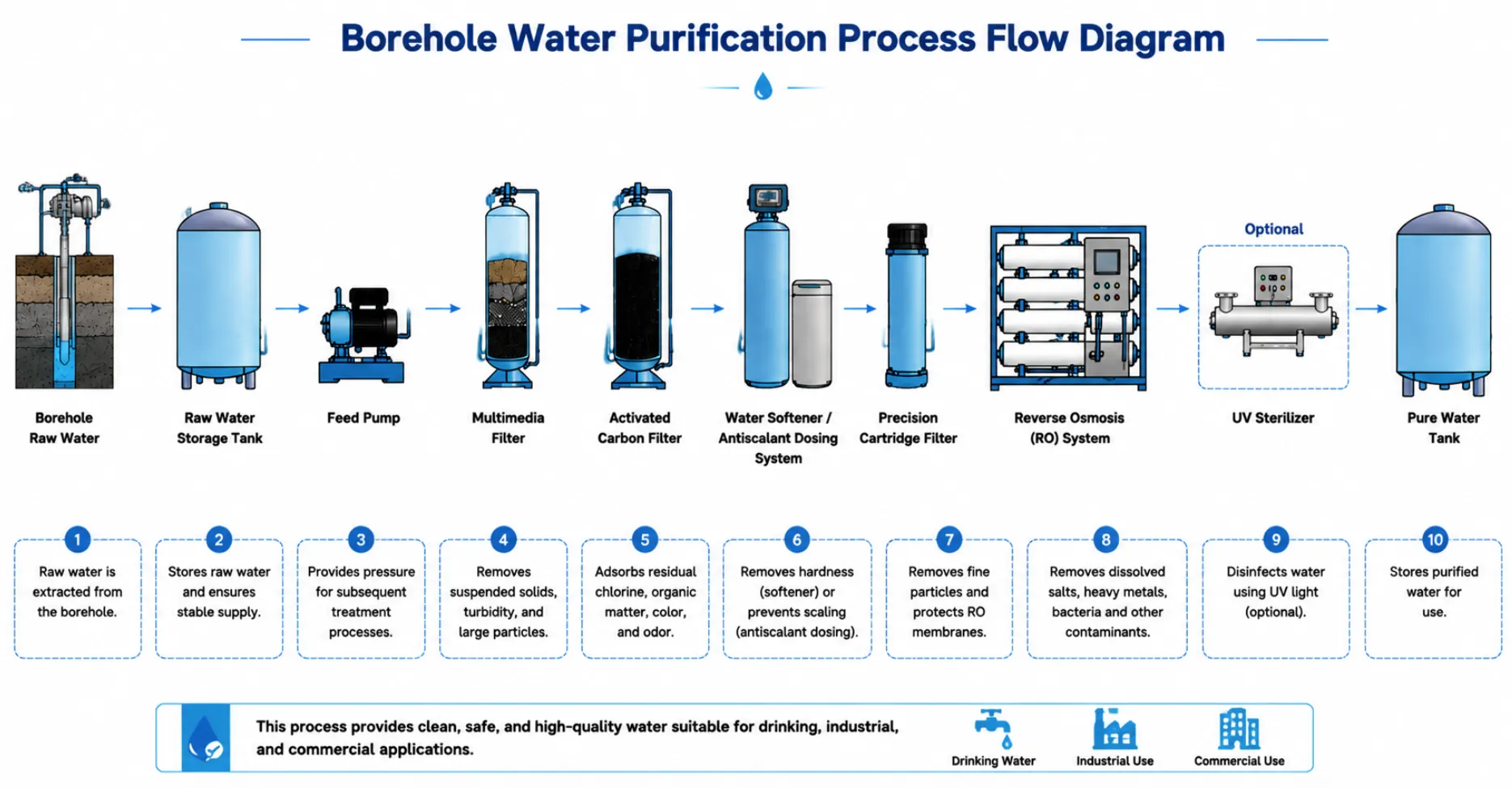
The final process must be adjusted according to the water analysis. High manganese, low pH, hydrogen sulfide, or organic contamination may require stronger oxidation or longer contact time.
For a complete groundwater treatment process, read our Borehole Water Treatment System Design Guide.
Is Reverse Osmosis Required?
RO is not always necessary for removing iron and manganese. Oxidation and filtration are usually the primary treatment methods.
However, RO may be required when the borehole water also has:
- High TDS or salinity
- Excessive hardness
- High chloride or sulfate
- Fluoride or nitrate
- Strict conductivity requirements
- Industrial purified-water requirements
Iron and manganese should be removed before the RO stage because deposits can foul the membranes, reduce water output, and increase operating pressure.
Learn more in our article: Reverse Osmosis System for Borehole Water: When Is RO Required?.
Information Required for System Design
Before selecting a borehole water iron removal system, provide:
- Complete raw-water analysis
- Iron and manganese concentrations
- pH, turbidity, hardness, and TDS
- Required treated-water capacity
- Daily operating hours
- Final water application
- Required outlet-water standard
- Local voltage and frequency
These parameters help engineers select the oxidation method, filter media, tank size, backwashing flow, and optional downstream treatment.
Why Customized Design Matters
There is no single filter suitable for every borehole. Incorrect media selection or insufficient oxidation may cause unstable water quality and rapid filter blockage.
Zhongnuo Water Treatment provides customized borehole water treatment systems based on raw-water conditions and project requirements. Available configurations include automatic dosing, manganese sand filtration, activated carbon filtration, water softening, ultrafiltration, RO, and UV sterilization.
Conclusion
Effective removal of iron and manganese from borehole water normally requires oxidation followed by filtration. RO should only be added when other dissolved contaminants or stricter water-quality requirements are present.
A recent water analysis is the most important starting point for designing a stable and cost-effective treatment system.
Contact Zhongnuo Water Treatment with your water report, required capacity, final application, and local voltage to receive a customized treatment process and quotation.
Frequently Asked Questions
Can a sand filter remove dissolved iron?
A standard sand filter may remove oxidized iron particles, but dissolved iron must first be converted into an insoluble form through aeration or chemical oxidation.
Can RO remove iron and manganese?
RO membranes can reject dissolved contaminants, but high iron and manganese concentrations may foul the membranes. Proper pretreatment should be installed before RO.
Why does clear borehole water turn brown?
Dissolved iron reacts with oxygen after the water is pumped from the well, forming visible iron oxide particles that make the water yellow or brown.
How often should an iron removal filter be backwashed?
The frequency depends on contaminant concentration, water consumption, filter size, and pressure difference. Automatic backwashing should be configured according to actual operating conditions.
Borehole water often contains dissolved iron and manganese from underground rocks and soil. Although the water may look clear when pumped from the well, it can turn yellow, brown, or black after contact with air.
A properly designed iron and manganese removal system for borehole water improves water color, taste, and stability while protecting pipelines and downstream equipment.
Common Signs of Iron and Manganese
Iron and manganese contamination may cause:
♦Yellow, brown, or black water
♦Metallic taste or unpleasant odor
♦Brown stains on tanks and equipment
♦Black deposits in pipes
♦Blocked filters and nozzles
♦Faster fouling of RO membranes
♦Increased cleaning and maintenance costs
Because iron and manganese may exist in dissolved or particulate form, treatment should begin with a complete borehole water analysis.
How Are Iron and Manganese Removed?
The standard method combines oxidation and filtration.
1. Oxidation
Dissolved iron and manganese must first be converted into insoluble particles. Common oxidation methods include:
- Aeration
- Chlorine dosing
- Sodium hypochlorite dosing
- Potassium permanganate
- Ozone oxidation
The correct method depends on iron and manganese concentration, pH, flow rate, organic matter, and the final use of the treated water.
2. Filtration
After oxidation, the particles are removed through suitable filter media. Common options include:
- Multimedia filtration
- Manganese sand filtration
- Catalytic filter media
- Automatic backwashing filters
- Ultrafiltration for challenging water conditions
The filter must be properly sized to provide sufficient contact time and allow regular backwashing. Explore our pretreatment equipment for different raw-water conditions.
3. Final Disinfection or Purification
UV sterilization or controlled chlorination may be added when microbiological safety is required. If the borehole water also contains high TDS, hardness, chloride, fluoride, or other dissolved contaminants, a reverse osmosis system may be installed after iron and manganese removal.
Typical Treatment Process
A common treatment process is:
Borehole Water → Raw Water Tank → Feed Pump → Aeration or Chemical Oxidation → Manganese Sand Filter → Activated Carbon Filter → Cartridge Filter → Optional RO System → UV Sterilizer → Treated Water Tank
The final process must be adjusted according to the water analysis. High manganese, low pH, hydrogen sulfide, or organic contamination may require stronger oxidation or longer contact time.
For a complete groundwater treatment process, read our Borehole Water Treatment System Design Guide.
Is Reverse Osmosis Required?
RO is not always necessary for removing iron and manganese. Oxidation and filtration are usually the primary treatment methods.
However, RO may be required when the borehole water also has:
- High TDS or salinity
- Excessive hardness
- High chloride or sulfate
- Fluoride or nitrate
- Strict conductivity requirements
- Industrial purified-water requirements
Iron and manganese should be removed before the RO stage because deposits can foul the membranes, reduce water output, and increase operating pressure.
Learn more in our article: Reverse Osmosis System for Borehole Water: When Is RO Required?.
Information Required for System Design
Before selecting a borehole water iron removal system, provide:
- Complete raw-water analysis
- Iron and manganese concentrations
- pH, turbidity, hardness, and TDS
- Required treated-water capacity
- Daily operating hours
- Final water application
- Required outlet-water standard
- Local voltage and frequency
These parameters help engineers select the oxidation method, filter media, tank size, backwashing flow, and optional downstream treatment.
Why Customized Design Matters
There is no single filter suitable for every borehole. Incorrect media selection or insufficient oxidation may cause unstable water quality and rapid filter blockage.
Zhongnuo Water Treatment provides customized borehole water treatment systems based on raw-water conditions and project requirements. Available configurations include automatic dosing, manganese sand filtration, activated carbon filtration, water softening, ultrafiltration, RO, and UV sterilization.
Conclusion
Effective removal of iron and manganese from borehole water normally requires oxidation followed by filtration. RO should only be added when other dissolved contaminants or stricter water-quality requirements are present.
A recent water analysis is the most important starting point for designing a stable and cost-effective treatment system.
Contact Zhongnuo Water Treatment with your water report, required capacity, final application, and local voltage to receive a customized treatment process and quotation.
Frequently Asked Questions
Can a sand filter remove dissolved iron?
A standard sand filter may remove oxidized iron particles, but dissolved iron must first be converted into an insoluble form through aeration or chemical oxidation.
Can RO remove iron and manganese?
RO membranes can reject dissolved contaminants, but high iron and manganese concentrations may foul the membranes. Proper pretreatment should be installed before RO.
Why does clear borehole water turn brown?
Dissolved iron reacts with oxygen after the water is pumped from the well, forming visible iron oxide particles that make the water yellow or brown.
How often should an iron removal filter be backwashed?
The frequency depends on contaminant concentration, water consumption, filter size, and pressure difference. Automatic backwashing should be configured according to actual operating conditions.
Get a Quote for Free
Submit this form and our sales representative will contact you soon.


ONLINE MESSAGE
Copyright © 2026 Zhongnuo Water Treatment Co., Ltd.