

SEARCH WHAT YOU WANT
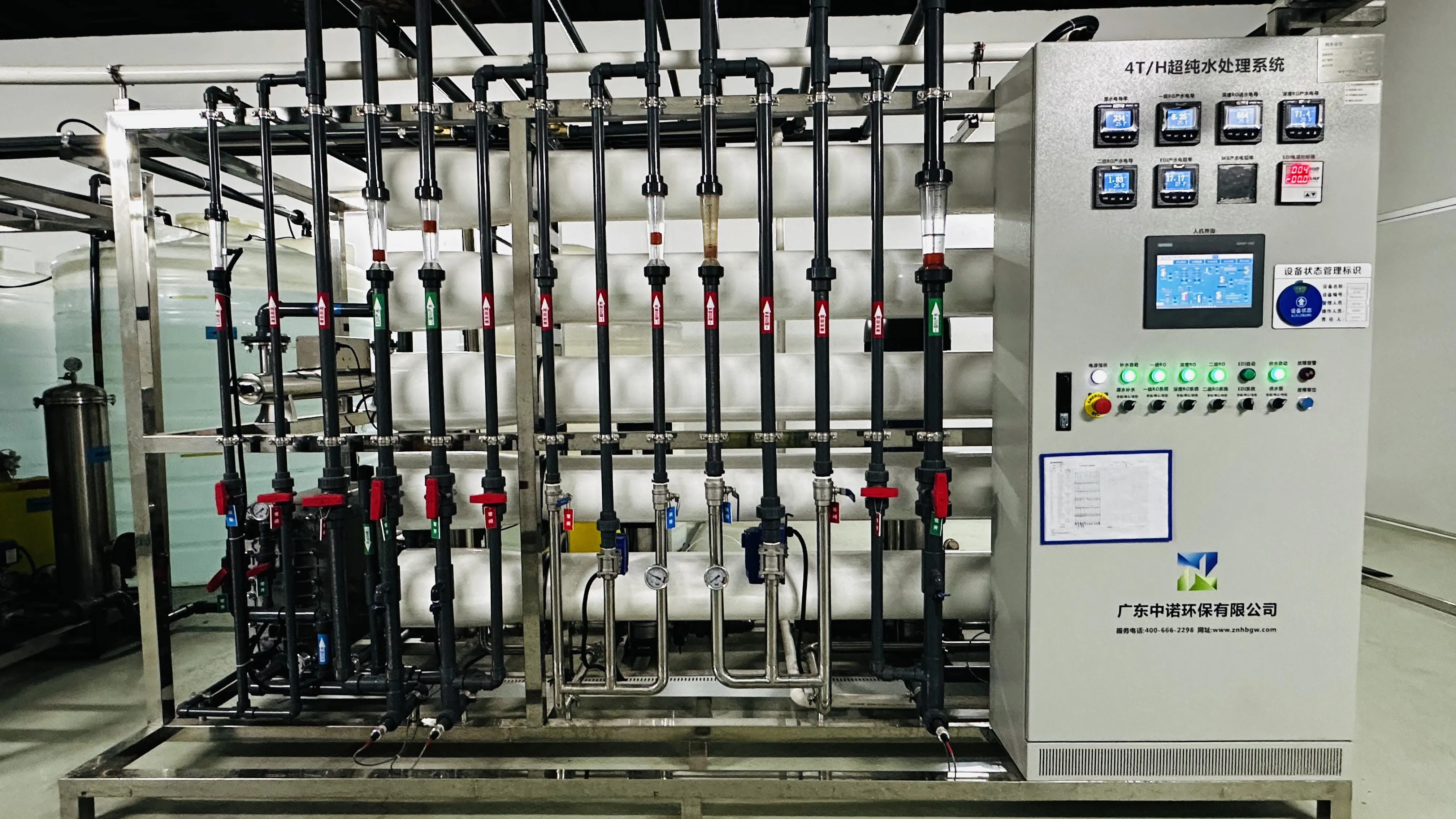
RO+EDI Ultrapure Water Systems for Laboratory Reagent Production
Time:2026-11-03
Water is often the largest ingredient in laboratory reagents. Its quality can affect formulation stability, analytical background and batch consistency. For reagent manufacturers, water treatment must therefore support the finished product’s requirements—not simply achieve a low conductivity reading.
Reverse osmosis combined with electrodeionization, or RO+EDI, provides a practical foundation for producing high-purity water continuously. However, whether that water is suitable for a particular reagent depends on more than ionic purity.
A reliable design starts with the reagent specification and follows the water through treatment, storage and delivery to the mixing vessel.
1. Define Water Quality Around the Reagent
“Ultrapure water” should not be the only water-quality requirement in a quotation. Different reagents have different sensitivities to contamination.
| Reagent Application | Water-Quality Factors to Evaluate |
|---|---|
| General analytical solutions and buffers | Ionic purity, relevant trace contaminants and consistency |
| Chromatography reagents | Organic contamination, particles and analytical background |
| Clinical chemistry and immunoassay reagents | Ionic purity, organics, microorganisms and assay-specific interference |
| Molecular biology reagents | Nucleases, nucleic acid contamination and other method-specific requirements |
These are starting points for specification, not universal acceptance limits. Manufacturers must establish limits through formulation requirements, applicable standards and product validation. Merck’s clinical chemistry guidance similarly distinguishes general reagent-water requirements from more demanding application-specific needs.
Resistivity alone cannot establish suitability for reagent production. Even a reading of 18.2 MΩ·cm at 25°C does not demonstrate that water is free from organic contamination, endotoxins or nucleases.
Define each required parameter, its limit, the test method and the sampling location before selecting equipment.
2. Understand What RO+EDI Can Deliver
RO and EDI perform complementary functions:
-
• RO reduces dissolved salts and many other contaminants, lowering the load on downstream treatment.
-
• EDI combines ion-exchange media, selective membranes and an electrical field to continuously remove residual ionic impurities.
-
• Additional polishing addresses specific contaminants that the base RO+EDI system does not adequately control.
EDI avoids routine acid and caustic regeneration of conventional ion-exchange beds. It does not eliminate the need for pretreatment chemicals, cleaning or sanitization.
A typical treatment arrangement is:
Pretreatment → RO → EDI → Protected Storage → Recirculating Distribution → Point of Use
Depending on the application, the design may also include a second RO pass, membrane degassing, UV treatment or final polishing.
These additions should have a defined purpose. For example, a particle filter does not remove dissolved ions, while a microbial filter does not automatically provide validated endotoxin or nuclease removal.
3. Design the RO Stage to Protect the EDI
An EDI module must receive water within its manufacturer’s operating limits. Selecting an EDI unit only by flow rate can overlook conditions that reduce performance or cause damage.
Confirm the selected module’s requirements for:
-
• Conductivity and total ionic load
-
• Hardness and silica
-
• Dissolved carbon dioxide
-
• Organic contamination and oxidants
-
• Feedwater temperature, pressure and flow
Low RO permeate conductivity does not necessarily mean low EDI loading. Dissolved carbon dioxide can add a significant treatment load that conductivity alone does not fully represent. DuPont’s EDI guidance therefore considers carbon dioxide and silica when evaluating feedwater conductivity equivalent.
The appropriate solution may involve revised RO operating conditions, a second pass or degassing. The choice should follow water analysis and process calculations rather than a standard equipment package.
Seasonal changes also matter. Our guide to how variable feedwater TDS affects RO pump and membrane selection explains why the design must cover the expected operating range.
4. Size Capacity Around Batch Production
Reagent production often creates intermittent demand. A mixing vessel may need a large volume quickly, followed by several hours of limited consumption.
Separate three requirements:
| Requirement | What It Determines |
|---|---|
| Net daily water demand | Required treatment production |
| Peak draw-off flow | Distribution pump and piping capacity |
| Volume needed during peak demand or downtime | Usable storage capacity |
For example, a batch requiring 2 m³ of water within 30 minutes needs a delivery rate of 4 m³/h. The treatment system does not necessarily need to produce 4 m³/h continuously if suitable storage can supply the difference and refill before the next batch.
However, the daily balance must also include sampling, flushing, sanitization-related losses and other water uses. Tank sizing should balance supply continuity with water turnover.
When comparing proposals, distinguish equipment output from water available to production. See Rated Capacity vs Guaranteed Net Permeate.
5. Protect Quality After the EDI Outlet
Water can meet its specification at the EDI outlet and become contaminated before reaching the formulation vessel.
Potential sources include air entering the storage tank, unsuitable wetted materials, stagnant branches, poorly maintained valves and temporary transfer hoses.
The storage and distribution design should address:
-
Compatible, low-leaching materials and seals
-
Hygienic tank connections and suitable vent protection
-
Drainability and minimized stagnant sections
-
Circulation under both high- and low-demand conditions
-
Accessible sampling points
-
A defined cleaning and sanitization procedure
Sanitization methods must be compatible with every exposed component. If the distribution loop uses heat or chemicals outside the EDI module’s limits, appropriate isolation is necessary.
The final connection to the mixing vessel deserves the same attention as the main loop. A well-designed central system cannot compensate for a contaminated transfer hose.
For more detail, read How Distribution-Loop Design Protects RO+EDI Water Quality.
6. Combine Online Monitoring with Application-Specific Testing
Online instruments provide continuous operating information, but they do not replace every water-quality test.
| Parameter | Main Function |
|---|---|
| Conductivity or resistivity | Monitor ionic quality |
| Temperature | Interpret quality readings and operating conditions |
| Flow and pressure | Confirm treatment and delivery conditions |
| Tank level | Manage production, storage and pump protection |
| TOC, where specified | Monitor organic contamination |
Microbial, endotoxin, nuclease or other application-specific testing should follow the established water specification and sampling plan.
Critical signals also need defined actions. For example, off-spec EDI product may require diversion before storage, while a distribution-loop quality failure may require suspending water release to production.
Our guide to essential online instruments for automatic RO systems explains how to connect measurements with alarms and protective controls.
7. Agree on Acceptance Criteria Before Ordering
A brief resistivity demonstration is not sufficient acceptance evidence for a reagent-production water system.
The quotation and test plan should define:
-
• Feedwater conditions: the agreed raw-water range and EDI inlet limits.
-
• Delivered quantity: continuous output, net daily supply and peak delivery capacity.
-
• Water quality: specified parameters, limits, methods and measurement points.
-
• Operating scenarios: normal production, low demand, restart and recovery after sanitization.
-
• Supply boundary: responsibility for tanks, distribution piping, polishing and final connections.
-
• Documentation: drawings, calibration records, operating procedures and maintenance requirements.
Equipment acceptance and reagent validation serve different purposes. The supplier must demonstrate the agreed water-system performance; the reagent manufacturer must confirm that the delivered water is suitable for its formulations.
These responsibilities should be documented alongside the industrial RO performance guarantee.
Plan an RO+EDI System Around Your Reagent Requirements
Send Zhongnuo Water Treatment your raw-water analysis, reagent applications, required water-quality limits, batch demand and operating schedule.
These details provide the basis for selecting RO and EDI equipment, evaluating additional polishing, and defining storage, distribution and acceptance requirements around the water your production process actually needs.
Water is often the largest ingredient in laboratory reagents. Its quality can affect formulation stability, analytical background and batch consistency. For reagent manufacturers, water treatment must therefore support the finished product’s requirements—not simply achieve a low conductivity reading.
Reverse osmosis combined with electrodeionization, or RO+EDI, provides a practical foundation for producing high-purity water continuously. However, whether that water is suitable for a particular reagent depends on more than ionic purity.
A reliable design starts with the reagent specification and follows the water through treatment, storage and delivery to the mixing vessel.
1. Define Water Quality Around the Reagent
“Ultrapure water” should not be the only water-quality requirement in a quotation. Different reagents have different sensitivities to contamination.
| Reagent Application | Water-Quality Factors to Evaluate |
|---|---|
| General analytical solutions and buffers | Ionic purity, relevant trace contaminants and consistency |
| Chromatography reagents | Organic contamination, particles and analytical background |
| Clinical chemistry and immunoassay reagents | Ionic purity, organics, microorganisms and assay-specific interference |
| Molecular biology reagents | Nucleases, nucleic acid contamination and other method-specific requirements |
These are starting points for specification, not universal acceptance limits. Manufacturers must establish limits through formulation requirements, applicable standards and product validation. Merck’s clinical chemistry guidance similarly distinguishes general reagent-water requirements from more demanding application-specific needs.
Resistivity alone cannot establish suitability for reagent production. Even a reading of 18.2 MΩ·cm at 25°C does not demonstrate that water is free from organic contamination, endotoxins or nucleases.
Define each required parameter, its limit, the test method and the sampling location before selecting equipment.
2. Understand What RO+EDI Can Deliver
RO and EDI perform complementary functions:
-
• RO reduces dissolved salts and many other contaminants, lowering the load on downstream treatment.
-
• EDI combines ion-exchange media, selective membranes and an electrical field to continuously remove residual ionic impurities.
-
• Additional polishing addresses specific contaminants that the base RO+EDI system does not adequately control.
EDI avoids routine acid and caustic regeneration of conventional ion-exchange beds. It does not eliminate the need for pretreatment chemicals, cleaning or sanitization.
A typical treatment arrangement is:
Pretreatment → RO → EDI → Protected Storage → Recirculating Distribution → Point of Use
Depending on the application, the design may also include a second RO pass, membrane degassing, UV treatment or final polishing.
These additions should have a defined purpose. For example, a particle filter does not remove dissolved ions, while a microbial filter does not automatically provide validated endotoxin or nuclease removal.
3. Design the RO Stage to Protect the EDI
An EDI module must receive water within its manufacturer’s operating limits. Selecting an EDI unit only by flow rate can overlook conditions that reduce performance or cause damage.
Confirm the selected module’s requirements for:
-
• Conductivity and total ionic load
-
• Hardness and silica
-
• Dissolved carbon dioxide
-
• Organic contamination and oxidants
-
• Feedwater temperature, pressure and flow
Low RO permeate conductivity does not necessarily mean low EDI loading. Dissolved carbon dioxide can add a significant treatment load that conductivity alone does not fully represent. DuPont’s EDI guidance therefore considers carbon dioxide and silica when evaluating feedwater conductivity equivalent.
The appropriate solution may involve revised RO operating conditions, a second pass or degassing. The choice should follow water analysis and process calculations rather than a standard equipment package.
Seasonal changes also matter. Our guide to how variable feedwater TDS affects RO pump and membrane selection explains why the design must cover the expected operating range.
4. Size Capacity Around Batch Production
Reagent production often creates intermittent demand. A mixing vessel may need a large volume quickly, followed by several hours of limited consumption.
Separate three requirements:
| Requirement | What It Determines |
|---|---|
| Net daily water demand | Required treatment production |
| Peak draw-off flow | Distribution pump and piping capacity |
| Volume needed during peak demand or downtime | Usable storage capacity |
For example, a batch requiring 2 m³ of water within 30 minutes needs a delivery rate of 4 m³/h. The treatment system does not necessarily need to produce 4 m³/h continuously if suitable storage can supply the difference and refill before the next batch.
However, the daily balance must also include sampling, flushing, sanitization-related losses and other water uses. Tank sizing should balance supply continuity with water turnover.
When comparing proposals, distinguish equipment output from water available to production. See Rated Capacity vs Guaranteed Net Permeate.
5. Protect Quality After the EDI Outlet
Water can meet its specification at the EDI outlet and become contaminated before reaching the formulation vessel.
Potential sources include air entering the storage tank, unsuitable wetted materials, stagnant branches, poorly maintained valves and temporary transfer hoses.
The storage and distribution design should address:
-
Compatible, low-leaching materials and seals
-
Hygienic tank connections and suitable vent protection
-
Drainability and minimized stagnant sections
-
Circulation under both high- and low-demand conditions
-
Accessible sampling points
-
A defined cleaning and sanitization procedure
Sanitization methods must be compatible with every exposed component. If the distribution loop uses heat or chemicals outside the EDI module’s limits, appropriate isolation is necessary.
The final connection to the mixing vessel deserves the same attention as the main loop. A well-designed central system cannot compensate for a contaminated transfer hose.
For more detail, read How Distribution-Loop Design Protects RO+EDI Water Quality.
6. Combine Online Monitoring with Application-Specific Testing
Online instruments provide continuous operating information, but they do not replace every water-quality test.
| Parameter | Main Function |
|---|---|
| Conductivity or resistivity | Monitor ionic quality |
| Temperature | Interpret quality readings and operating conditions |
| Flow and pressure | Confirm treatment and delivery conditions |
| Tank level | Manage production, storage and pump protection |
| TOC, where specified | Monitor organic contamination |
Microbial, endotoxin, nuclease or other application-specific testing should follow the established water specification and sampling plan.
Critical signals also need defined actions. For example, off-spec EDI product may require diversion before storage, while a distribution-loop quality failure may require suspending water release to production.
Our guide to essential online instruments for automatic RO systems explains how to connect measurements with alarms and protective controls.
7. Agree on Acceptance Criteria Before Ordering
A brief resistivity demonstration is not sufficient acceptance evidence for a reagent-production water system.
The quotation and test plan should define:
-
• Feedwater conditions: the agreed raw-water range and EDI inlet limits.
-
• Delivered quantity: continuous output, net daily supply and peak delivery capacity.
-
• Water quality: specified parameters, limits, methods and measurement points.
-
• Operating scenarios: normal production, low demand, restart and recovery after sanitization.
-
• Supply boundary: responsibility for tanks, distribution piping, polishing and final connections.
-
• Documentation: drawings, calibration records, operating procedures and maintenance requirements.
Equipment acceptance and reagent validation serve different purposes. The supplier must demonstrate the agreed water-system performance; the reagent manufacturer must confirm that the delivered water is suitable for its formulations.
These responsibilities should be documented alongside the industrial RO performance guarantee.
Plan an RO+EDI System Around Your Reagent Requirements
Send Zhongnuo Water Treatment your raw-water analysis, reagent applications, required water-quality limits, batch demand and operating schedule.
These details provide the basis for selecting RO and EDI equipment, evaluating additional polishing, and defining storage, distribution and acceptance requirements around the water your production process actually needs.
Previous: No more data
Get a Quote for Free
Submit this form and our sales representative will contact you soon.


ONLINE MESSAGE
Copyright © 2026 Zhongnuo Water Treatment Co., Ltd.