

SEARCH WHAT YOU WANT
Ultrafiltration Systems for River-Water Pretreatment in Industrial Parks
Time:2026-10-23
River water can supply large volumes of industrial water, but its quality changes with rainfall, algae growth and upstream activities. These changes can disrupt treatment and affect several factories sharing the same supply.
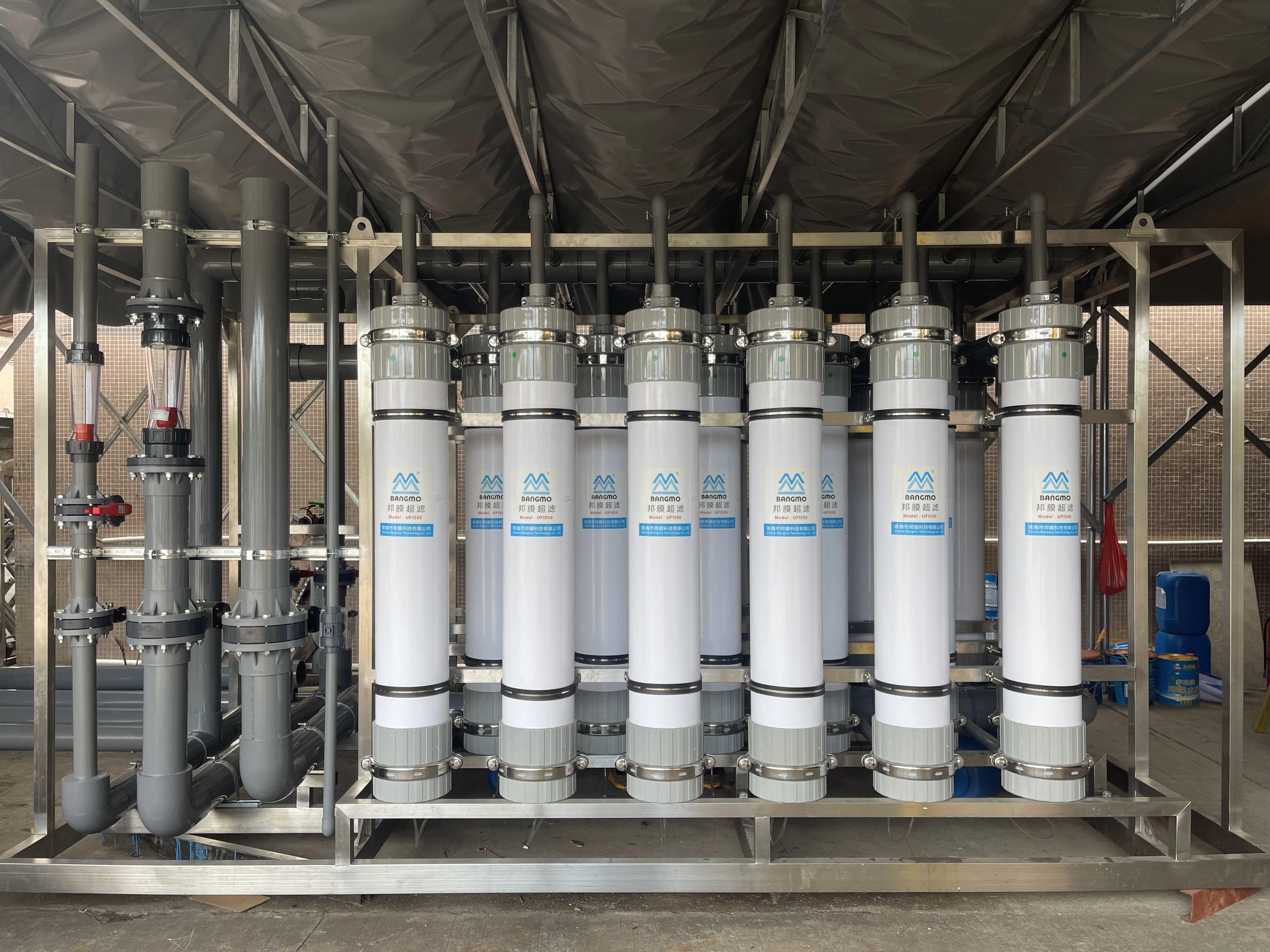
Ultrafiltration (UF) helps stabilize water quality by removing suspended solids and colloids before downstream treatment. A reliable system must also account for seasonal conditions, cleaning requirements and actual net water demand.
1. Match Treatment to the Required Water Quality
Industrial parks often serve users with different water requirements. Some need filtered utility water, while others require low-salinity or high-purity process water.
| Water requirement | Possible treatment approach |
|---|---|
| Filtered utility water | River-water pretreatment + UF, with additional conditioning where needed |
| Low-salinity process water | Pretreatment + UF + RO |
| High-purity process water | Pretreatment + UF + RO + suitable polishing, such as EDI |
UF removes particles, but generally does not remove dissolved salts or hardness. Its removal of dissolved organic substances is also limited and depends on their characteristics.
Clear UF filtrate is not automatically suitable for every industrial application. Final treatment should follow the required water specification.
2. Design for Seasonal River-Water Conditions
A single water sample may not represent the conditions the system will face throughout the year.
Before sizing the UF system, review:
-
• Normal and peak turbidity and suspended solids.
-
• Minimum and maximum water temperature.
-
• Seasonal algae and organic loading.
-
• pH, alkalinity, iron and manganese.
-
• TDS and ionic composition for downstream RO design.
-
• Source-specific risks, such as oil contamination.
Define both the raw-river-water conditions and the acceptable UF inlet conditions after upstream treatment. A membrane’s maximum feed limit does not guarantee continuous production at that limit.
Where water quality varies significantly, jar tests or pilot trials can help establish suitable treatment conditions.
3. Select the Right Treatment Before UF
Intake screening protects pumps and membranes from debris. Additional treatment depends on the type and amount of contamination.
| Source-water condition | Treatment to evaluate |
|---|---|
| Manageable suspended-solids loading | Screening followed by UF |
| Fine colloids or organic fouling | Coagulation based on testing |
| High or prolonged solids loading | Clarification or other solids separation |
| Significant algae loading | An algae-focused pretreatment strategy, potentially including flotation |
Coagulant type, dose, pH and mixing conditions should be established through testing. Poorly controlled dosing can increase membrane loading or leave unwanted residuals. DuPont’s UF guidance identifies feedwater characteristics as an important basis for coagulation design.
A typical process is:
River Intake → Screening → Required Pretreatment → UF → Filtrate Storage → Industrial Supply or RO
Each stage should address an identified water-quality requirement.
4. Size UF for Net Available Water
UF systems periodically stop filtering for backwashing and cleaning. They also consume some filtrate internally.
Therefore:
Net UF delivery = Compliant filtrate produced − Internal water consumption − Other applicable losses
Consider this illustrative example:
| Item | Value |
|---|---|
| Flow during filtration | 100 m³/h |
| Equivalent filtration time | 22 hours/day |
| Total filtrate produced | 2,200 m³/day |
| Internal filtrate consumption | 100 m³/day |
| Net available water | 2,100 m³/day |
| Average net delivery over 24 hours | 87.5 m³/h |
A nominal filtration rate of 100 m³/h does not provide continuous net delivery of 100 m³/h under these assumptions.
For downstream RO producing 60 m³/h at 75% recovery:
Required RO feed = 60 ÷ 0.75 = 80 m³/h
UF capacity must cover this demand and any other users supplied from the filtrate tank. Storage can bridge short interruptions, but cannot correct a persistent daily production deficit.
For more on defining usable output, see Rated Capacity vs Guaranteed Net Permeate: What RO Buyers Should Confirm.
5. Include Cleaning and Maintenance in the Design
Membrane area should be based on a sustainable operating flux under the project’s water-quality and temperature conditions.
Higher flux can reduce initial membrane quantity, but may increase fouling and cleaning demand.
The quotation should distinguish:
-
• Backwashing: Routine removal of accumulated solids.
-
• Chemically enhanced backwashing: Chemical assistance for routine fouling control.
-
• CIP: More intensive cleaning when routine methods are insufficient.
Cleaning chemicals and operating conditions must remain within the selected membrane’s limits.
Multiple trains allow cleaning to be staggered, but do not automatically provide full standby capacity. Confirm available net output with one train offline, including the effect of shared pumps, air supplies and chemical systems.
6. Protect Downstream RO and Monitor Performance
UF reduces particulate loading, but downstream RO still requires control of scaling chemistry, dissolved contaminants and oxidants.
Confirm RO inlet requirements for turbidity, SDI, residual oxidants, pressure and flow. Turbidity and SDI provide different information and should not be treated as interchangeable.
If oxidizing chemicals are used for UF cleaning, isolation and rinsing procedures must prevent harmful carryover to sensitive RO membranes.
UF also does not control seasonal salinity changes. These remain relevant to RO Pump and Membrane Selection Under Variable Feedwater TDS.
A practical monitoring plan should include:
| Measurement or check | Purpose |
|---|---|
| Feed and filtrate flow | Verify output and water balance |
| Relevant pressures and transmembrane pressure | Track filtration resistance |
| Temperature | Interpret permeability changes |
| Feed and filtrate turbidity | Detect source changes and abnormal filtrate quality |
| Tank levels | Coordinate filtration, backwashing and downstream demand |
| Membrane integrity testing | Check the membrane barrier using the specified procedure |
Each critical signal needs a defined response, such as an alarm, diversion or shutdown. This follows the control-planning principles described in Essential Online Instruments for Automatic Industrial RO Systems.
Backwash water and chemical-cleaning waste must also have suitable collection and handling arrangements.
7. What Buyers Should Confirm Before Ordering
Request a proposal that clearly states:
-
Raw-water design conditions and required UF inlet quality.
-
Membrane model, area and operating flux.
-
Guaranteed net delivery and filtrate-quality limits.
-
Backwash, chemical-cleaning and integrity-test procedures.
-
Available capacity during maintenance.
-
Utility consumption, waste volumes and supply scope.
-
Acceptance-test conditions and verification methods.
Compare suppliers using the same requirements. A lower price may reflect fewer included auxiliaries or more optimistic operating assumptions. For a broader procurement checklist, see How to Compare Industrial RO System Quotations.
Plan a Reliable River-Water UF System
A suitable UF system connects seasonal water conditions, effective pretreatment, sustainable membrane operation and the industrial park’s actual supply requirements.
Planning a project? Send Zhongnuo Water Treatment your seasonal water analyses, hourly and daily demand, intended uses, downstream treatment requirements and site conditions. Our engineering team can develop a coordinated UF pretreatment and industrial water-treatment proposal.
River water can supply large volumes of industrial water, but its quality changes with rainfall, algae growth and upstream activities. These changes can disrupt treatment and affect several factories sharing the same supply.
Ultrafiltration (UF) helps stabilize water quality by removing suspended solids and colloids before downstream treatment. A reliable system must also account for seasonal conditions, cleaning requirements and actual net water demand.
1. Match Treatment to the Required Water Quality
Industrial parks often serve users with different water requirements. Some need filtered utility water, while others require low-salinity or high-purity process water.
| Water requirement | Possible treatment approach |
|---|---|
| Filtered utility water | River-water pretreatment + UF, with additional conditioning where needed |
| Low-salinity process water | Pretreatment + UF + RO |
| High-purity process water | Pretreatment + UF + RO + suitable polishing, such as EDI |
UF removes particles, but generally does not remove dissolved salts or hardness. Its removal of dissolved organic substances is also limited and depends on their characteristics.
Clear UF filtrate is not automatically suitable for every industrial application. Final treatment should follow the required water specification.
2. Design for Seasonal River-Water Conditions
A single water sample may not represent the conditions the system will face throughout the year.
Before sizing the UF system, review:
-
• Normal and peak turbidity and suspended solids.
-
• Minimum and maximum water temperature.
-
• Seasonal algae and organic loading.
-
• pH, alkalinity, iron and manganese.
-
• TDS and ionic composition for downstream RO design.
-
• Source-specific risks, such as oil contamination.
Define both the raw-river-water conditions and the acceptable UF inlet conditions after upstream treatment. A membrane’s maximum feed limit does not guarantee continuous production at that limit.
Where water quality varies significantly, jar tests or pilot trials can help establish suitable treatment conditions.
3. Select the Right Treatment Before UF
Intake screening protects pumps and membranes from debris. Additional treatment depends on the type and amount of contamination.
| Source-water condition | Treatment to evaluate |
|---|---|
| Manageable suspended-solids loading | Screening followed by UF |
| Fine colloids or organic fouling | Coagulation based on testing |
| High or prolonged solids loading | Clarification or other solids separation |
| Significant algae loading | An algae-focused pretreatment strategy, potentially including flotation |
Coagulant type, dose, pH and mixing conditions should be established through testing. Poorly controlled dosing can increase membrane loading or leave unwanted residuals. DuPont’s UF guidance identifies feedwater characteristics as an important basis for coagulation design.
A typical process is:
River Intake → Screening → Required Pretreatment → UF → Filtrate Storage → Industrial Supply or RO
Each stage should address an identified water-quality requirement.
4. Size UF for Net Available Water
UF systems periodically stop filtering for backwashing and cleaning. They also consume some filtrate internally.
Therefore:
Net UF delivery = Compliant filtrate produced − Internal water consumption − Other applicable losses
Consider this illustrative example:
| Item | Value |
|---|---|
| Flow during filtration | 100 m³/h |
| Equivalent filtration time | 22 hours/day |
| Total filtrate produced | 2,200 m³/day |
| Internal filtrate consumption | 100 m³/day |
| Net available water | 2,100 m³/day |
| Average net delivery over 24 hours | 87.5 m³/h |
A nominal filtration rate of 100 m³/h does not provide continuous net delivery of 100 m³/h under these assumptions.
For downstream RO producing 60 m³/h at 75% recovery:
Required RO feed = 60 ÷ 0.75 = 80 m³/h
UF capacity must cover this demand and any other users supplied from the filtrate tank. Storage can bridge short interruptions, but cannot correct a persistent daily production deficit.
For more on defining usable output, see Rated Capacity vs Guaranteed Net Permeate: What RO Buyers Should Confirm.
5. Include Cleaning and Maintenance in the Design
Membrane area should be based on a sustainable operating flux under the project’s water-quality and temperature conditions.
Higher flux can reduce initial membrane quantity, but may increase fouling and cleaning demand.
The quotation should distinguish:
-
• Backwashing: Routine removal of accumulated solids.
-
• Chemically enhanced backwashing: Chemical assistance for routine fouling control.
-
• CIP: More intensive cleaning when routine methods are insufficient.
Cleaning chemicals and operating conditions must remain within the selected membrane’s limits.
Multiple trains allow cleaning to be staggered, but do not automatically provide full standby capacity. Confirm available net output with one train offline, including the effect of shared pumps, air supplies and chemical systems.
6. Protect Downstream RO and Monitor Performance
UF reduces particulate loading, but downstream RO still requires control of scaling chemistry, dissolved contaminants and oxidants.
Confirm RO inlet requirements for turbidity, SDI, residual oxidants, pressure and flow. Turbidity and SDI provide different information and should not be treated as interchangeable.
If oxidizing chemicals are used for UF cleaning, isolation and rinsing procedures must prevent harmful carryover to sensitive RO membranes.
UF also does not control seasonal salinity changes. These remain relevant to RO Pump and Membrane Selection Under Variable Feedwater TDS.
A practical monitoring plan should include:
| Measurement or check | Purpose |
|---|---|
| Feed and filtrate flow | Verify output and water balance |
| Relevant pressures and transmembrane pressure | Track filtration resistance |
| Temperature | Interpret permeability changes |
| Feed and filtrate turbidity | Detect source changes and abnormal filtrate quality |
| Tank levels | Coordinate filtration, backwashing and downstream demand |
| Membrane integrity testing | Check the membrane barrier using the specified procedure |
Each critical signal needs a defined response, such as an alarm, diversion or shutdown. This follows the control-planning principles described in Essential Online Instruments for Automatic Industrial RO Systems.
Backwash water and chemical-cleaning waste must also have suitable collection and handling arrangements.
7. What Buyers Should Confirm Before Ordering
Request a proposal that clearly states:
-
Raw-water design conditions and required UF inlet quality.
-
Membrane model, area and operating flux.
-
Guaranteed net delivery and filtrate-quality limits.
-
Backwash, chemical-cleaning and integrity-test procedures.
-
Available capacity during maintenance.
-
Utility consumption, waste volumes and supply scope.
-
Acceptance-test conditions and verification methods.
Compare suppliers using the same requirements. A lower price may reflect fewer included auxiliaries or more optimistic operating assumptions. For a broader procurement checklist, see How to Compare Industrial RO System Quotations.
Plan a Reliable River-Water UF System
A suitable UF system connects seasonal water conditions, effective pretreatment, sustainable membrane operation and the industrial park’s actual supply requirements.
Planning a project? Send Zhongnuo Water Treatment your seasonal water analyses, hourly and daily demand, intended uses, downstream treatment requirements and site conditions. Our engineering team can develop a coordinated UF pretreatment and industrial water-treatment proposal.
Previous: No more data
Get a Quote for Free
Submit this form and our sales representative will contact you soon.


ONLINE MESSAGE
Copyright © 2026 Zhongnuo Water Treatment Co., Ltd.