

SEARCH WHAT YOU WANT
Signs Your RO Membrane Needs Replacement: A Complete Guide
Time:2026-07-30
Reverse osmosis membranes are the core separation components of an industrial RO water treatment system. They remove dissolved salts, heavy metals, minerals, and many other contaminants from feedwater to produce purified water for industrial processes, drinking water, food and beverage production, pharmaceutical manufacturing, electronics, boiler feedwater, and other applications.
Like all filtration components, RO membranes gradually lose performance. However, reduced system output does not always mean that the membranes must be replaced immediately. Low permeate flow, high conductivity, or increased pressure may also be caused by clogged cartridge filters, incorrect valve settings, low feedwater temperature, pump problems, membrane fouling, or inadequate pretreatment.
Replacing membranes too early increases operating costs. Replacing them too late can reduce water quality, increase energy consumption, interrupt production, and damage other system components.
This guide explains the most common signs of RO membrane failure, how to distinguish a membrane problem from other system faults, and when cleaning is no longer sufficient.
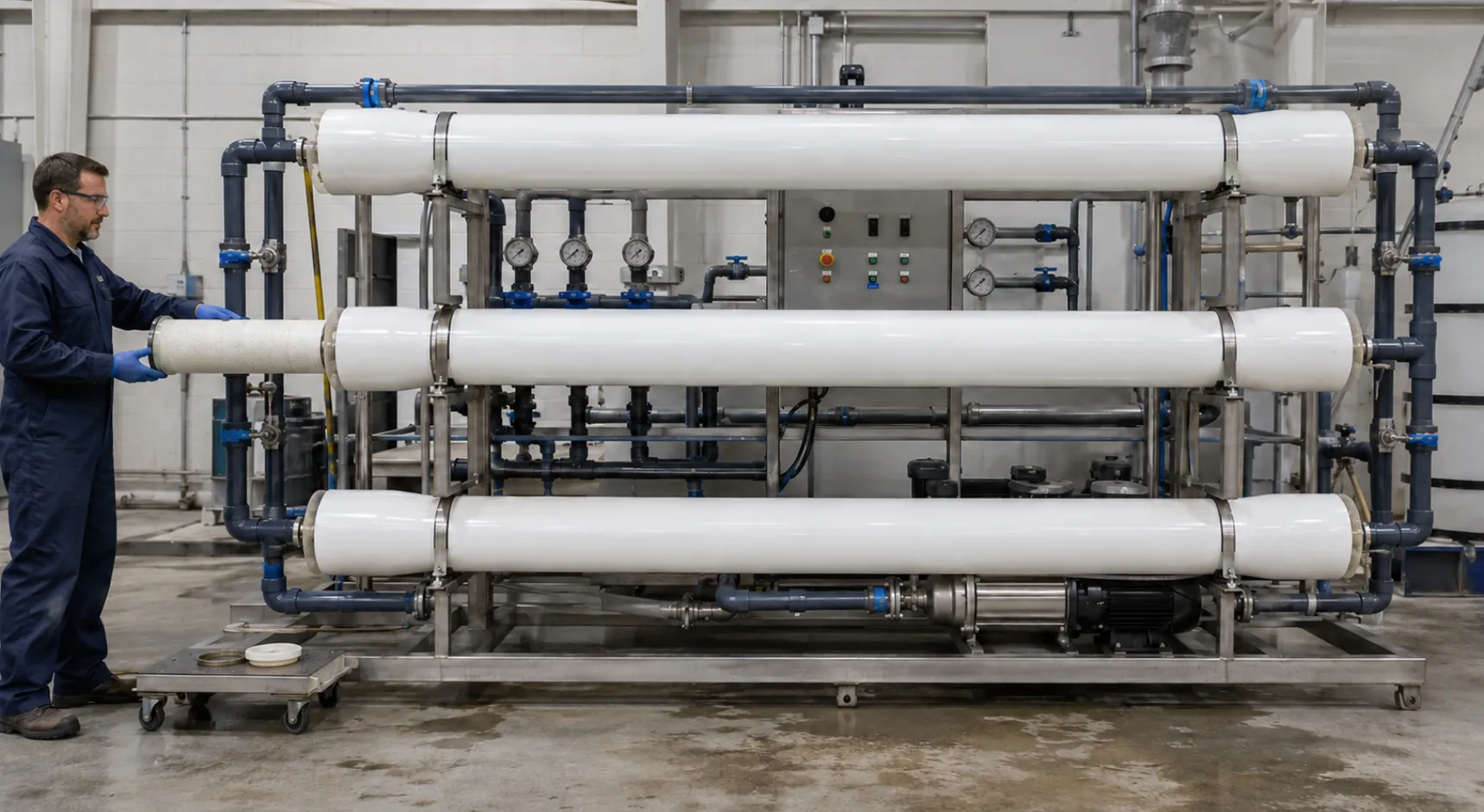
How Long Do Industrial RO Membranes Last?
Under suitable operating conditions, industrial RO membranes commonly operate for approximately three to five years. However, membrane life varies considerably from one system to another.
Some membranes may require replacement earlier because of poor feedwater quality, oxidation, severe scaling, frequent shutdowns, or improper cleaning. Other membranes may remain effective for longer when the system has reliable pretreatment and is operated within the membrane manufacturer’s recommended limits.
The actual RO membrane lifespan depends on:
- Feedwater quality
- Pretreatment efficiency
- Operating pressure
- System recovery rate
- Feedwater temperature
- Membrane cleaning frequency
- Exposure to chlorine and oxidants
- Frequency of system shutdowns
- Biological contamination
- Operator maintenance practices
- Product-water quality requirements
Membrane age alone should not be used as the only replacement criterion. The decision should be based primarily on normalized performance data and whether cleaning can restore acceptable operation.
1. The Product-Water Conductivity Keeps Increasing
One of the most important signs of deteriorating RO membrane performance is a continuous increase in permeate conductivity.
Conductivity indicates the amount of dissolved ionic material present in the water. When an RO membrane loses its ability to reject salts, more dissolved ions pass through the membrane and enter the purified-water stream.
Possible causes of rising permeate conductivity include:
- Membrane oxidation
- Mechanical membrane damage
- Damaged O-rings or interconnectors
- Incorrectly installed membrane elements
- Membrane telescoping
- Excessive feedwater pressure
- Chemical attack
- Normal membrane aging
- A sudden change in feedwater TDS
A higher permeate conductivity does not automatically prove membrane failure. Feedwater conductivity, water temperature, operating pressure, recovery rate, and permeate flow should be checked at the same time.
If the feedwater TDS increases, the permeate conductivity may also increase even when the membrane is operating normally. For this reason, operators should compare normalized salt passage or salt rejection rather than relying only on a single conductivity reading.
2. Salt Rejection Has Dropped Significantly
Salt rejection is one of the clearest indicators of an RO membrane’s separation performance.
It can be calculated using the following formula:

For example, if the feedwater conductivity is 1,000 μS/cm and the permeate conductivity is 20 μS/cm:

A gradual reduction in salt rejection may indicate membrane aging or fouling. A sudden reduction may indicate oxidation damage, mechanical failure, leakage around membrane seals, or incorrect membrane installation.
DuPont’s current FilmTec technical guidance recommends considering membrane cleaning when normalized salt passage increases by approximately 5%–10%, rather than waiting for a much larger performance loss.DuPont FilmTec RO Membranes Technical Manual
If salt rejection remains below the required level after correct cleaning and mechanical inspection, membrane replacement may be necessary.
3. Permeate Flow Continues to Decrease
A reduction in purified-water output is another common warning sign. Fouling or scaling blocks the membrane surface and makes it more difficult for water to pass through.
Possible causes include:
- Calcium carbonate scaling
- Calcium sulfate scaling
- Silica deposits
- Iron and manganese fouling
- Suspended solids
- Organic matter
- Biological fouling
- Oil or hydrocarbon contamination
- Membrane compaction
DuPont recommends initiating cleaning when normalized permeate flow decreases by approximately 10% from the established baseline. Waiting too long can make it more difficult to restore membrane performance successfully.DuPont FilmTec RO Membranes Technical Manual
However, raw flow readings can be misleading. Permeate output naturally changes with:
- Feedwater temperature
- Feedwater pressure
- Feedwater salinity
- Recovery rate
- Permeate backpressure
Cold water, for example, passes through the membrane more slowly. A lower winter flow rate does not necessarily mean the membranes have failed.
Operators should therefore compare normalized permeate flow under equivalent operating conditions.
If cleaning restores the flow close to the original baseline, replacement may not be necessary. If the normalized flow remains low after proper cleaning, the membrane may be irreversibly fouled, compacted, or damaged.
4. Operating Pressure Keeps Increasing
When membrane permeability decreases, the high-pressure pump must work harder to maintain the required permeate production.
A gradual increase in feed pressure may indicate:
- Membrane scaling
- Organic fouling
- Colloidal fouling
- Membrane compaction
- Blocked feed channels
- Insufficient pretreatment
Higher operating pressure leads to:
- Increased electricity consumption
- Greater pump load
- Higher operating costs
- Increased risk of membrane damage
- Reduced system efficiency
Before replacing the membranes, operators should check the cartridge filters, valves, pressure gauges, high-pressure pump, feedwater temperature, and pretreatment system.
If the pressure remains significantly higher than the original normalized baseline after cleaning and system inspection, membrane replacement may be more economical than continuing to operate at excessive pressure.
5. Differential Pressure Has Increased
Differential pressure is the difference between the feed pressure and concentrate pressure across an RO stage or membrane vessel.
An increasing differential pressure normally indicates that feed channels are becoming restricted by deposits.
Common causes include:
- Suspended solids
- Biological growth
- Iron deposits
- Organic fouling
- Scale formation
- Debris from damaged cartridge filters
Current DuPont guidance recommends cleaning when normalized pressure drop increases by approximately 10%–15%. DuPont also warns that excessive pressure drop across a stage can result in significant membrane damage.DuPont FilmTec Cleaning Procedures
A high differential pressure does not always mean that the membrane separation layer has failed. It often indicates fouling inside the feed spacer.
Early cleaning may restore normal flow. If the feed channel remains blocked after professional cleaning, the membrane element may be permanently damaged and require replacement.
6. Chemical Cleaning No Longer Restores Performance
Chemical cleaning is intended to remove deposits from membrane surfaces and feed channels. A successful cleaning should restore a meaningful portion of the lost normalized flow, pressure drop, and salt rejection.
Membrane replacement should be considered when:
- Permeate flow remains low after cleaning
- Differential pressure remains high
- Salt rejection does not improve
- Product-water conductivity remains unacceptable
- Cleaning results last only a very short time
- Cleaning frequency continues to increase
- Multiple cleaning procedures produce little improvement
Repeated chemical cleaning cannot repair a membrane that has been oxidized, physically damaged, compacted, or irreversibly contaminated.
If cleaning is required increasingly often, the underlying cause should also be investigated. Possible problems include inadequate pretreatment, incorrect chemical dosing, excessive recovery, poor microbial control, high SDI, chlorine exposure, or unsuitable operating conditions.
Simply installing new membranes without correcting the root cause may lead to another premature failure.
7. Product Water No Longer Meets the Required Standard
The acceptable product-water quality depends on its final application.
Examples include:
- Bottled drinking water
- Food and beverage production
- Pharmaceutical manufacturing
- Semiconductor production
- Laboratory water
- Boiler feedwater
- Cooling tower makeup
- Chemical production
- Battery manufacturing
- EDI pretreatment
A membrane may still produce water, but its performance may no longer satisfy the required conductivity, TDS, silica, hardness, or contaminant limits.
For example, an RO system used as pretreatment for EDI must provide more stable and higher-quality water than a system used for general equipment washing.
If product-water quality exceeds the acceptable specification, operators should first inspect:
- Feedwater quality
- Conductivity meter calibration
- System recovery
- Membrane seals and connectors
- Permeate sampling points
- Chemical dosing
- Operating pressure
- Membrane cleaning history
If these factors are normal and the membranes cannot achieve the required rejection rate, replacement may be necessary.
8. Membrane Cleaning Is Required More Frequently
A membrane system that once operated for several months between cleanings may gradually require cleaning every few weeks.
Shortening cleaning intervals may indicate:
- Irreversible membrane fouling
- Poor pretreatment performance
- Biological contamination
- Increased feedwater turbidity
- High scaling potential
- Damaged membrane surfaces
- Incorrect antiscalant dosing
- Excessive system recovery
Increasing the cleaning frequency raises chemical consumption, labor costs, wastewater generation, and production downtime.
When the cost and frequency of cleaning become excessive, replacing the membranes may be more economical. However, the pretreatment and operating conditions should be corrected before installing new elements.
9. Membranes Have Been Exposed to Chlorine
Most commonly used polyamide thin-film composite RO membranes have very limited tolerance to free chlorine.
Chlorine oxidizes the membrane’s selective layer. This may initially appear to improve water flow, but it also allows more dissolved salts to pass through.
Typical signs of chlorine damage include:
- A sudden increase in permeate conductivity
- Reduced salt rejection
- Higher-than-normal permeate flow
- Failure to recover performance after cleaning
- Continued deterioration over time
Oxidation damage is generally irreversible. Chemical cleaning cannot rebuild the damaged polyamide layer.
Potential chlorine exposure may result from:
- Activated carbon filter failure
- Incorrect sodium metabisulfite dosing
- Empty chemical tanks
- Dosing pump failure
- Poor chemical mixing
- Operator error
- Sudden municipal chlorine changes
If chlorine damage is confirmed, the affected membranes usually require replacement. The dechlorination system must also be repaired before installing new elements.
10. The Membrane Has Suffered Physical Damage
RO membrane elements can be damaged by incorrect installation or operation.
Physical damage may include:
- Torn membrane leaves
- Broken fiberglass shells
- Damaged brine seals
- Damaged O-rings
- Membrane telescoping
- Cracked connectors
- Excessive backpressure
- Hydraulic shock
- Incorrect pressure-vessel loading
A rapid increase in permeate conductivity across a specific pressure vessel may indicate mechanical leakage rather than general membrane aging.
Useful diagnostic methods include:
- Vessel-by-vessel conductivity testing
- Permeate probing
- Vacuum testing
- Inspection of O-rings and connectors
- Visual inspection of removed elements
- Pressure-vessel examination
Sometimes only one membrane element or sealing component is defective. Testing the system by stage and pressure vessel can prevent unnecessary replacement of all membranes.
11. Energy Consumption Has Increased
An older or heavily fouled membrane system may require more pressure and electricity to produce the same quantity of purified water.
Increased energy consumption may be caused by:
- Reduced membrane permeability
- Membrane scaling
- Organic fouling
- Feed-channel blockage
- Excessive recovery
- High feedwater salinity
- Low feedwater temperature
- Pump wear
Operators should compare energy consumption per cubic meter of permeate rather than only checking the total electricity bill.
If membrane cleaning does not reduce the normalized operating pressure and energy use, replacement may offer a better long-term return than continuing to operate inefficient membranes.
Membrane Fouling or Permanent Failure?
It is important to distinguish between a membrane that needs cleaning and one that needs replacement.
| Performance condition | Cleaning may help | Replacement may be required |
|---|---|---|
| Moderate flow reduction | Yes | If cleaning fails |
| Moderate differential-pressure increase | Yes | If blockage is irreversible |
| Mineral scaling | Often | If severe or permanent |
| Organic fouling | Often | If contaminants cannot be removed |
| Biological fouling | Often | If biofilm repeatedly returns |
| Chlorine oxidation | No | Yes |
| Mechanical damage | No | Yes |
| Damaged O-rings | Not applicable | Replace seals first |
| Membrane compaction | Usually no | Yes |
| Increasing salt passage | Sometimes | If rejection cannot be restored |
| Age alone | Not necessarily | Only when performance is unacceptable |
RO Membrane Troubleshooting Checklist
Before deciding to replace the membranes, perform the following checks.
Step 1: Verify the Instruments
Confirm that the following instruments are calibrated and working correctly:
- Conductivity meters
- Pressure gauges
- Flow meters
- pH instruments
- ORP meters
- Temperature sensors
Incorrect instrument readings can lead to a false diagnosis.
Step 2: Check Feedwater Conditions
Compare current feedwater data with the original design values:
- TDS or conductivity
- Temperature
- pH
- Hardness
- Turbidity
- SDI
- Iron and manganese
- Silica
- Chlorine
- Microbiological activity
Changes in feedwater quality can affect system performance even when the membranes are still functional.
Step 3: Inspect the Pretreatment System
Check:
- Multimedia filter backwashing
- Activated carbon performance
- Water-softener regeneration
- Antiscalant dosing
- Sodium metabisulfite dosing
- Cartridge-filter condition
- Ultrafiltration performance
- Chemical tank levels
Poor pretreatment is one of the most common causes of premature RO membrane failure.
Step 4: Normalize the Operating Data
Raw operating data should be normalized for changes in:
- Temperature
- Feedwater salinity
- Pressure
- Recovery rate
- Permeate backpressure
Normalized data provides a more accurate comparison with startup performance.
Step 5: Perform a Suitable Chemical Cleaning
The cleaning procedure should match the suspected foulant.
- Acidic cleaning is commonly used for mineral scale and metal deposits.
- Alkaline cleaning is commonly used for organic and biological fouling.
- Specialized chemicals may be needed for silica, oil, or difficult deposits.
Follow the membrane manufacturer’s instructions regarding chemical type, concentration, temperature, pH, flow rate, and contact time.
Step 6: Evaluate Post-Cleaning Performance
After cleaning, compare:
- Normalized permeate flow
- Normalized salt passage
- Normalized pressure drop
- Required operating pressure
- Product-water quality
If performance remains outside the acceptable range, membrane replacement should be considered.
Should You Replace All RO Membranes at Once?
Not every system requires complete membrane replacement.
Depending on the system condition, replacement strategies may include:
- Replacing one damaged element
- Replacing membranes in one pressure vessel
- Replacing only the first-stage membranes
- Replacing only the final-stage membranes
- Replacing all membranes in the RO train
Partial replacement may reduce immediate costs, but mixing old and new membrane elements can create performance imbalances.
Before partial replacement, engineers should evaluate:
- Membrane model compatibility
- Permeate flow differences
- Salt rejection differences
- Pressure distribution
- Stage configuration
- Remaining life of older membranes
For small systems or systems with widespread deterioration, replacing the complete membrane set is often simpler and more reliable.
How to Extend RO Membrane Life
The following practices can reduce membrane replacement frequency:
- Conduct a complete feedwater analysis before system design.
- Use properly designed pretreatment.
- Maintain a low and stable SDI.
- Prevent free chlorine from reaching polyamide membranes.
- Use the correct antiscalant dosage.
- Avoid operating above the designed recovery rate.
- Record daily operating data.
- Normalize membrane performance.
- Clean membranes before fouling becomes severe.
- Flush the system during shutdown.
- Prevent stagnant water and microbial growth.
- Follow the correct startup and shutdown sequence.
- Replace cartridge filters on time.
- Investigate every sudden performance change.
DuPont recommends flushing RO systems during shutdown to remove concentrated salts, preferably using permeate water or otherwise high-quality feedwater.DuPont RO and NF System Shutdown Guidance
When Should an RO Membrane Be Replaced?
RO membrane replacement is generally justified when one or more of the following conditions apply:
- Product-water quality no longer meets requirements
- Normalized salt passage remains too high
- Permeate flow cannot be restored by cleaning
- Operating pressure remains excessively high
- Differential pressure remains unacceptable
- Membranes require increasingly frequent cleaning
- Chlorine oxidation has occurred
- Membranes are physically damaged
- Energy and maintenance costs have become uneconomical
- The process cannot maintain reliable production
The final decision should consider both technical performance and total operating cost.
Frequently Asked Questions
How do I know if my RO membrane is bad?
Common warning signs include increasing permeate conductivity, decreasing salt rejection, reduced normalized permeate flow, higher operating pressure, increased differential pressure, and poor performance after chemical cleaning.
Can a dirty RO membrane be restored?
Many scaling, organic fouling, and biological fouling problems can be improved through proper chemical cleaning. However, oxidation, compaction, severe irreversible fouling, and physical damage usually cannot be repaired.
Does low RO water flow always mean membrane replacement?
No. Low flow may also be caused by cold feedwater, low pressure, clogged cartridge filters, closed valves, pump problems, high feedwater TDS, or incorrect instrument readings.
Can chlorine-damaged RO membranes be cleaned?
No. Chlorine oxidation damages the membrane’s selective polyamide layer. Cleaning may remove deposits but cannot restore the oxidized membrane structure.
Should all RO membranes be replaced together?
Not always. Individual elements or pressure vessels may be replaced when the problem is localized. However, compatibility and performance differences between old and new membranes must be evaluated.
What happens if RO membranes are not replaced on time?
Delayed replacement may cause poor product-water quality, increased electricity consumption, lower production capacity, frequent shutdowns, higher cleaning costs, and potential disruption to downstream processes.
How often should RO membrane performance be recorded?
Important operating parameters should be recorded daily whenever possible. Regular data collection makes it easier to identify gradual performance changes and determine the correct cleaning or replacement time.
Conclusion
RO membrane replacement should be based on performance data, not membrane age alone.
Increasing permeate conductivity, declining salt rejection, reduced normalized flow, higher pressure, rising differential pressure, and poor recovery after cleaning are the most important warning signs.
Before replacing the membranes, operators should verify the instruments, analyze feedwater changes, inspect pretreatment, normalize operating data, and conduct an appropriate chemical cleaning.
If the membranes cannot achieve the required water quality or production capacity after these steps, replacement is likely the most reliable and cost-effective solution.
Call to Action
Are you experiencing reduced RO system output or unstable product-water quality?
Zhongnuo Water Treatment manufactures industrial reverse osmosis systems, ultrafiltration systems, ultrapure water equipment, water softeners, brackish water desalination systems, seawater desalination systems, and containerized RO systems.
Send us the following information for technical evaluation:
- Feedwater analysis
- Feed and permeate conductivity
- Current permeate flow
- Feed and concentrate pressure
- Membrane model and quantity
- Membrane operating time
- Cleaning history
- Required product-water quality
Our engineering team can help you determine whether the problem is caused by membrane fouling, system operation, pretreatment failure, or permanent membrane damage.
Contact Zhongnuo Water Treatment for an industrial RO system assessment and customized water treatment solution.
Reverse osmosis membranes are the core separation components of an industrial RO water treatment system. They remove dissolved salts, heavy metals, minerals, and many other contaminants from feedwater to produce purified water for industrial processes, drinking water, food and beverage production, pharmaceutical manufacturing, electronics, boiler feedwater, and other applications.
Like all filtration components, RO membranes gradually lose performance. However, reduced system output does not always mean that the membranes must be replaced immediately. Low permeate flow, high conductivity, or increased pressure may also be caused by clogged cartridge filters, incorrect valve settings, low feedwater temperature, pump problems, membrane fouling, or inadequate pretreatment.
Replacing membranes too early increases operating costs. Replacing them too late can reduce water quality, increase energy consumption, interrupt production, and damage other system components.
This guide explains the most common signs of RO membrane failure, how to distinguish a membrane problem from other system faults, and when cleaning is no longer sufficient.
How Long Do Industrial RO Membranes Last?
Under suitable operating conditions, industrial RO membranes commonly operate for approximately three to five years. However, membrane life varies considerably from one system to another.
Some membranes may require replacement earlier because of poor feedwater quality, oxidation, severe scaling, frequent shutdowns, or improper cleaning. Other membranes may remain effective for longer when the system has reliable pretreatment and is operated within the membrane manufacturer’s recommended limits.
The actual RO membrane lifespan depends on:
- Feedwater quality
- Pretreatment efficiency
- Operating pressure
- System recovery rate
- Feedwater temperature
- Membrane cleaning frequency
- Exposure to chlorine and oxidants
- Frequency of system shutdowns
- Biological contamination
- Operator maintenance practices
- Product-water quality requirements
Membrane age alone should not be used as the only replacement criterion. The decision should be based primarily on normalized performance data and whether cleaning can restore acceptable operation.
1. The Product-Water Conductivity Keeps Increasing
One of the most important signs of deteriorating RO membrane performance is a continuous increase in permeate conductivity.
Conductivity indicates the amount of dissolved ionic material present in the water. When an RO membrane loses its ability to reject salts, more dissolved ions pass through the membrane and enter the purified-water stream.
Possible causes of rising permeate conductivity include:
- Membrane oxidation
- Mechanical membrane damage
- Damaged O-rings or interconnectors
- Incorrectly installed membrane elements
- Membrane telescoping
- Excessive feedwater pressure
- Chemical attack
- Normal membrane aging
- A sudden change in feedwater TDS
A higher permeate conductivity does not automatically prove membrane failure. Feedwater conductivity, water temperature, operating pressure, recovery rate, and permeate flow should be checked at the same time.
If the feedwater TDS increases, the permeate conductivity may also increase even when the membrane is operating normally. For this reason, operators should compare normalized salt passage or salt rejection rather than relying only on a single conductivity reading.
2. Salt Rejection Has Dropped Significantly
Salt rejection is one of the clearest indicators of an RO membrane’s separation performance.
It can be calculated using the following formula:
For example, if the feedwater conductivity is 1,000 μS/cm and the permeate conductivity is 20 μS/cm:
A gradual reduction in salt rejection may indicate membrane aging or fouling. A sudden reduction may indicate oxidation damage, mechanical failure, leakage around membrane seals, or incorrect membrane installation.
DuPont’s current FilmTec technical guidance recommends considering membrane cleaning when normalized salt passage increases by approximately 5%–10%, rather than waiting for a much larger performance loss.DuPont FilmTec RO Membranes Technical Manual
If salt rejection remains below the required level after correct cleaning and mechanical inspection, membrane replacement may be necessary.
3. Permeate Flow Continues to Decrease
A reduction in purified-water output is another common warning sign. Fouling or scaling blocks the membrane surface and makes it more difficult for water to pass through.
Possible causes include:
- Calcium carbonate scaling
- Calcium sulfate scaling
- Silica deposits
- Iron and manganese fouling
- Suspended solids
- Organic matter
- Biological fouling
- Oil or hydrocarbon contamination
- Membrane compaction
DuPont recommends initiating cleaning when normalized permeate flow decreases by approximately 10% from the established baseline. Waiting too long can make it more difficult to restore membrane performance successfully.DuPont FilmTec RO Membranes Technical Manual
However, raw flow readings can be misleading. Permeate output naturally changes with:
- Feedwater temperature
- Feedwater pressure
- Feedwater salinity
- Recovery rate
- Permeate backpressure
Cold water, for example, passes through the membrane more slowly. A lower winter flow rate does not necessarily mean the membranes have failed.
Operators should therefore compare normalized permeate flow under equivalent operating conditions.
If cleaning restores the flow close to the original baseline, replacement may not be necessary. If the normalized flow remains low after proper cleaning, the membrane may be irreversibly fouled, compacted, or damaged.
4. Operating Pressure Keeps Increasing
When membrane permeability decreases, the high-pressure pump must work harder to maintain the required permeate production.
A gradual increase in feed pressure may indicate:
- Membrane scaling
- Organic fouling
- Colloidal fouling
- Membrane compaction
- Blocked feed channels
- Insufficient pretreatment
Higher operating pressure leads to:
- Increased electricity consumption
- Greater pump load
- Higher operating costs
- Increased risk of membrane damage
- Reduced system efficiency
Before replacing the membranes, operators should check the cartridge filters, valves, pressure gauges, high-pressure pump, feedwater temperature, and pretreatment system.
If the pressure remains significantly higher than the original normalized baseline after cleaning and system inspection, membrane replacement may be more economical than continuing to operate at excessive pressure.
5. Differential Pressure Has Increased
Differential pressure is the difference between the feed pressure and concentrate pressure across an RO stage or membrane vessel.
An increasing differential pressure normally indicates that feed channels are becoming restricted by deposits.
Common causes include:
- Suspended solids
- Biological growth
- Iron deposits
- Organic fouling
- Scale formation
- Debris from damaged cartridge filters
Current DuPont guidance recommends cleaning when normalized pressure drop increases by approximately 10%–15%. DuPont also warns that excessive pressure drop across a stage can result in significant membrane damage.DuPont FilmTec Cleaning Procedures
A high differential pressure does not always mean that the membrane separation layer has failed. It often indicates fouling inside the feed spacer.
Early cleaning may restore normal flow. If the feed channel remains blocked after professional cleaning, the membrane element may be permanently damaged and require replacement.
6. Chemical Cleaning No Longer Restores Performance
Chemical cleaning is intended to remove deposits from membrane surfaces and feed channels. A successful cleaning should restore a meaningful portion of the lost normalized flow, pressure drop, and salt rejection.
Membrane replacement should be considered when:
- Permeate flow remains low after cleaning
- Differential pressure remains high
- Salt rejection does not improve
- Product-water conductivity remains unacceptable
- Cleaning results last only a very short time
- Cleaning frequency continues to increase
- Multiple cleaning procedures produce little improvement
Repeated chemical cleaning cannot repair a membrane that has been oxidized, physically damaged, compacted, or irreversibly contaminated.
If cleaning is required increasingly often, the underlying cause should also be investigated. Possible problems include inadequate pretreatment, incorrect chemical dosing, excessive recovery, poor microbial control, high SDI, chlorine exposure, or unsuitable operating conditions.
Simply installing new membranes without correcting the root cause may lead to another premature failure.
7. Product Water No Longer Meets the Required Standard
The acceptable product-water quality depends on its final application.
Examples include:
- Bottled drinking water
- Food and beverage production
- Pharmaceutical manufacturing
- Semiconductor production
- Laboratory water
- Boiler feedwater
- Cooling tower makeup
- Chemical production
- Battery manufacturing
- EDI pretreatment
A membrane may still produce water, but its performance may no longer satisfy the required conductivity, TDS, silica, hardness, or contaminant limits.
For example, an RO system used as pretreatment for EDI must provide more stable and higher-quality water than a system used for general equipment washing.
If product-water quality exceeds the acceptable specification, operators should first inspect:
- Feedwater quality
- Conductivity meter calibration
- System recovery
- Membrane seals and connectors
- Permeate sampling points
- Chemical dosing
- Operating pressure
- Membrane cleaning history
If these factors are normal and the membranes cannot achieve the required rejection rate, replacement may be necessary.
8. Membrane Cleaning Is Required More Frequently
A membrane system that once operated for several months between cleanings may gradually require cleaning every few weeks.
Shortening cleaning intervals may indicate:
- Irreversible membrane fouling
- Poor pretreatment performance
- Biological contamination
- Increased feedwater turbidity
- High scaling potential
- Damaged membrane surfaces
- Incorrect antiscalant dosing
- Excessive system recovery
Increasing the cleaning frequency raises chemical consumption, labor costs, wastewater generation, and production downtime.
When the cost and frequency of cleaning become excessive, replacing the membranes may be more economical. However, the pretreatment and operating conditions should be corrected before installing new elements.
9. Membranes Have Been Exposed to Chlorine
Most commonly used polyamide thin-film composite RO membranes have very limited tolerance to free chlorine.
Chlorine oxidizes the membrane’s selective layer. This may initially appear to improve water flow, but it also allows more dissolved salts to pass through.
Typical signs of chlorine damage include:
- A sudden increase in permeate conductivity
- Reduced salt rejection
- Higher-than-normal permeate flow
- Failure to recover performance after cleaning
- Continued deterioration over time
Oxidation damage is generally irreversible. Chemical cleaning cannot rebuild the damaged polyamide layer.
Potential chlorine exposure may result from:
- Activated carbon filter failure
- Incorrect sodium metabisulfite dosing
- Empty chemical tanks
- Dosing pump failure
- Poor chemical mixing
- Operator error
- Sudden municipal chlorine changes
If chlorine damage is confirmed, the affected membranes usually require replacement. The dechlorination system must also be repaired before installing new elements.
10. The Membrane Has Suffered Physical Damage
RO membrane elements can be damaged by incorrect installation or operation.
Physical damage may include:
- Torn membrane leaves
- Broken fiberglass shells
- Damaged brine seals
- Damaged O-rings
- Membrane telescoping
- Cracked connectors
- Excessive backpressure
- Hydraulic shock
- Incorrect pressure-vessel loading
A rapid increase in permeate conductivity across a specific pressure vessel may indicate mechanical leakage rather than general membrane aging.
Useful diagnostic methods include:
- Vessel-by-vessel conductivity testing
- Permeate probing
- Vacuum testing
- Inspection of O-rings and connectors
- Visual inspection of removed elements
- Pressure-vessel examination
Sometimes only one membrane element or sealing component is defective. Testing the system by stage and pressure vessel can prevent unnecessary replacement of all membranes.
11. Energy Consumption Has Increased
An older or heavily fouled membrane system may require more pressure and electricity to produce the same quantity of purified water.
Increased energy consumption may be caused by:
- Reduced membrane permeability
- Membrane scaling
- Organic fouling
- Feed-channel blockage
- Excessive recovery
- High feedwater salinity
- Low feedwater temperature
- Pump wear
Operators should compare energy consumption per cubic meter of permeate rather than only checking the total electricity bill.
If membrane cleaning does not reduce the normalized operating pressure and energy use, replacement may offer a better long-term return than continuing to operate inefficient membranes.
Membrane Fouling or Permanent Failure?
It is important to distinguish between a membrane that needs cleaning and one that needs replacement.
| Performance condition | Cleaning may help | Replacement may be required |
|---|---|---|
| Moderate flow reduction | Yes | If cleaning fails |
| Moderate differential-pressure increase | Yes | If blockage is irreversible |
| Mineral scaling | Often | If severe or permanent |
| Organic fouling | Often | If contaminants cannot be removed |
| Biological fouling | Often | If biofilm repeatedly returns |
| Chlorine oxidation | No | Yes |
| Mechanical damage | No | Yes |
| Damaged O-rings | Not applicable | Replace seals first |
| Membrane compaction | Usually no | Yes |
| Increasing salt passage | Sometimes | If rejection cannot be restored |
| Age alone | Not necessarily | Only when performance is unacceptable |
RO Membrane Troubleshooting Checklist
Before deciding to replace the membranes, perform the following checks.
Step 1: Verify the Instruments
Confirm that the following instruments are calibrated and working correctly:
- Conductivity meters
- Pressure gauges
- Flow meters
- pH instruments
- ORP meters
- Temperature sensors
Incorrect instrument readings can lead to a false diagnosis.
Step 2: Check Feedwater Conditions
Compare current feedwater data with the original design values:
- TDS or conductivity
- Temperature
- pH
- Hardness
- Turbidity
- SDI
- Iron and manganese
- Silica
- Chlorine
- Microbiological activity
Changes in feedwater quality can affect system performance even when the membranes are still functional.
Step 3: Inspect the Pretreatment System
Check:
- Multimedia filter backwashing
- Activated carbon performance
- Water-softener regeneration
- Antiscalant dosing
- Sodium metabisulfite dosing
- Cartridge-filter condition
- Ultrafiltration performance
- Chemical tank levels
Poor pretreatment is one of the most common causes of premature RO membrane failure.
Step 4: Normalize the Operating Data
Raw operating data should be normalized for changes in:
- Temperature
- Feedwater salinity
- Pressure
- Recovery rate
- Permeate backpressure
Normalized data provides a more accurate comparison with startup performance.
Step 5: Perform a Suitable Chemical Cleaning
The cleaning procedure should match the suspected foulant.
- Acidic cleaning is commonly used for mineral scale and metal deposits.
- Alkaline cleaning is commonly used for organic and biological fouling.
- Specialized chemicals may be needed for silica, oil, or difficult deposits.
Follow the membrane manufacturer’s instructions regarding chemical type, concentration, temperature, pH, flow rate, and contact time.
Step 6: Evaluate Post-Cleaning Performance
After cleaning, compare:
- Normalized permeate flow
- Normalized salt passage
- Normalized pressure drop
- Required operating pressure
- Product-water quality
If performance remains outside the acceptable range, membrane replacement should be considered.
Should You Replace All RO Membranes at Once?
Not every system requires complete membrane replacement.
Depending on the system condition, replacement strategies may include:
- Replacing one damaged element
- Replacing membranes in one pressure vessel
- Replacing only the first-stage membranes
- Replacing only the final-stage membranes
- Replacing all membranes in the RO train
Partial replacement may reduce immediate costs, but mixing old and new membrane elements can create performance imbalances.
Before partial replacement, engineers should evaluate:
- Membrane model compatibility
- Permeate flow differences
- Salt rejection differences
- Pressure distribution
- Stage configuration
- Remaining life of older membranes
For small systems or systems with widespread deterioration, replacing the complete membrane set is often simpler and more reliable.
How to Extend RO Membrane Life
The following practices can reduce membrane replacement frequency:
- Conduct a complete feedwater analysis before system design.
- Use properly designed pretreatment.
- Maintain a low and stable SDI.
- Prevent free chlorine from reaching polyamide membranes.
- Use the correct antiscalant dosage.
- Avoid operating above the designed recovery rate.
- Record daily operating data.
- Normalize membrane performance.
- Clean membranes before fouling becomes severe.
- Flush the system during shutdown.
- Prevent stagnant water and microbial growth.
- Follow the correct startup and shutdown sequence.
- Replace cartridge filters on time.
- Investigate every sudden performance change.
DuPont recommends flushing RO systems during shutdown to remove concentrated salts, preferably using permeate water or otherwise high-quality feedwater.DuPont RO and NF System Shutdown Guidance
When Should an RO Membrane Be Replaced?
RO membrane replacement is generally justified when one or more of the following conditions apply:
- Product-water quality no longer meets requirements
- Normalized salt passage remains too high
- Permeate flow cannot be restored by cleaning
- Operating pressure remains excessively high
- Differential pressure remains unacceptable
- Membranes require increasingly frequent cleaning
- Chlorine oxidation has occurred
- Membranes are physically damaged
- Energy and maintenance costs have become uneconomical
- The process cannot maintain reliable production
The final decision should consider both technical performance and total operating cost.
Frequently Asked Questions
How do I know if my RO membrane is bad?
Common warning signs include increasing permeate conductivity, decreasing salt rejection, reduced normalized permeate flow, higher operating pressure, increased differential pressure, and poor performance after chemical cleaning.
Can a dirty RO membrane be restored?
Many scaling, organic fouling, and biological fouling problems can be improved through proper chemical cleaning. However, oxidation, compaction, severe irreversible fouling, and physical damage usually cannot be repaired.
Does low RO water flow always mean membrane replacement?
No. Low flow may also be caused by cold feedwater, low pressure, clogged cartridge filters, closed valves, pump problems, high feedwater TDS, or incorrect instrument readings.
Can chlorine-damaged RO membranes be cleaned?
No. Chlorine oxidation damages the membrane’s selective polyamide layer. Cleaning may remove deposits but cannot restore the oxidized membrane structure.
Should all RO membranes be replaced together?
Not always. Individual elements or pressure vessels may be replaced when the problem is localized. However, compatibility and performance differences between old and new membranes must be evaluated.
What happens if RO membranes are not replaced on time?
Delayed replacement may cause poor product-water quality, increased electricity consumption, lower production capacity, frequent shutdowns, higher cleaning costs, and potential disruption to downstream processes.
How often should RO membrane performance be recorded?
Important operating parameters should be recorded daily whenever possible. Regular data collection makes it easier to identify gradual performance changes and determine the correct cleaning or replacement time.
Conclusion
RO membrane replacement should be based on performance data, not membrane age alone.
Increasing permeate conductivity, declining salt rejection, reduced normalized flow, higher pressure, rising differential pressure, and poor recovery after cleaning are the most important warning signs.
Before replacing the membranes, operators should verify the instruments, analyze feedwater changes, inspect pretreatment, normalize operating data, and conduct an appropriate chemical cleaning.
If the membranes cannot achieve the required water quality or production capacity after these steps, replacement is likely the most reliable and cost-effective solution.
Call to Action
Are you experiencing reduced RO system output or unstable product-water quality?
Zhongnuo Water Treatment manufactures industrial reverse osmosis systems, ultrafiltration systems, ultrapure water equipment, water softeners, brackish water desalination systems, seawater desalination systems, and containerized RO systems.
Send us the following information for technical evaluation:
- Feedwater analysis
- Feed and permeate conductivity
- Current permeate flow
- Feed and concentrate pressure
- Membrane model and quantity
- Membrane operating time
- Cleaning history
- Required product-water quality
Our engineering team can help you determine whether the problem is caused by membrane fouling, system operation, pretreatment failure, or permanent membrane damage.
Contact Zhongnuo Water Treatment for an industrial RO system assessment and customized water treatment solution.
Get a Quote for Free
Submit this form and our sales representative will contact you soon.


ONLINE MESSAGE
Copyright © 2026 Zhongnuo Water Treatment Co., Ltd.