

SEARCH WHAT YOU WANT
2500L/H Industrial Reverse Osmosis Water Treatment System
The 2500L/H industrial reverse osmosis water treatment system produces 2.5m³ of purified water per hour. It combines customized pretreatment with industrial RO membrane technology to reduce dissolved salts, hardness and other contaminants.
The compact skid-mounted system is suitable for small and medium-sized factories, bottled-water plants, food and beverage production, hotels and commercial water-supply projects.
Next: No more data
Share to
Product Description
Capacity and System Design
| Item | Typical Specification |
|---|---|
| Product name | 2500L/H Industrial Reverse Osmosis Water Treatment System |
| Product-water capacity | 2,500 L/h (2.5m³/h) |
| Maximum daily production | Up to 60m³/day |
| RO process | Single-pass industrial reverse osmosis |
| Installation | Compact skid-mounted system |
| Control | Automatic PLC or relay control |
| Operating mode | Automatic continuous operation |
| Power supply | Customized to local voltage and frequency |
Actual water production depends on feedwater quality, temperature, operating pressure and membrane condition.
Suitable Raw Water
The 2.5m³/h RO system can be designed to treat:
-
• Municipal tap water
-
• Borehole and well water
-
• Low-salinity groundwater
-
• Rainwater after suitable pretreatment
-
• Pretreated river, lake or reservoir water
-
• Industrial process water requiring further purification
The standard configuration is generally suitable for feedwater with TDS up to approximately 2,000 mg/L.
Water with higher salinity requires a customized BWRO design with suitable membranes, high-pressure pumps and pressure vessels. Learn more about our brackish water desalination systems.
A raw-water analysis is required when the water contains high hardness, iron, manganese, silica, suspended solids or organic matter.
Product-Water Quality
Under suitable design and operating conditions, the system can typically achieve:
-
• Salt rejection of approximately 97%–99%
-
• Significant reduction in TDS and conductivity
-
• Substantial reduction in calcium and magnesium hardness
-
• Reduced chloride, sulfate and other dissolved ions
-
• Clear and stable product water
-
• Consistent water quality for general industrial use
The actual product-water TDS depends on feedwater quality, membrane selection, recovery rate and operating conditions.
For drinking water, food production, laboratory use or boiler feedwater, the complete system must be designed according to the required water-quality standard. Additional disinfection, remineralization or polishing treatment may be necessary.
Typical Treatment Process
Standard Process
Raw Water → Raw-Water Tank → Feed Pump → Multimedia Filter → Activated-Carbon Filter → Softener or Antiscalant Dosing → 5μm Cartridge Filter → High-Pressure Pump → RO Membrane System → Product-Water Tank
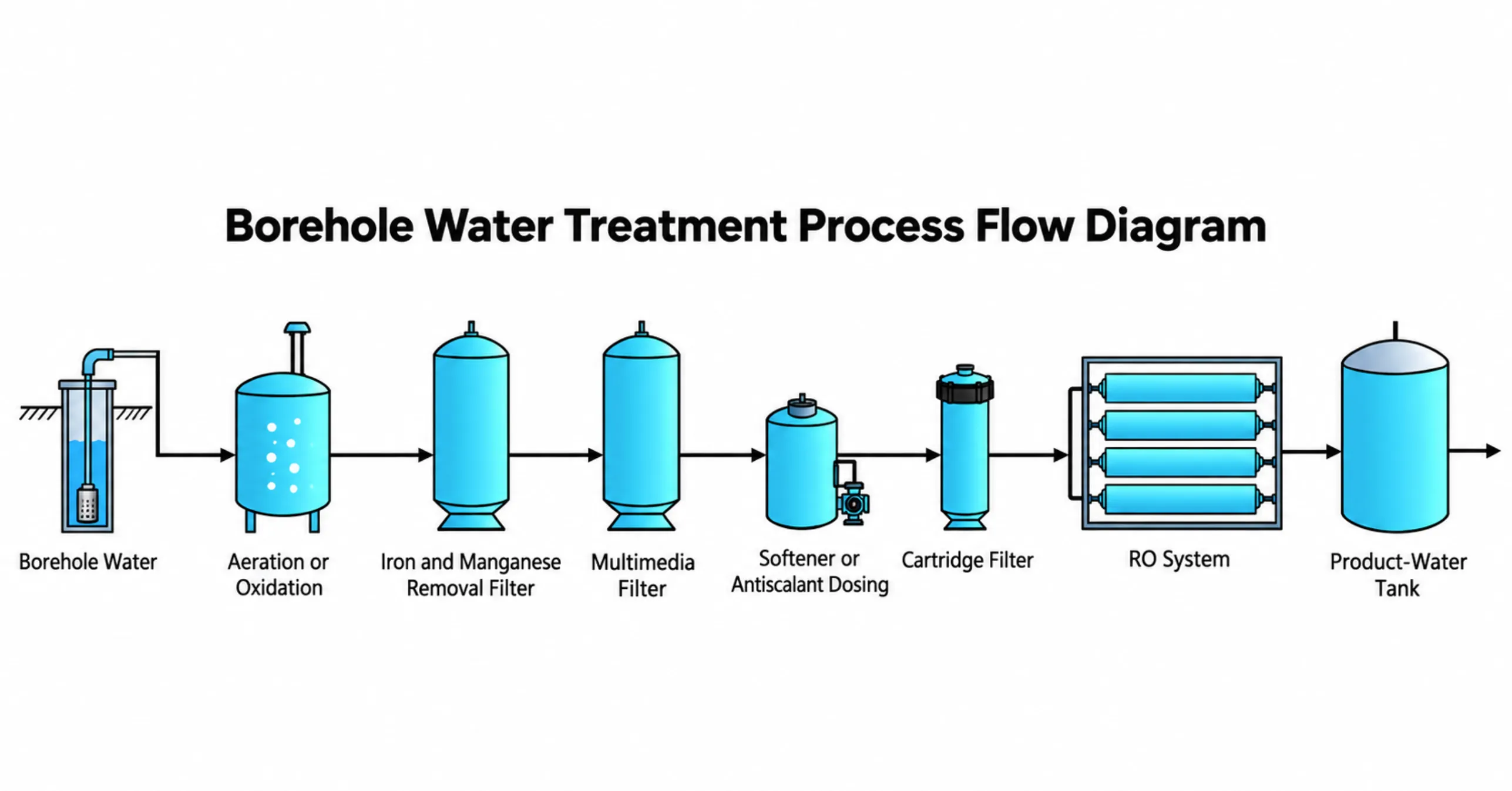
Pretreatment is selected according to the raw-water analysis. Correct pretreatment helps control membrane fouling and scaling while maintaining stable RO performance.
For groundwater projects, view our borehole water treatment solutions.
Main Equipment
A typical 2500L/H RO system can include:
-
 Raw-water feed pump
-
Multimedia filtration system
-
Activated-carbon filter
-
Automatic water softener or antiscalant dosing unit
-
5μm cartridge security filter
-
High-pressure pump
-
Industrial RO membrane modules
-
Membrane pressure vessels
-
Pressure gauges and flow meters
-
Online conductivity or TDS monitoring
-
Automatic control panel
-
Skid-mounted piping and valves
Raw-water tanks, product-water tanks and delivery pumps can be supplied according to the project scope.
Optional Configurations
| Project Requirement | Optional Configuration |
|---|---|
| High-hardness water | Automatic water softener |
| High iron and manganese | Oxidation and iron/manganese removal filter |
| High-turbidity surface water | Coagulation, clarification or UF pretreatment |
| Higher feedwater TDS | BWRO membranes and upgraded high-pressure pump |
| Higher product-water purity | Double-pass RO or EDI polishing |
| Drinking-water application | UV, ozone and remineralization |
| Membrane maintenance | CIP membrane-cleaning system |
| Online monitoring | TDS, conductivity, pressure and flow instruments |
| Automatic operation | PLC and HMI touchscreen |
| Remote supervision | Remote monitoring and fault alarms |
| Food-grade construction | SS304 or SS316L piping and frame |
| Outdoor installation | Containerized enclosure |
| Future expansion | Reserved modular connection points |
Technical Parameters
| Parameter | Typical Specification |
|---|---|
| Product-water capacity | 2,500 L/h (2.5m³/h) |
| Maximum daily production | Up to 60,000 L/day |
| Recommended feedwater TDS | ≤2,000 mg/L for standard configuration |
| Typical salt rejection | 97%–99% |
| System recovery | 50%–70% |
| Estimated feedwater demand | Approximately 3.6–5.0m³/h |
| Feedwater required at 60% recovery | Approximately 4.17m³/h |
| RO membrane | Industrial 4040 or equivalent membrane |
| Cartridge filtration | 5μm |
| Operating temperature | Typically 5–40°C |
| Control system | Automatic PLC or relay control |
| Monitoring | Pressure, flow and conductivity/TDS |
| Protection | Low-pressure, high-pressure and pump protection |
| Frame material | SS304 or coated carbon steel |
| Piping material | UPVC, SS304 or SS316L |
| Power supply | Customized to local voltage and frequency |
| Installation | Compact skid-mounted structure |
| Warranty | One year |
Final specifications must be confirmed through raw-water analysis, membrane calculation and engineering design.
Applications
The 2.5m³/h industrial RO system is suitable for:
-
Small and medium-sized food and beverage factories
-
Bottled-water plants and drinking-water stations
-
Hotels, restaurants and commercial kitchens
-
Cosmetic and personal-care production
-
Laboratories and testing facilities
-
Boiler makeup-water pretreatment
-
Equipment and container washing
-
Schools, offices and commercial buildings
-
Rural communities and construction camps
-
Small and medium-sized industrial production lines
Applications with specific chemical, sanitary or microbial requirements may require additional treatment and final water-quality testing.
Frequently Asked Questions
Does 2500L/H refer to feedwater or product water?
It refers to the rated RO product-water output. The required feedwater flow is higher and depends on the system recovery rate.
At 60% recovery, producing 2,500 L/h of purified water requires approximately 4,170 L/h of feedwater.
Can this system treat borehole water?
Yes. Pretreatment for sediment, hardness, iron and manganese will be selected according to the borehole water analysis.
What feedwater TDS can the system handle?
The standard configuration is generally suitable for feedwater with TDS up to approximately 2,000 mg/L. Higher TDS requires a customized brackish-water RO design.
Can the system operate continuously?
Yes. The system can support continuous automatic operation when properly sized with suitable raw-water and product-water storage. Routine inspection, filter replacement and membrane maintenance are still required.
Can the system use 220V single-phase power?
The power supply can be customized, but the final voltage and phase depend on the selected pumps and total electrical load. For a 2.5m³/h industrial system, three-phase power is generally preferred where available.
Can the product water be used for drinking?
The system can be configured for drinking-water production. Suitable disinfection and, where required, remineralization should be included. Final product water must be tested against applicable local standards.
How long do RO membranes last?
RO membranes typically operate for approximately two to four years, depending on feedwater quality, pretreatment performance, operating conditions and maintenance.
How much installation space is required?
The required space depends on the pretreatment vessels, tanks, pumps and optional equipment. A detailed general arrangement drawing will be provided after the final configuration is confirmed.
Information Required for Quotation
Please provide:
-
Raw-water source
-
Complete water-analysis report
-
Required product-water capacity
-
Intended water application
-
Target TDS, conductivity or water-quality standard
-
Daily operating hours
-
Local voltage, phase and frequency
-
Available installation space
-
Project location and destination port
-
Preferred component brands and construction materials
-
Installation and commissioning requirements
Send Zhongnuo your water analysis and project information to receive a customized 2500L/H RO system configuration and quotation.
Capacity and System Design
| Item | Typical Specification |
|---|---|
| Product name | 2500L/H Industrial Reverse Osmosis Water Treatment System |
| Product-water capacity | 2,500 L/h (2.5m³/h) |
| Maximum daily production | Up to 60m³/day |
| RO process | Single-pass industrial reverse osmosis |
| Installation | Compact skid-mounted system |
| Control | Automatic PLC or relay control |
| Operating mode | Automatic continuous operation |
| Power supply | Customized to local voltage and frequency |
Actual water production depends on feedwater quality, temperature, operating pressure and membrane condition.
Suitable Raw Water
The 2.5m³/h RO system can be designed to treat:
-
• Municipal tap water
-
• Borehole and well water
-
• Low-salinity groundwater
-
• Rainwater after suitable pretreatment
-
• Pretreated river, lake or reservoir water
-
• Industrial process water requiring further purification
The standard configuration is generally suitable for feedwater with TDS up to approximately 2,000 mg/L.
Water with higher salinity requires a customized BWRO design with suitable membranes, high-pressure pumps and pressure vessels. Learn more about our brackish water desalination systems.
A raw-water analysis is required when the water contains high hardness, iron, manganese, silica, suspended solids or organic matter.
Product-Water Quality
Under suitable design and operating conditions, the system can typically achieve:
-
• Salt rejection of approximately 97%–99%
-
• Significant reduction in TDS and conductivity
-
• Substantial reduction in calcium and magnesium hardness
-
• Reduced chloride, sulfate and other dissolved ions
-
• Clear and stable product water
-
• Consistent water quality for general industrial use
The actual product-water TDS depends on feedwater quality, membrane selection, recovery rate and operating conditions.
For drinking water, food production, laboratory use or boiler feedwater, the complete system must be designed according to the required water-quality standard. Additional disinfection, remineralization or polishing treatment may be necessary.
Typical Treatment Process
Standard Process
Raw Water → Raw-Water Tank → Feed Pump → Multimedia Filter → Activated-Carbon Filter → Softener or Antiscalant Dosing → 5μm Cartridge Filter → High-Pressure Pump → RO Membrane System → Product-Water Tank
Pretreatment is selected according to the raw-water analysis. Correct pretreatment helps control membrane fouling and scaling while maintaining stable RO performance.
For groundwater projects, view our borehole water treatment solutions.
Main Equipment
A typical 2500L/H RO system can include:
-
Raw-water feed pump
-
Multimedia filtration system
-
Activated-carbon filter
-
Automatic water softener or antiscalant dosing unit
-
5μm cartridge security filter
-
High-pressure pump
-
Industrial RO membrane modules
-
Membrane pressure vessels
-
Pressure gauges and flow meters
-
Online conductivity or TDS monitoring
-
Automatic control panel
-
Skid-mounted piping and valves
Raw-water tanks, product-water tanks and delivery pumps can be supplied according to the project scope.
Optional Configurations
| Project Requirement | Optional Configuration |
|---|---|
| High-hardness water | Automatic water softener |
| High iron and manganese | Oxidation and iron/manganese removal filter |
| High-turbidity surface water | Coagulation, clarification or UF pretreatment |
| Higher feedwater TDS | BWRO membranes and upgraded high-pressure pump |
| Higher product-water purity | Double-pass RO or EDI polishing |
| Drinking-water application | UV, ozone and remineralization |
| Membrane maintenance | CIP membrane-cleaning system |
| Online monitoring | TDS, conductivity, pressure and flow instruments |
| Automatic operation | PLC and HMI touchscreen |
| Remote supervision | Remote monitoring and fault alarms |
| Food-grade construction | SS304 or SS316L piping and frame |
| Outdoor installation | Containerized enclosure |
| Future expansion | Reserved modular connection points |
Technical Parameters
| Parameter | Typical Specification |
|---|---|
| Product-water capacity | 2,500 L/h (2.5m³/h) |
| Maximum daily production | Up to 60,000 L/day |
| Recommended feedwater TDS | ≤2,000 mg/L for standard configuration |
| Typical salt rejection | 97%–99% |
| System recovery | 50%–70% |
| Estimated feedwater demand | Approximately 3.6–5.0m³/h |
| Feedwater required at 60% recovery | Approximately 4.17m³/h |
| RO membrane | Industrial 4040 or equivalent membrane |
| Cartridge filtration | 5μm |
| Operating temperature | Typically 5–40°C |
| Control system | Automatic PLC or relay control |
| Monitoring | Pressure, flow and conductivity/TDS |
| Protection | Low-pressure, high-pressure and pump protection |
| Frame material | SS304 or coated carbon steel |
| Piping material | UPVC, SS304 or SS316L |
| Power supply | Customized to local voltage and frequency |
| Installation | Compact skid-mounted structure |
| Warranty | One year |
Final specifications must be confirmed through raw-water analysis, membrane calculation and engineering design.
Applications
The 2.5m³/h industrial RO system is suitable for:
-
Small and medium-sized food and beverage factories
-
Bottled-water plants and drinking-water stations
-
Hotels, restaurants and commercial kitchens
-
Cosmetic and personal-care production
-
Laboratories and testing facilities
-
Boiler makeup-water pretreatment
-
Equipment and container washing
-
Schools, offices and commercial buildings
-
Rural communities and construction camps
-
Small and medium-sized industrial production lines
Applications with specific chemical, sanitary or microbial requirements may require additional treatment and final water-quality testing.
Frequently Asked Questions
Does 2500L/H refer to feedwater or product water?
It refers to the rated RO product-water output. The required feedwater flow is higher and depends on the system recovery rate.
At 60% recovery, producing 2,500 L/h of purified water requires approximately 4,170 L/h of feedwater.
Can this system treat borehole water?
Yes. Pretreatment for sediment, hardness, iron and manganese will be selected according to the borehole water analysis.
What feedwater TDS can the system handle?
The standard configuration is generally suitable for feedwater with TDS up to approximately 2,000 mg/L. Higher TDS requires a customized brackish-water RO design.
Can the system operate continuously?
Yes. The system can support continuous automatic operation when properly sized with suitable raw-water and product-water storage. Routine inspection, filter replacement and membrane maintenance are still required.
Can the system use 220V single-phase power?
The power supply can be customized, but the final voltage and phase depend on the selected pumps and total electrical load. For a 2.5m³/h industrial system, three-phase power is generally preferred where available.
Can the product water be used for drinking?
The system can be configured for drinking-water production. Suitable disinfection and, where required, remineralization should be included. Final product water must be tested against applicable local standards.
How long do RO membranes last?
RO membranes typically operate for approximately two to four years, depending on feedwater quality, pretreatment performance, operating conditions and maintenance.
How much installation space is required?
The required space depends on the pretreatment vessels, tanks, pumps and optional equipment. A detailed general arrangement drawing will be provided after the final configuration is confirmed.
Information Required for Quotation
Please provide:
-
Raw-water source
-
Complete water-analysis report
-
Required product-water capacity
-
Intended water application
-
Target TDS, conductivity or water-quality standard
-
Daily operating hours
-
Local voltage, phase and frequency
-
Available installation space
-
Project location and destination port
-
Preferred component brands and construction materials
-
Installation and commissioning requirements
Send Zhongnuo your water analysis and project information to receive a customized 2500L/H RO system configuration and quotation.
Next: No more data
Get a Quote for Free
Submit this form and our sales representative will contact you soon.


ONLINE MESSAGE
Copyright © 2026 Zhongnuo Water Treatment Co., Ltd.