

SEARCH WHAT YOU WANT
3m³/h Industrial Reverse Osmosis Water Treatment System
The 3m³/h industrial reverse osmosis water treatment system produces up to 3,000 liters of purified water per hour. It combines customized pretreatment with industrial RO membrane technology to reduce dissolved salts, hardness and other contaminants from the feedwater.
Its compact skid-mounted structure simplifies transportation and onsite installation, making it suitable for small factories, food and beverage facilities, commercial water plants and other projects requiring a stable supply of low-TDS water.
The 3m³/h industrial reverse osmosis water treatment system produces up to 3,000 liters of purified water per hour. It combines customized pretreatment with industrial RO membrane technology to reduce dissolved salts, hardness and other contaminants from the feedwater.
Its compact skid-mounted structure simplifies transportation and onsite installation, making it suitable for small factories, food and beverage facilities, commercial water plants and other projects requiring a stable supply of low-TDS water.
Next: No more data
Share to
Product Description
Capacity and System Design
| Item | Typical Specification |
|---|---|
| Product name | 3m³/h Industrial Reverse Osmosis Water Treatment System |
| Rated product-water capacity | 3m³/h (3,000 L/h) |
| Maximum daily production | Up to 72m³/day at 24-hour operation |
| Core process | Customized pretreatment + single-pass RO |
| Operation | Automatic continuous operation |
| Installation | Compact skid-mounted system |
| Capacity customization | Available according to project demand |
Actual production depends on feedwater TDS, temperature, operating pressure, membrane condition and system recovery.
Suitable Raw Water
The 3m³/h RO system can be designed for:
-
• Municipal tap water
-
• Borehole and well water
-
• Low- to moderate-TDS groundwater
-
• Pretreated river, lake or reservoir water
-
• Process water requiring further desalination
-
• Water used for small food and beverage production
-
• Commercial or community water-supply projects
A complete water analysis is required before final system design.
If the water contains high hardness, iron, manganese, silica, turbidity or organic matter, additional pretreatment may be necessary. View our borehole water treatment solutions for groundwater projects.
Feedwater with higher salinity requires a dedicated brackish water desalination system rather than a standard low-pressure RO configuration.
Product-Water Quality
Under suitable design and operating conditions, the system can typically achieve:
-
• Salt rejection of approximately 97%–99%
-
• Significant reduction of TDS and conductivity
-
• Significant reduction of calcium and magnesium hardness
-
• Reduction of many dissolved metals and ionic contaminants
-
• Clear, low-turbidity product water
-
• More stable water quality for industrial processes
Final product-water TDS depends on the feedwater TDS, membrane selection, temperature, pressure and system design. It should therefore be calculated from the actual water analysis rather than guaranteed from capacity alone.
RO membranes can also reduce microorganisms, but an RO system should not be treated as the only microbiological barrier. Drinking-water applications normally require suitable disinfection and laboratory testing.
Boiler feedwater, food production and other regulated applications must be designed according to the specific water-quality standard required by the project.
Typical Treatment Process
Standard Process
Suitable for municipal water or groundwater with relatively stable quality:
Raw Water → Raw-Water Tank → Feed Pump → Multimedia Filter → Activated-Carbon Filter → Softener or Antiscalant Dosing → 5 μm Cartridge Filter → High-Pressure Pump → RO Membrane System → Product-Water Tank
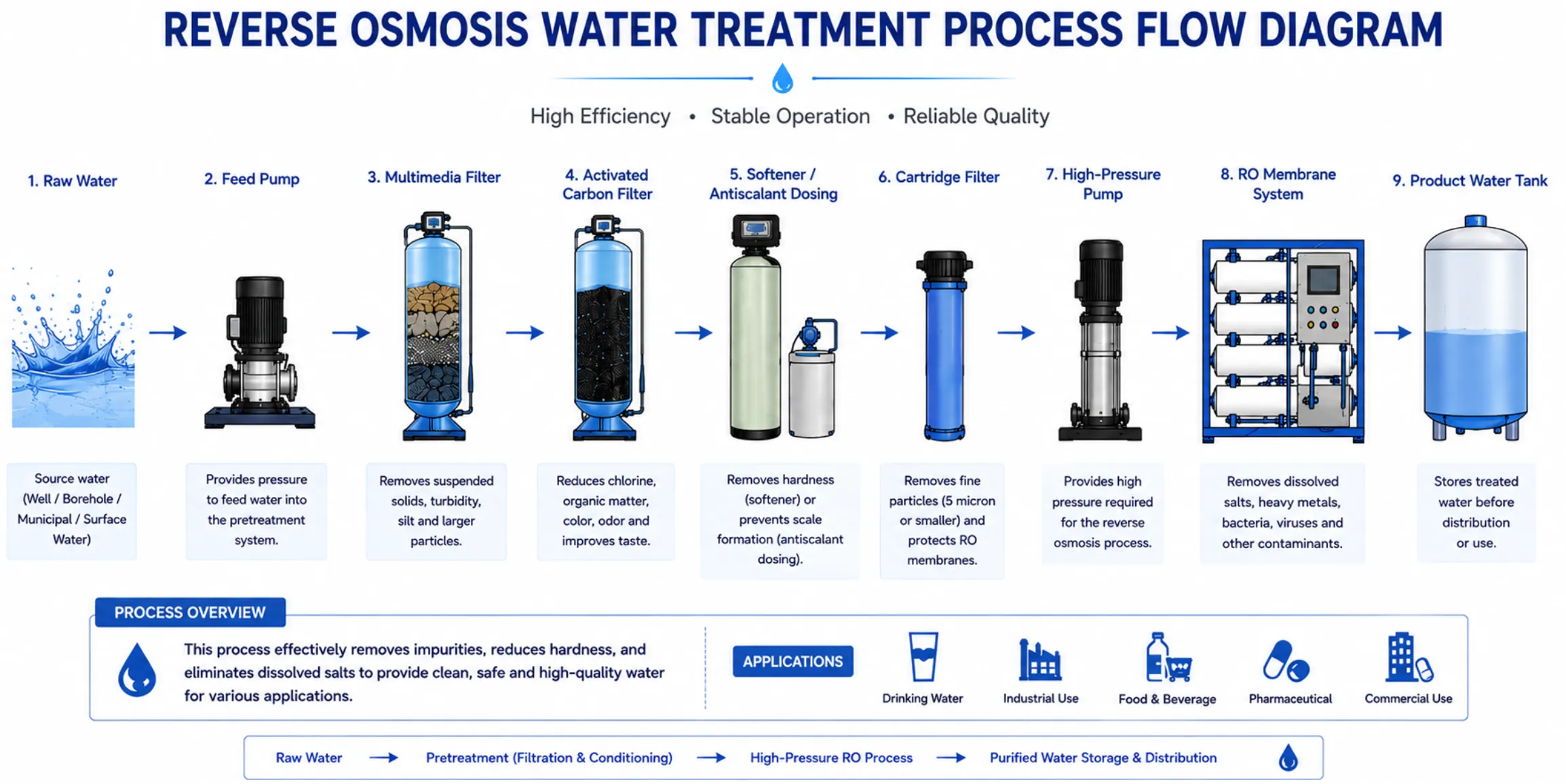
The final pretreatment process is selected according to the raw-water analysis. Correct pretreatment helps control RO membrane fouling, scaling and premature performance loss.
Main Equipment Configuration
A typical 3m³/h RO system includes:
-
• Raw-water feed pump
-
• Multimedia filtration system
-
• Activated-carbon filtration system
-
• Water softener or antiscalant dosing unit
-
• 5 μm cartridge security filter
-
• RO high-pressure pump
-
• Industrial RO membrane elements
-
• RO membrane pressure vessels
-
• Automatic flushing system
-
• Flow and pressure instruments
-
• Online conductivity or TDS monitoring
-
• Electrical control panel
-
• Skid-mounted frame and connecting pipelines
The exact configuration and component brands are confirmed according to the customer’s water quality, application and budget.
Optional Configurations
| Project Requirement | Recommended Option |
|---|---|
| High iron and manganese | Oxidation and iron/manganese removal |
| High hardness | Automatic water softener or optimized antiscalant dosing |
| High-turbidity surface water | Coagulation, clarification or UF pretreatment |
| Higher feedwater salinity | BWRO membranes and suitable high-pressure pump |
| Higher-purity product water | Double-pass RO or RO+EDI |
| Drinking-water production | UV, ozone and optional remineralization |
| Membrane maintenance | Independent CIP cleaning system |
| Remote operation | PLC, HMI and remote monitoring |
| Food-grade requirements | SS304 or SS316L frame and piping |
| Outdoor or remote installation | Containerized equipment room |
| Future capacity increase | Modular parallel RO trains |
Power supply, membrane brands, pump brands, electrical components and construction materials can be customized.
Technical Parameters
| Parameter | Typical Specification |
|---|---|
| Product-water capacity | 3m³/h |
| Maximum daily production | Up to 72m³/day |
| RO configuration | Single-pass industrial RO |
| Typical salt rejection | 97%–99% |
| Typical recovery rate | 50%–70%, subject to water analysis |
| Membrane size | Industrial 4040 membrane elements |
| Pretreatment | Customized according to feedwater quality |
| Cartridge filtration | 5 μm |
| Operating temperature | Typically 5–40°C |
| Control system | Automatic PLC or relay control |
| Monitoring | Conductivity/TDS, pressure, flow and tank level |
| Protection | High/low-pressure shutdown and dry-run protection |
| Frame material | SS304 or customized |
| Pipeline material | UPVC, SS304 or SS316L |
| Power supply | Customized to local voltage, phase and frequency |
| Installation | Compact skid-mounted system |
| Warranty | One year |
All parameters are subject to final engineering design and membrane calculations.
Applications
The 3m³/h industrial RO system is suitable for:
-
 Small food and beverage factories
 -
Bottled-water and drinking-water plants
-
Hotels, restaurants and commercial buildings
-
Boiler makeup-water preparation
-
Cosmetics and personal-care production
-
Equipment and container washing
-
Small manufacturing facilities
-
Construction camps and remote project sites
-
Community water-supply projects
-
Laboratory and medical-water pretreatment
Applications requiring pharmaceutical purified water, laboratory-grade water or electronics-grade ultrapure water may require double-pass RO, EDI and additional post-treatment.
Frequently Asked Questions
What feedwater TDS can this system treat?
A standard configuration is normally used for low- to moderate-TDS water. A typical design reference may be up to approximately 2,000 mg/L, but the actual limit depends on hardness, alkalinity, silica, sulfate, temperature and required recovery.
Higher TDS requires a dedicated BWRO membrane and pump design.
Does 3m³/h refer to feedwater or product water?
It refers to the rated RO product-water output. Feedwater demand is higher and depends on the system recovery rate.
For example:
-
At 60% recovery, approximately 5m³/h of feedwater is required.
-
At 70% recovery, approximately 4.3m³/h of feedwater is required.
Can the system operate 24 hours per day?
Yes, when it is correctly designed with adequate raw-water and product-water storage. Scheduled inspection, filter replacement, membrane cleaning and maintenance are still required.
Can it treat borehole water containing iron and manganese?
Yes, but excessive iron and manganese must be removed before the RO membranes. Oxidation and dedicated filtration are normally used to prevent membrane fouling.
Can the product water be used for drinking?
The system can be configured for drinking-water production. Suitable disinfection, optional remineralization and final laboratory testing are required according to local regulations.
Adding UV or ozone alone does not automatically confirm drinking-water compliance.
Can the system be installed inside a container?
Yes. The RO equipment, pretreatment system, tanks and control panel can be integrated into a container for outdoor or remote-site installation.
How long do RO membranes last?
RO membranes commonly operate for approximately 2–5 years. Actual service life depends on feedwater quality, pretreatment, operating pressure, cleaning frequency and maintenance.
Capacity and System Design
| Item | Typical Specification |
|---|---|
| Product name | 3m³/h Industrial Reverse Osmosis Water Treatment System |
| Rated product-water capacity | 3m³/h (3,000 L/h) |
| Maximum daily production | Up to 72m³/day at 24-hour operation |
| Core process | Customized pretreatment + single-pass RO |
| Operation | Automatic continuous operation |
| Installation | Compact skid-mounted system |
| Capacity customization | Available according to project demand |
Actual production depends on feedwater TDS, temperature, operating pressure, membrane condition and system recovery.
Suitable Raw Water
The 3m³/h RO system can be designed for:
-
• Municipal tap water
-
• Borehole and well water
-
• Low- to moderate-TDS groundwater
-
• Pretreated river, lake or reservoir water
-
• Process water requiring further desalination
-
• Water used for small food and beverage production
-
• Commercial or community water-supply projects
A complete water analysis is required before final system design.
If the water contains high hardness, iron, manganese, silica, turbidity or organic matter, additional pretreatment may be necessary. View our borehole water treatment solutions for groundwater projects.
Feedwater with higher salinity requires a dedicated brackish water desalination system rather than a standard low-pressure RO configuration.
Product-Water Quality
Under suitable design and operating conditions, the system can typically achieve:
-
• Salt rejection of approximately 97%–99%
-
• Significant reduction of TDS and conductivity
-
• Significant reduction of calcium and magnesium hardness
-
• Reduction of many dissolved metals and ionic contaminants
-
• Clear, low-turbidity product water
-
• More stable water quality for industrial processes
Final product-water TDS depends on the feedwater TDS, membrane selection, temperature, pressure and system design. It should therefore be calculated from the actual water analysis rather than guaranteed from capacity alone.
RO membranes can also reduce microorganisms, but an RO system should not be treated as the only microbiological barrier. Drinking-water applications normally require suitable disinfection and laboratory testing.
Boiler feedwater, food production and other regulated applications must be designed according to the specific water-quality standard required by the project.
Typical Treatment Process
Standard Process
Suitable for municipal water or groundwater with relatively stable quality:
Raw Water → Raw-Water Tank → Feed Pump → Multimedia Filter → Activated-Carbon Filter → Softener or Antiscalant Dosing → 5 μm Cartridge Filter → High-Pressure Pump → RO Membrane System → Product-Water Tank
The final pretreatment process is selected according to the raw-water analysis. Correct pretreatment helps control RO membrane fouling, scaling and premature performance loss.
Main Equipment Configuration
A typical 3m³/h RO system includes:
-
• Raw-water feed pump
-
• Multimedia filtration system
-
• Activated-carbon filtration system
-
• Water softener or antiscalant dosing unit
-
• 5 μm cartridge security filter
-
• RO high-pressure pump
-
• Industrial RO membrane elements
-
• RO membrane pressure vessels
-
• Automatic flushing system
-
• Flow and pressure instruments
-
• Online conductivity or TDS monitoring
-
• Electrical control panel
-
• Skid-mounted frame and connecting pipelines
The exact configuration and component brands are confirmed according to the customer’s water quality, application and budget.
Optional Configurations
| Project Requirement | Recommended Option |
|---|---|
| High iron and manganese | Oxidation and iron/manganese removal |
| High hardness | Automatic water softener or optimized antiscalant dosing |
| High-turbidity surface water | Coagulation, clarification or UF pretreatment |
| Higher feedwater salinity | BWRO membranes and suitable high-pressure pump |
| Higher-purity product water | Double-pass RO or RO+EDI |
| Drinking-water production | UV, ozone and optional remineralization |
| Membrane maintenance | Independent CIP cleaning system |
| Remote operation | PLC, HMI and remote monitoring |
| Food-grade requirements | SS304 or SS316L frame and piping |
| Outdoor or remote installation | Containerized equipment room |
| Future capacity increase | Modular parallel RO trains |
Power supply, membrane brands, pump brands, electrical components and construction materials can be customized.
Technical Parameters
| Parameter | Typical Specification |
|---|---|
| Product-water capacity | 3m³/h |
| Maximum daily production | Up to 72m³/day |
| RO configuration | Single-pass industrial RO |
| Typical salt rejection | 97%–99% |
| Typical recovery rate | 50%–70%, subject to water analysis |
| Membrane size | Industrial 4040 membrane elements |
| Pretreatment | Customized according to feedwater quality |
| Cartridge filtration | 5 μm |
| Operating temperature | Typically 5–40°C |
| Control system | Automatic PLC or relay control |
| Monitoring | Conductivity/TDS, pressure, flow and tank level |
| Protection | High/low-pressure shutdown and dry-run protection |
| Frame material | SS304 or customized |
| Pipeline material | UPVC, SS304 or SS316L |
| Power supply | Customized to local voltage, phase and frequency |
| Installation | Compact skid-mounted system |
| Warranty | One year |
All parameters are subject to final engineering design and membrane calculations.
Applications
The 3m³/h industrial RO system is suitable for:
-
Small food and beverage factories
-
Bottled-water and drinking-water plants
-
Hotels, restaurants and commercial buildings
-
Boiler makeup-water preparation
-
Cosmetics and personal-care production
-
Equipment and container washing
-
Small manufacturing facilities
-
Construction camps and remote project sites
-
Community water-supply projects
-
Laboratory and medical-water pretreatment
Applications requiring pharmaceutical purified water, laboratory-grade water or electronics-grade ultrapure water may require double-pass RO, EDI and additional post-treatment.
Frequently Asked Questions
What feedwater TDS can this system treat?
A standard configuration is normally used for low- to moderate-TDS water. A typical design reference may be up to approximately 2,000 mg/L, but the actual limit depends on hardness, alkalinity, silica, sulfate, temperature and required recovery.
Higher TDS requires a dedicated BWRO membrane and pump design.
Does 3m³/h refer to feedwater or product water?
It refers to the rated RO product-water output. Feedwater demand is higher and depends on the system recovery rate.
For example:
-
At 60% recovery, approximately 5m³/h of feedwater is required.
-
At 70% recovery, approximately 4.3m³/h of feedwater is required.
Can the system operate 24 hours per day?
Yes, when it is correctly designed with adequate raw-water and product-water storage. Scheduled inspection, filter replacement, membrane cleaning and maintenance are still required.
Can it treat borehole water containing iron and manganese?
Yes, but excessive iron and manganese must be removed before the RO membranes. Oxidation and dedicated filtration are normally used to prevent membrane fouling.
Can the product water be used for drinking?
The system can be configured for drinking-water production. Suitable disinfection, optional remineralization and final laboratory testing are required according to local regulations.
Adding UV or ozone alone does not automatically confirm drinking-water compliance.
Can the system be installed inside a container?
Yes. The RO equipment, pretreatment system, tanks and control panel can be integrated into a container for outdoor or remote-site installation.
How long do RO membranes last?
RO membranes commonly operate for approximately 2–5 years. Actual service life depends on feedwater quality, pretreatment, operating pressure, cleaning frequency and maintenance.
Next: No more data
Get a Quote for Free
Submit this form and our sales representative will contact you soon.


ONLINE MESSAGE
Copyright © 2026 Zhongnuo Water Treatment Co., Ltd.