

SEARCH WHAT YOU WANT
6m³/h UF +4m³/h RO Integrated Water Treatment System
The 4m³/h RO + 6m³/h UF integrated water treatment system combines hollow-fiber ultrafiltration with industrial reverse osmosis desalination.
The UF unit reduces turbidity, suspended solids, colloids and microorganisms before the RO stage. The RO system then removes dissolved salts and hardness to produce lower-TDS purified water.
With separate water tanks and distribution lines, the system can provide:
-
UF water for general industrial use
-
RO water for applications requiring lower TDS
-
UF pretreatment water for continuous RO operation
The system can be supplied as an integrated skid or modular treatment plant with automatic PLC and HMI control.
The 4m³/h RO + 6m³/h UF integrated water treatment system combines hollow-fiber ultrafiltration with industrial reverse osmosis desalination.
The UF unit reduces turbidity, suspended solids, colloids and microorganisms before the RO stage. The RO system then removes dissolved salts and hardness to produce lower-TDS purified water.
With separate water tanks and distribution lines, the system can provide:
-
UF water for general industrial use
-
RO water for applications requiring lower TDS
-
UF pretreatment water for continuous RO operation
The system can be supplied as an integrated skid or modular treatment plant with automatic PLC and HMI control.
Previous: 80m³/h Industrial Reverse Osmosis System
Next: No more data
Share to
Product Description
Capacity and System Design
| Item | Typical Specification |
|---|---|
| UF product-water capacity | 6m³/h |
| RO product-water capacity | 4m³/h |
| Core process | UF pretreatment + single-pass RO |
| Water-supply mode | Integrated treatment or optional dual-grade output |
| UF operation | Automatic filtration and backwashing |
| RO operation | Automatic desalination and flushing |
| Control system | PLC with HMI touchscreen |
| Installation | Integrated skid-mounted or modular system |
Important Flow-Balance Note
A 4m³/h RO system normally requires approximately 5.7–6.7m³/h of feedwater at a 60%–70% recovery rate. UF backwashing and cleaning also consume part of the UF output.
Therefore, continuous 4m³/h RO production must be confirmed through hydraulic and membrane calculations. Depending on the raw-water quality and selected recovery rate, the final design may require:
-
• A larger UF capacity
-
• A UF product-water buffer tank
-
• Intermittent UF backwashing
-
• Parallel UF membrane modules
-
• Adjustment of the sustainable RO recovery rate
This calculation prevents insufficient RO feed flow during continuous operation.
Suitable Raw Water
The integrated UF and RO system can be designed for:
-
• Municipal tap water
-
• Clarified river, lake or reservoir water
-
• Borehole and well water
-
• Groundwater with fluctuating turbidity
-
• Pretreated industrial process water
-
• Low- to moderate-TDS groundwater
-
• Water sources with seasonal changes in suspended solids
Groundwater containing excessive iron, manganese or hardness requires suitable pretreatment.
High-TDS groundwater requires a dedicated brackish-water RO design with appropriate membranes, pumps and operating pressure.
What Does Each Treatment Stage Remove?
| Treatment Stage | Main Function | Does Not Normally Remove |
|---|---|---|
| Ultrafiltration | Suspended solids, turbidity, colloids, bacteria and fine particles | Dissolved salts, hardness and TDS |
| Reverse osmosis | Dissolved salts, hardness and many dissolved contaminants | Performance depends on membrane design and feedwater conditions |
Typical UF Product-Water Targets
Under suitable feedwater and operating conditions:
-
-
 Filtration precision: approximately 0.01 μm
 -
Product-water turbidity: typically ≤0.1 NTU
-
SDI₁₅: typically ≤3 for RO pretreatment
-
Significant reduction of suspended solids and colloids
-
High reduction of bacteria and particulate microorganisms
-
Typical RO Product-Water Performance
Depending on feedwater quality and system design:
-
Typical salt rejection: 97%–99%
-
Significant reduction of TDS and hardness
-
Stable low-conductivity water for industrial use
-
Product-water quality customized according to the final application
Final performance must be confirmed through raw-water analysis and membrane calculations.
Typical Treatment Process
Integrated UF + RO Process
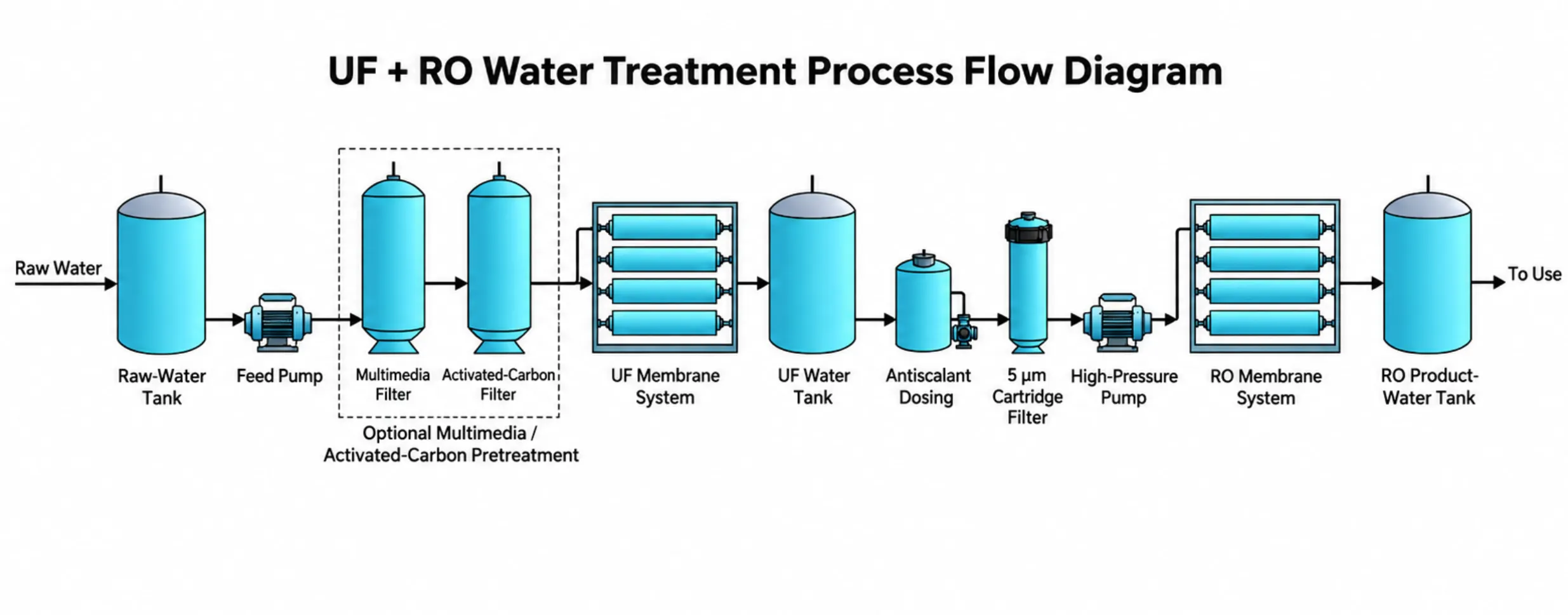
Raw Water → Raw-Water Tank → Feed Pump → Optional Multimedia/Activated-Carbon Pretreatment → UF Membrane System → UF Water Tank → Antiscalant Dosing → 5 μm Cartridge Filter → High-Pressure Pump → RO Membrane System → RO Product-Water Tank
Optional Dual-Grade Water Supply
Raw Water → Pretreatment → UF System → UF Water Tank
The UF water can then follow two routes:
-
-
Route 1: UF water supplied for general industrial use
-
Route 2: UF water sent to the RO system for further desalination
-
Separate tanks, pumps and distribution pipelines are required when both water grades are supplied simultaneously.
Main Equipment Configuration
-
Raw-water feed pump
-
Optional multimedia filter
-
Optional activated-carbon filter
-
Hollow-fiber UF membrane modules
-
Automatic UF backwash system
-
UF product-water tank
-
Antiscalant dosing system
-
5 μm cartridge security filter
-
RO high-pressure pump
-
Industrial RO membrane system
-
RO product-water tank
-
Flow, pressure and conductivity instruments
-
PLC and HMI control panel
-
Skid-mounted frame and connecting pipelines
Technical Parameters
| Parameter | Typical Specification |
|---|---|
| UF Section | |
| Rated UF permeate | 6m³/h |
| Membrane type | Hollow-fiber UF membrane |
| Nominal filtration precision | Approximately 0.01 μm |
| Typical UF recovery | 85%–95% |
| UF operating pressure | 0.1–0.3 MPa |
| UF cleaning | Automatic backwash; CEB/CIP optional |
| RO Section | |
| Rated RO permeate | 4m³/h |
| RO configuration | Single-pass industrial RO |
| Typical salt rejection | 97%–99% |
| Typical RO recovery | 60%–70%, subject to scaling analysis |
| RO operating pressure | Customized according to feedwater TDS |
| General Parameters | |
| Operating temperature | 5–40°C |
| Control system | Automatic PLC and HMI |
| Monitoring | Flow, pressure, tank level and conductivity |
| Protection | High/low-pressure shutdown and dry-run protection |
| Frame and piping | UPVC, SS304 or SS316L |
| Power supply | Customized to local voltage and frequency |
| Installation | Integrated skid-mounted or modular |
All parameters are subject to final engineering design and water analysis.
Applications
The system is suitable for:
-
Food and beverage process-water production
-
Bottled-water plants
-
Boiler makeup-water preparation
-
Industrial parks requiring two water-quality grades
-
Chemical blending and equipment cleaning
-
Electronics manufacturing pretreatment
-
Pharmaceutical and cosmetics utility-water pretreatment
-
Hotels and commercial facilities
-
Small centralized water-supply projects
-
General industrial process-water treatment
Applications requiring pharmaceutical purified water or electronics-grade ultrapure water may need double-pass RO, EDI, UV and hygienic storage and distribution.
Frequently Asked Questions
Why install UF before RO?
UF reduces turbidity, colloids and suspended solids before the RO stage. This can lower RO fouling risk and cleaning frequency, especially when treating surface water or water with unstable turbidity.
Can UF and RO produce water independently?
Yes. With separate tanks, pumps and distribution pipelines, UF water can be used directly while part of the flow receives further RO treatment.
Is a 6m³/h UF unit always sufficient for a 4m³/h RO system?
Not always. The answer depends on RO recovery, UF backwash consumption and daily operating requirements. The final flow balance must be verified before production.
Can UF reduce TDS and hardness?
No. UF mainly removes suspended and colloidal contaminants. Dissolved salts and hardness require RO or another desalination process.
Can the system operate continuously?
Yes, but UF backwashing temporarily interrupts filtration. A correctly sized UF water tank or parallel membrane arrangement is recommended to maintain a stable RO feed supply.
Can it treat high-TDS brackish water?
A dedicated BWRO configuration may be required. Membrane type, high-pressure pump, recovery rate and antiscalant dosage must be selected according to the complete water analysis.
Can EDI be added later?
Yes. EDI can be installed after a suitably designed RO system. The achievable resistivity depends on RO feed quality, carbon dioxide, silica and the selected EDI module.
Capacity and System Design
| Item | Typical Specification |
|---|---|
| UF product-water capacity | 6m³/h |
| RO product-water capacity | 4m³/h |
| Core process | UF pretreatment + single-pass RO |
| Water-supply mode | Integrated treatment or optional dual-grade output |
| UF operation | Automatic filtration and backwashing |
| RO operation | Automatic desalination and flushing |
| Control system | PLC with HMI touchscreen |
| Installation | Integrated skid-mounted or modular system |
Important Flow-Balance Note
A 4m³/h RO system normally requires approximately 5.7–6.7m³/h of feedwater at a 60%–70% recovery rate. UF backwashing and cleaning also consume part of the UF output.
Therefore, continuous 4m³/h RO production must be confirmed through hydraulic and membrane calculations. Depending on the raw-water quality and selected recovery rate, the final design may require:
-
• A larger UF capacity
-
• A UF product-water buffer tank
-
• Intermittent UF backwashing
-
• Parallel UF membrane modules
-
• Adjustment of the sustainable RO recovery rate
This calculation prevents insufficient RO feed flow during continuous operation.
Suitable Raw Water
The integrated UF and RO system can be designed for:
-
• Municipal tap water
-
• Clarified river, lake or reservoir water
-
• Borehole and well water
-
• Groundwater with fluctuating turbidity
-
• Pretreated industrial process water
-
• Low- to moderate-TDS groundwater
-
• Water sources with seasonal changes in suspended solids
Groundwater containing excessive iron, manganese or hardness requires suitable pretreatment.
High-TDS groundwater requires a dedicated brackish-water RO design with appropriate membranes, pumps and operating pressure.
What Does Each Treatment Stage Remove?
| Treatment Stage | Main Function | Does Not Normally Remove |
|---|---|---|
| Ultrafiltration | Suspended solids, turbidity, colloids, bacteria and fine particles | Dissolved salts, hardness and TDS |
| Reverse osmosis | Dissolved salts, hardness and many dissolved contaminants | Performance depends on membrane design and feedwater conditions |
Typical UF Product-Water Targets
Under suitable feedwater and operating conditions:
-
-
Filtration precision: approximately 0.01 μm
-
Product-water turbidity: typically ≤0.1 NTU
-
SDI₁₅: typically ≤3 for RO pretreatment
-
Significant reduction of suspended solids and colloids
-
High reduction of bacteria and particulate microorganisms
-
Typical RO Product-Water Performance
Depending on feedwater quality and system design:
-
Typical salt rejection: 97%–99%
-
Significant reduction of TDS and hardness
-
Stable low-conductivity water for industrial use
-
Product-water quality customized according to the final application
Final performance must be confirmed through raw-water analysis and membrane calculations.
Typical Treatment Process
Integrated UF + RO Process
Raw Water → Raw-Water Tank → Feed Pump → Optional Multimedia/Activated-Carbon Pretreatment → UF Membrane System → UF Water Tank → Antiscalant Dosing → 5 μm Cartridge Filter → High-Pressure Pump → RO Membrane System → RO Product-Water Tank
Optional Dual-Grade Water Supply
Raw Water → Pretreatment → UF System → UF Water Tank
The UF water can then follow two routes:
-
-
Route 1: UF water supplied for general industrial use
-
Route 2: UF water sent to the RO system for further desalination
-
Separate tanks, pumps and distribution pipelines are required when both water grades are supplied simultaneously.
Main Equipment Configuration
-
Raw-water feed pump
-
Optional multimedia filter
-
Optional activated-carbon filter
-
Hollow-fiber UF membrane modules
-
Automatic UF backwash system
-
UF product-water tank
-
Antiscalant dosing system
-
5 μm cartridge security filter
-
RO high-pressure pump
-
Industrial RO membrane system
-
RO product-water tank
-
Flow, pressure and conductivity instruments
-
PLC and HMI control panel
-
Skid-mounted frame and connecting pipelines
Technical Parameters
| Parameter | Typical Specification |
|---|---|
| UF Section | |
| Rated UF permeate | 6m³/h |
| Membrane type | Hollow-fiber UF membrane |
| Nominal filtration precision | Approximately 0.01 μm |
| Typical UF recovery | 85%–95% |
| UF operating pressure | 0.1–0.3 MPa |
| UF cleaning | Automatic backwash; CEB/CIP optional |
| RO Section | |
| Rated RO permeate | 4m³/h |
| RO configuration | Single-pass industrial RO |
| Typical salt rejection | 97%–99% |
| Typical RO recovery | 60%–70%, subject to scaling analysis |
| RO operating pressure | Customized according to feedwater TDS |
| General Parameters | |
| Operating temperature | 5–40°C |
| Control system | Automatic PLC and HMI |
| Monitoring | Flow, pressure, tank level and conductivity |
| Protection | High/low-pressure shutdown and dry-run protection |
| Frame and piping | UPVC, SS304 or SS316L |
| Power supply | Customized to local voltage and frequency |
| Installation | Integrated skid-mounted or modular |
All parameters are subject to final engineering design and water analysis.
Applications
The system is suitable for:
-
Food and beverage process-water production
-
Bottled-water plants
-
Boiler makeup-water preparation
-
Industrial parks requiring two water-quality grades
-
Chemical blending and equipment cleaning
-
Electronics manufacturing pretreatment
-
Pharmaceutical and cosmetics utility-water pretreatment
-
Hotels and commercial facilities
-
Small centralized water-supply projects
-
General industrial process-water treatment
Applications requiring pharmaceutical purified water or electronics-grade ultrapure water may need double-pass RO, EDI, UV and hygienic storage and distribution.
Frequently Asked Questions
Why install UF before RO?
UF reduces turbidity, colloids and suspended solids before the RO stage. This can lower RO fouling risk and cleaning frequency, especially when treating surface water or water with unstable turbidity.
Can UF and RO produce water independently?
Yes. With separate tanks, pumps and distribution pipelines, UF water can be used directly while part of the flow receives further RO treatment.
Is a 6m³/h UF unit always sufficient for a 4m³/h RO system?
Not always. The answer depends on RO recovery, UF backwash consumption and daily operating requirements. The final flow balance must be verified before production.
Can UF reduce TDS and hardness?
No. UF mainly removes suspended and colloidal contaminants. Dissolved salts and hardness require RO or another desalination process.
Can the system operate continuously?
Yes, but UF backwashing temporarily interrupts filtration. A correctly sized UF water tank or parallel membrane arrangement is recommended to maintain a stable RO feed supply.
Can it treat high-TDS brackish water?
A dedicated BWRO configuration may be required. Membrane type, high-pressure pump, recovery rate and antiscalant dosage must be selected according to the complete water analysis.
Can EDI be added later?
Yes. EDI can be installed after a suitably designed RO system. The achievable resistivity depends on RO feed quality, carbon dioxide, silica and the selected EDI module.
Previous: 80m³/h Industrial Reverse Osmosis System
Next: No more data
Get a Quote for Free
Submit this form and our sales representative will contact you soon.


ONLINE MESSAGE
Copyright © 2026 Zhongnuo Water Treatment Co., Ltd.