

SEARCH WHAT YOU WANT
60 m³/h Brackish Water Desalination System
The 60 m³/h brackish water desalination system combines ultrafiltration pretreatment with double-pass reverse osmosis.
UF removes suspended solids, colloids and microorganisms, while double-pass RO reduces dissolved salts and hardness. The system provides stable purified water for drinking-water and industrial projects.
The 60 m³/h brackish water desalination system combines ultrafiltration pretreatment with double-pass reverse osmosis.
UF removes suspended solids, colloids and microorganisms, while double-pass RO reduces dissolved salts and hardness. The system provides stable purified water for drinking-water and industrial projects.
Share to
Product Description
60 m³/h Brackish Water Desalination System
Product Name and Capacity
Product: 60 m³/h UF + Double-Pass RO Brackish Water Desalination System
Final capacity: 60 m³/h (60,000 L/H)
Capacity range: 20–100 m³/h
Operation: Fully automatic
Installation: Skid-mounted, modular or containerized
The final capacity depends on feed-water temperature, salinity and operating conditions.
Suitable Raw Water
The system is suitable for:
- Brackish borehole water
- Saline groundwater
- Coastal groundwater
- High-TDS well water
- Saline river water
- Water affected by seawater intrusion
Reference Feed-Water Conditions
| Parameter | Reference range |
|---|---|
| Feed-water TDS | 2,000–10,000 mg/L |
| Temperature | 5–40°C |
| pH | 6.5–8.5 |
| Oil and grease | Not detectable |
| Free chlorine before RO | <0.1 mg/L |
| RO feed SDI | ≤3 recommended |
A complete water analysis is required before final design.
Product-Water Quality
| Parameter | Typical target |
|---|---|
| Final capacity | 60 m³/h |
| System salt rejection | ≥99% |
| Product-water TDS | ≤10–20 mg/L* |
| Conductivity | ≤20–30 μS/cm* |
| Turbidity | ≤0.5 NTU |
| Overall recovery | Approximately 55%–70% |
*Final water quality depends on feed-water composition and operating conditions.
For drinking-water projects, remineralization, pH adjustment and final disinfection can be added to meet local requirements.
Typical Process Flow
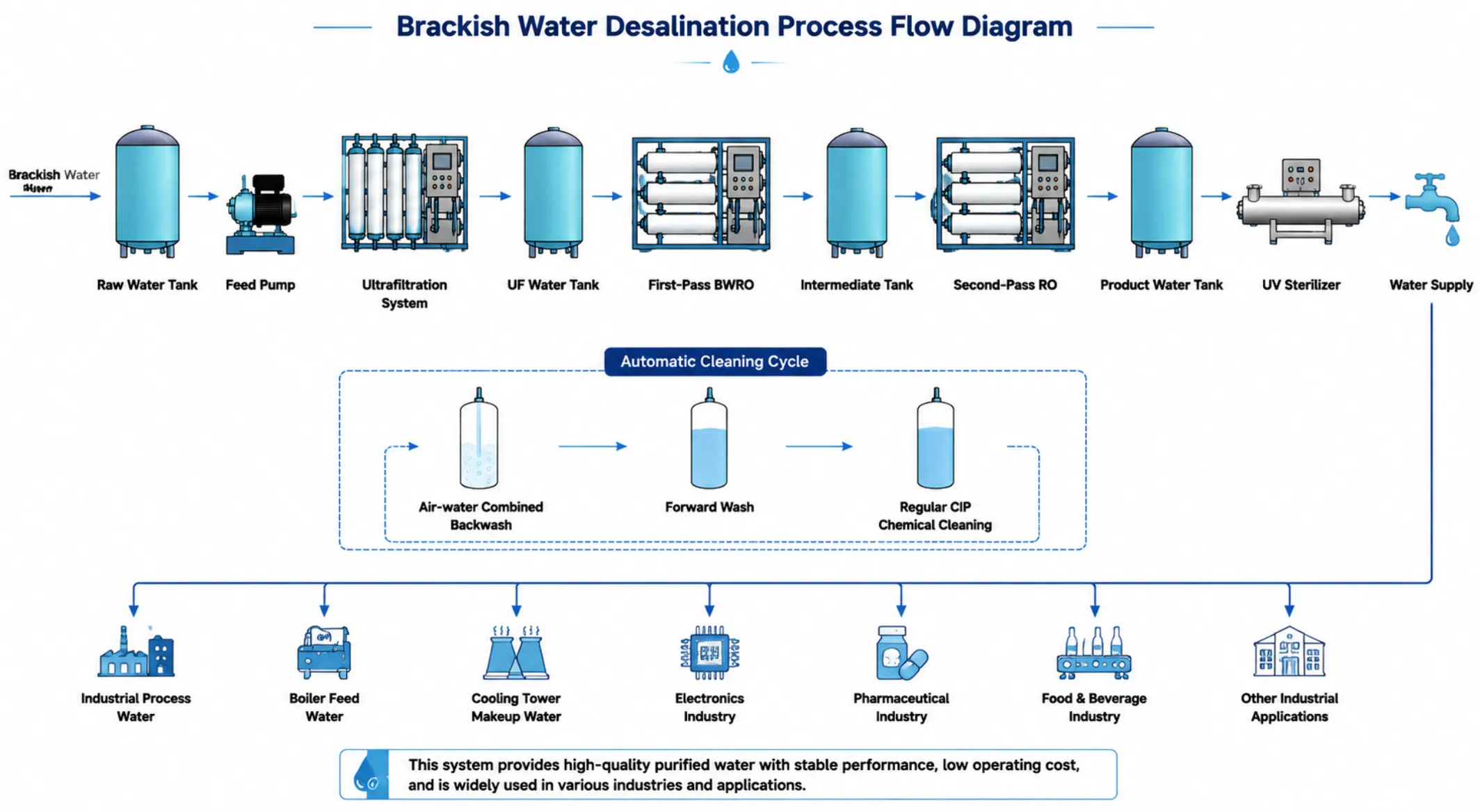
Brackish Water → Raw Water Tank → Feed Pump → Ultrafiltration System → UF Water Tank → First-Pass BWRO → Intermediate Tank → Second-Pass RO → Product Water Tank → UV Sterilizer → Water Supply
Chemical dosing and membrane-cleaning systems are added according to the water analysis.
Main System Components
Ultrafiltration Pretreatment
UF removes suspended solids, colloids and microorganisms, helping protect the RO membranes and maintain stable feed-water quality.
First-Pass BWRO
The first-pass RO removes most dissolved salts, hardness, heavy metals and other dissolved contaminants.
Second-Pass RO
The second-pass RO further reduces TDS and conductivity to produce higher-quality purified water.
Automatic Control System
The PLC and HMI system provides:
- Automatic operation
- UF backwashing
- RO membrane flushing
- Tank-level control
- Conductivity monitoring
- Pressure and flow monitoring
- Fault alarms and system protection
Optional Configurations
| Optional configuration | Function |
|---|---|
| Chemical dosing system | Controls scaling, oxidation and pH |
| UF chemical backwash | Improves membrane cleaning |
| RO CIP system | Cleans RO membranes |
| UV or ozone sterilization | Supports microbial control |
| Remineralization system | Adjusts drinking-water minerals |
| Online monitoring | Monitors TDS, flow and pressure |
| Remote control | Enables online system management |
| Stainless-steel piping | Improves corrosion resistance |
| Containerized design | Simplifies transport and installation |
| Solar power interface | Supports off-grid projects |
Technical Parameters
| Item | Reference specification |
|---|---|
| Product-water capacity | 60 m³/h |
| Main process | UF + double-pass RO |
| Feed-water TDS | 2,000–10,000 mg/L |
| UF product-water SDI | ≤3 recommended |
| First-pass RO recovery | 70%–80% |
| Second-pass RO recovery | 80%–90% |
| Overall recovery | Approximately 55%–70% |
| Salt rejection | ≥99% |
| Product-water TDS | ≤10–20 mg/L |
| RO membrane | Industrial 8040 membrane |
| Control | PLC + HMI |
| Power supply | 380–415 V, 50/60 Hz, 3-phase |
| Frame | Coated carbon steel/SS304 optional |
| Installation | Skid, modular or containerized |
Final pressure, power, dimensions and membrane quantity depend on the confirmed system design.
Application Industries
The system can be used for:
- Municipal drinking-water projects
- Bottled-water factories
- Food and beverage production
- Agricultural irrigation
- Mining operations
- Construction camps
- Hotels and resorts
- Boiler feedwater
- Chemical manufacturing
- Textile factories
- Livestock farms
- Industrial process water
Similar Project Case
Large-Capacity Brackish Water Treatment Project
A customer needed to treat high-salinity borehole water for industrial production.
The supplied solution combined UF pretreatment and double-pass RO. UF stabilized the RO feed water, while the two RO passes reduced TDS and conductivity. Automatic backwashing, membrane flushing and PLC control simplified operation and maintenance.
The final configuration was designed according to the customer’s water analysis, required capacity and installation conditions.
Frequently Asked Questions
Why is UF used before RO?
UF removes particles, colloids and microorganisms, reducing RO membrane fouling.
Why use double-pass RO?
Double-pass RO produces lower TDS and conductivity than single-pass RO.
Does 60 m³/h refer to final product water?
Yes. The rated capacity refers to the final water after the second-pass RO under the agreed design conditions.
Can the product water be used for drinking?
Yes, but remineralization, pH adjustment and final disinfection may be required according to local standards.
What is the system recovery rate?
The overall recovery is normally around 55%–70%, depending on the raw-water quality.
Can the equipment be containerized?
Yes. Modular and containerized designs are available.
Can the voltage be customized?
Yes. Voltage and frequency can be adjusted for the destination country.
Information Required for Quotation
Please provide:
- Raw-water source and water analysis
- Required product-water quality
- Required final capacity
- Daily operating hours
- Application industry
- Installation space and conditions
- Indoor, outdoor or containerized installation
- Local voltage and frequency
- Preferred equipment materials
- Destination port
If no complete water report is available, please provide at least the TDS, hardness, pH, turbidity, iron, manganese, silica and chloride levels.
Contact Us
Zhongnuo Water Treatment provides customized brackish water desalination systems for drinking-water and industrial projects.
Send us your water analysis, required capacity and application. Our engineering team will prepare a customized process design and quotation.
60 m³/h Brackish Water Desalination System
Product Name and Capacity
Product: 60 m³/h UF + Double-Pass RO Brackish Water Desalination System
Final capacity: 60 m³/h (60,000 L/H)
Capacity range: 20–100 m³/h
Operation: Fully automatic
Installation: Skid-mounted, modular or containerized
The final capacity depends on feed-water temperature, salinity and operating conditions.
Suitable Raw Water
The system is suitable for:
- Brackish borehole water
- Saline groundwater
- Coastal groundwater
- High-TDS well water
- Saline river water
- Water affected by seawater intrusion
Reference Feed-Water Conditions
| Parameter | Reference range |
|---|---|
| Feed-water TDS | 2,000–10,000 mg/L |
| Temperature | 5–40°C |
| pH | 6.5–8.5 |
| Oil and grease | Not detectable |
| Free chlorine before RO | <0.1 mg/L |
| RO feed SDI | ≤3 recommended |
A complete water analysis is required before final design.
Product-Water Quality
| Parameter | Typical target |
|---|---|
| Final capacity | 60 m³/h |
| System salt rejection | ≥99% |
| Product-water TDS | ≤10–20 mg/L* |
| Conductivity | ≤20–30 μS/cm* |
| Turbidity | ≤0.5 NTU |
| Overall recovery | Approximately 55%–70% |
*Final water quality depends on feed-water composition and operating conditions.
For drinking-water projects, remineralization, pH adjustment and final disinfection can be added to meet local requirements.
Typical Process Flow
Brackish Water → Raw Water Tank → Feed Pump → Ultrafiltration System → UF Water Tank → First-Pass BWRO → Intermediate Tank → Second-Pass RO → Product Water Tank → UV Sterilizer → Water Supply
Chemical dosing and membrane-cleaning systems are added according to the water analysis.
Main System Components
Ultrafiltration Pretreatment
UF removes suspended solids, colloids and microorganisms, helping protect the RO membranes and maintain stable feed-water quality.
First-Pass BWRO
The first-pass RO removes most dissolved salts, hardness, heavy metals and other dissolved contaminants.
Second-Pass RO
The second-pass RO further reduces TDS and conductivity to produce higher-quality purified water.
Automatic Control System
The PLC and HMI system provides:
- Automatic operation
- UF backwashing
- RO membrane flushing
- Tank-level control
- Conductivity monitoring
- Pressure and flow monitoring
- Fault alarms and system protection
Optional Configurations
| Optional configuration | Function |
|---|---|
| Chemical dosing system | Controls scaling, oxidation and pH |
| UF chemical backwash | Improves membrane cleaning |
| RO CIP system | Cleans RO membranes |
| UV or ozone sterilization | Supports microbial control |
| Remineralization system | Adjusts drinking-water minerals |
| Online monitoring | Monitors TDS, flow and pressure |
| Remote control | Enables online system management |
| Stainless-steel piping | Improves corrosion resistance |
| Containerized design | Simplifies transport and installation |
| Solar power interface | Supports off-grid projects |
Technical Parameters
| Item | Reference specification |
|---|---|
| Product-water capacity | 60 m³/h |
| Main process | UF + double-pass RO |
| Feed-water TDS | 2,000–10,000 mg/L |
| UF product-water SDI | ≤3 recommended |
| First-pass RO recovery | 70%–80% |
| Second-pass RO recovery | 80%–90% |
| Overall recovery | Approximately 55%–70% |
| Salt rejection | ≥99% |
| Product-water TDS | ≤10–20 mg/L |
| RO membrane | Industrial 8040 membrane |
| Control | PLC + HMI |
| Power supply | 380–415 V, 50/60 Hz, 3-phase |
| Frame | Coated carbon steel/SS304 optional |
| Installation | Skid, modular or containerized |
Final pressure, power, dimensions and membrane quantity depend on the confirmed system design.
Application Industries
The system can be used for:
- Municipal drinking-water projects
- Bottled-water factories
- Food and beverage production
- Agricultural irrigation
- Mining operations
- Construction camps
- Hotels and resorts
- Boiler feedwater
- Chemical manufacturing
- Textile factories
- Livestock farms
- Industrial process water
Similar Project Case
Large-Capacity Brackish Water Treatment Project
A customer needed to treat high-salinity borehole water for industrial production.
The supplied solution combined UF pretreatment and double-pass RO. UF stabilized the RO feed water, while the two RO passes reduced TDS and conductivity. Automatic backwashing, membrane flushing and PLC control simplified operation and maintenance.
The final configuration was designed according to the customer’s water analysis, required capacity and installation conditions.
Frequently Asked Questions
Why is UF used before RO?
UF removes particles, colloids and microorganisms, reducing RO membrane fouling.
Why use double-pass RO?
Double-pass RO produces lower TDS and conductivity than single-pass RO.
Does 60 m³/h refer to final product water?
Yes. The rated capacity refers to the final water after the second-pass RO under the agreed design conditions.
Can the product water be used for drinking?
Yes, but remineralization, pH adjustment and final disinfection may be required according to local standards.
What is the system recovery rate?
The overall recovery is normally around 55%–70%, depending on the raw-water quality.
Can the equipment be containerized?
Yes. Modular and containerized designs are available.
Can the voltage be customized?
Yes. Voltage and frequency can be adjusted for the destination country.
Information Required for Quotation
Please provide:
- Raw-water source and water analysis
- Required product-water quality
- Required final capacity
- Daily operating hours
- Application industry
- Installation space and conditions
- Indoor, outdoor or containerized installation
- Local voltage and frequency
- Preferred equipment materials
- Destination port
If no complete water report is available, please provide at least the TDS, hardness, pH, turbidity, iron, manganese, silica and chloride levels.
Contact Us
Zhongnuo Water Treatment provides customized brackish water desalination systems for drinking-water and industrial projects.
Send us your water analysis, required capacity and application. Our engineering team will prepare a customized process design and quotation.
Get a Quote for Free
Submit this form and our sales representative will contact you soon.


ONLINE MESSAGE
Copyright © 2026 Zhongnuo Water Treatment Co., Ltd.