

SEARCH WHAT YOU WANT
3600 TPD Ultrafiltration System for Municipal Water Plant Upgrade in Yaoundé, Cameroon
Project Overview
Zhongnuo supplied a 3600 TPD ultrafiltration water treatment system for a municipal water plant upgrade in Yaoundé, Cameroon. The project was designed to improve surface-water treatment capacity and provide a more stable source of clean water for nearby urban communities.
The existing treatment plant relied mainly on conventional sedimentation and sand filtration. Population growth, limited expansion space and seasonal changes in reservoir and river-water quality created an urgent need for a compact, automated treatment solution.
A modular skid-mounted UF system was selected to increase capacity while reducing the civil-construction work required for the water-plant expansion.
Project Information
| Item | Project Details |
|---|---|
| Location | Yaoundé, Cameroon |
| Application | Municipal water-treatment plant upgrade |
| Raw water | Reservoir and river surface water |
| Daily net capacity | 3600m³/day |
| Average hourly output | Approximately 150m³/h |
| Main technology | Hollow-fiber ultrafiltration |
| Installation | Modular skid-mounted membrane trains |
| Cleaning system | Automatic backwashing + CEB + CIP |
| Control system | Industrial PLC with touchscreen HMI |
| Product-water use | Municipal drinking-water treatment |
Customer Challenges
The Yaoundé water plant faced several capacity and water-quality problems:
- • Growing urban demand exceeded the capacity of the existing plant
- • Limited land was available for conventional expansion
- • New sedimentation tanks would require extensive civil construction
- • Seasonal rainfall increased sediment and turbidity in the source water
- • Conventional filters provided limited control of fine colloids
- • Organic loading affected treated-water stability
- • The plant required simple operation with limited manual intervention
- • Final water quality needed to remain stable during raw-water fluctuations
Raw-Water Conditions
The reservoir and river source water contained variable levels of:
- • Suspended sediment
- • High seasonal turbidity
- • Fine colloidal particles
- • Natural organic matter
- • Algae and microorganisms
Peak rainy-season water quality was used as an important basis for designing the pretreatment and membrane-cleaning system.
Customized Ultrafiltration Solution
Zhongnuo designed a 150m³/h municipal ultrafiltration system for surface-water treatment in Cameroon.
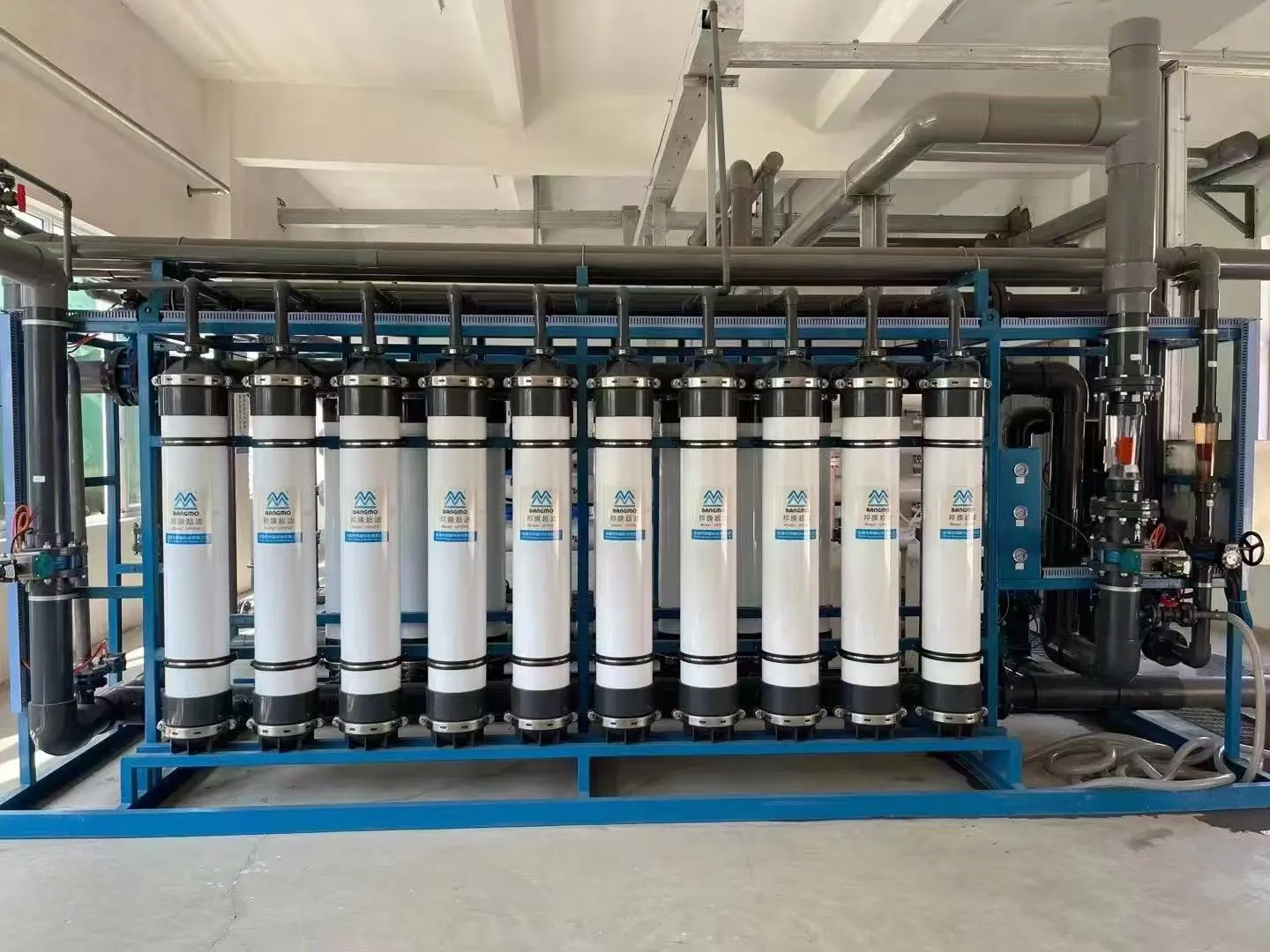
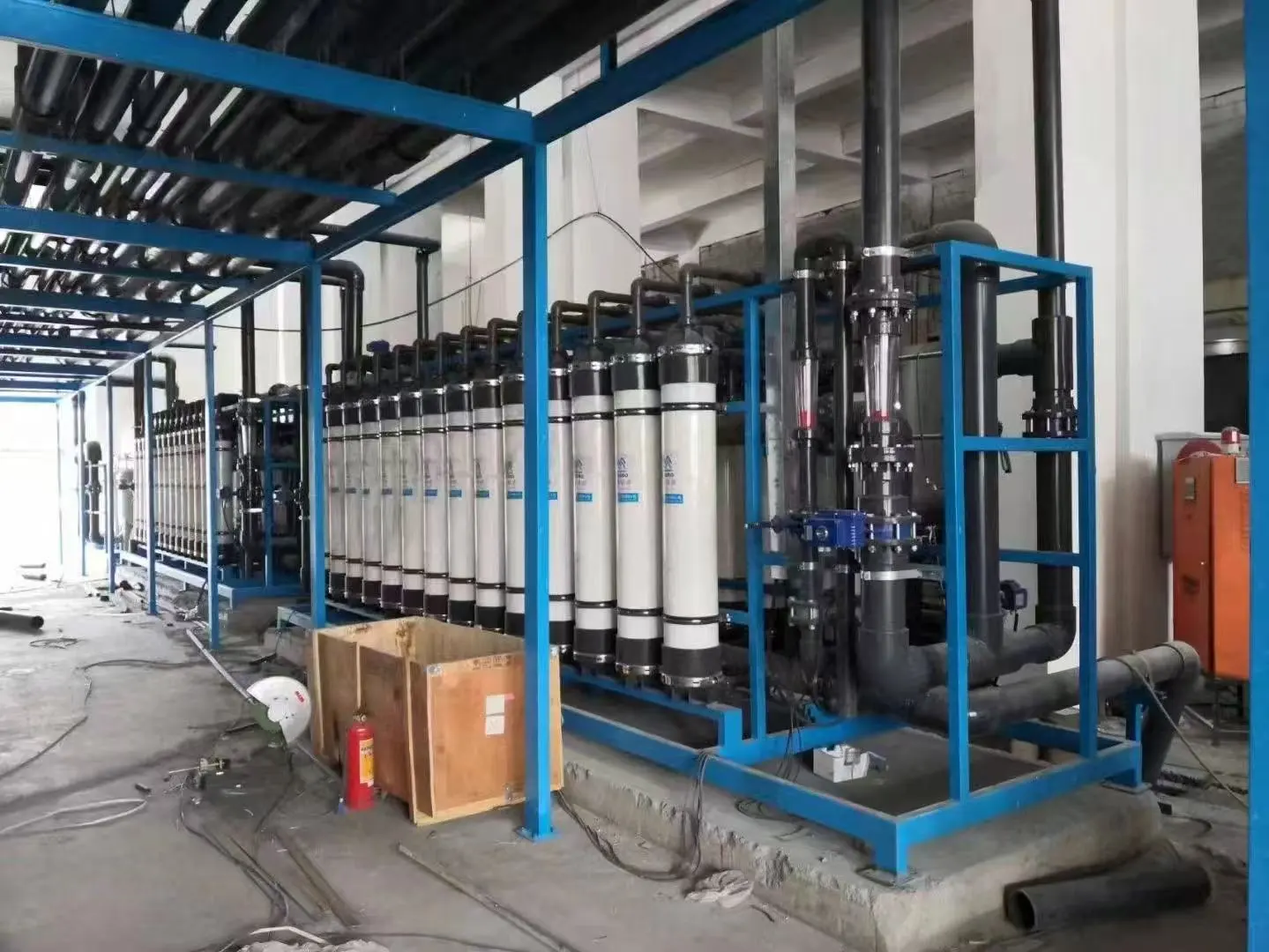
Multiple UF membrane trains operate in parallel, allowing individual trains to enter backwashing or cleaning cycles while the remaining modules continue producing water. The system uses cross-flow filtration, automatic backwashing, chemically enhanced backwashing and periodic CIP cleaning to control membrane fouling.
Treatment Process
Reservoir/River Water → Screening → Coagulation and Flocculation → Clarification → Multimedia Filtration → Ultrafiltration System → UF Product-Water Tank → Final Disinfection → Municipal Distribution Network
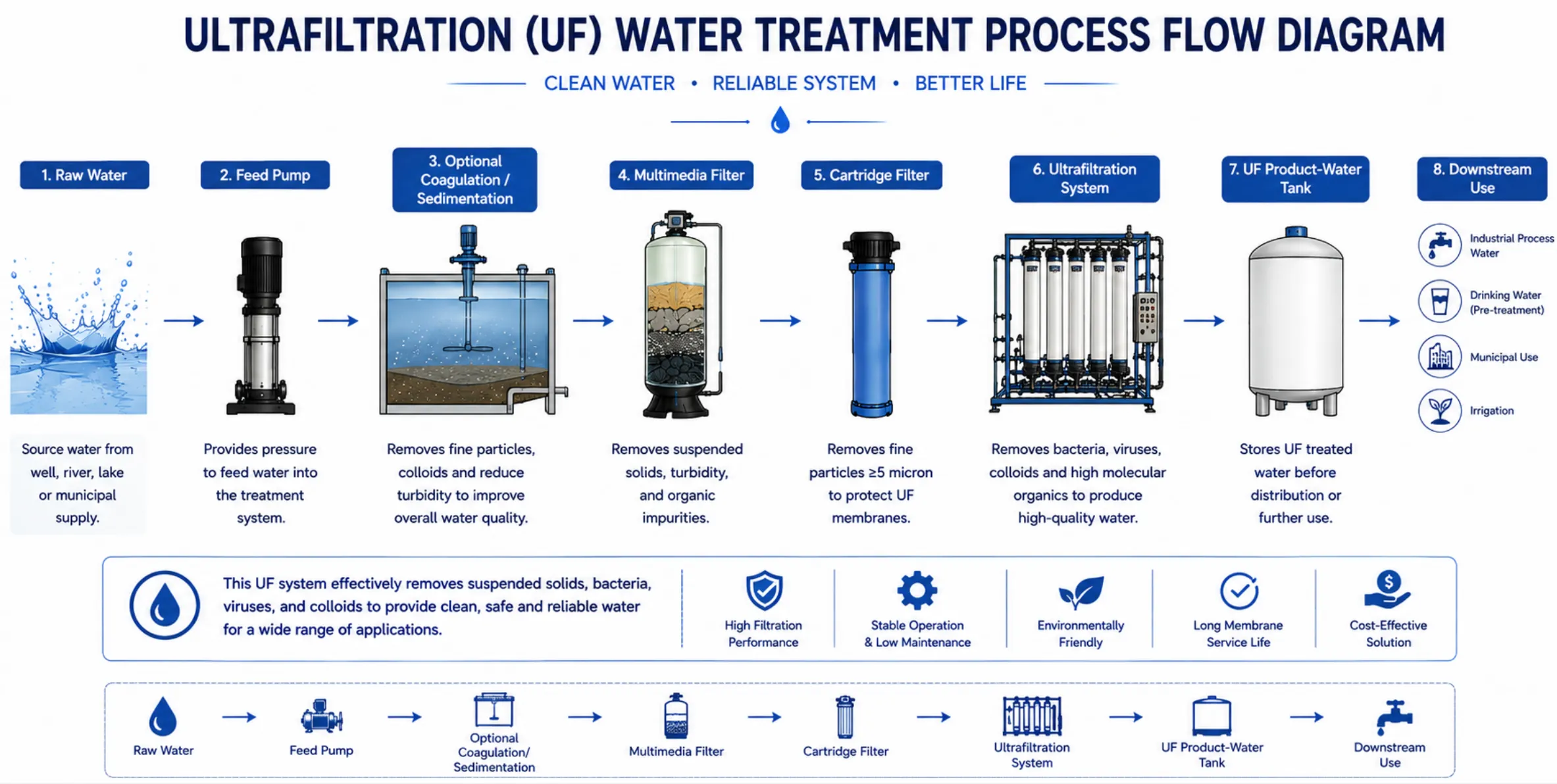
The exact pretreatment process is adjusted according to peak turbidity, algae, organic matter and other raw-water parameters.
Main Treatment Functions
| Treatment Stage | Main Function |
|---|---|
| Screening | Removes leaves and larger debris |
| Coagulation and flocculation | Destabilizes fine particles and colloids |
| Clarification | Reduces sediment and solids loading |
| Multimedia filtration | Protects UF membranes from larger particles |
| Ultrafiltration | Reduces turbidity, colloids and many microorganisms |
| Backwashing and CEB | Removes accumulated membrane contaminants |
| CIP cleaning | Restores membrane performance when required |
| Final disinfection | Provides a disinfectant barrier before distribution |
Core System Configuration
The 3600m³/day UF plant in Yaoundé includes:
- • Industrial hollow-fiber UF membranes
- • Modular parallel membrane trains
- • Automatic filtration and backwashing
- • Air-scour cleaning
- • Chemically enhanced backwashing
- • Independent CIP cleaning unit
- • Automatic chemical dosing
- • PLC control with touchscreen HMI
- • Online flow, pressure and turbidity monitoring
- • Transmembrane-pressure monitoring
- • Automatic tank-level control
- • Fault alarms and equipment protection
- • Compact skid-mounted construction
Technical Parameters
| Parameter | Project Specification |
|---|---|
| Net daily product-water capacity | 3600m³/day |
| Average net output | Approximately 150m³/h |
| Membrane type | Hollow-fiber UF membrane |
| Typical pore size | Approximately 0.01μm |
| Operating mode | Cross-flow filtration |
| Typical operating pressure | 0.1–0.3MPa |
| Design recovery rate | ≥90% under project conditions |
| Backwashing | Automatic |
| Chemical cleaning | CEB and CIP |
| Control mode | Automatic PLC |
| Installation type | Modular skid-mounted |
Actual output, recovery and cleaning frequency depend on source-water quality, temperature and membrane operating conditions.
Project Results
After commissioning, the municipal UF water treatment system in Yaoundé provided up to 3600m³ of treated water per day under its design conditions.
The project delivered the following benefits:
-
 Increased the water plant’s treatment capacity
 - Reduced product-water turbidity and suspended solids
- Improved the removal of fine particles and colloids
- Strengthened the treatment barrier against microorganisms
- Stabilized water quality during seasonal raw-water changes
- Reduced the expansion footprint by more than 60% compared with the original conventional expansion concept
- Shortened on-site construction and installation time
- Simplified routine operation through automatic control
- Provided additional clean-water capacity for surrounding communities
The number of residents served depends on local daily per-capita water consumption and distribution-network capacity.
For drinking-water supply, UF must be combined with suitable final disinfection, distribution residual control and regular laboratory testing. Compliance with local requirements or relevant WHO guideline values should be confirmed using validated chemical and microbiological results.
Why Use UF for Municipal Water-Plant Expansion?
A modular ultrafiltration system for municipal water treatment offers several advantages where land and construction time are limited:
- • Smaller footprint than large conventional treatment basins
- • Modular capacity expansion
- • Stable particle and turbidity removal
- • Automatic filtration and cleaning
- • Faster installation of prefabricated skids
- • Easier integration with existing treatment facilities
- • Flexible standby capacity for continuous water production
FAQ
Can ultrafiltration treat high-turbidity surface water?
Yes, but high-turbidity river or reservoir water normally requires screening, coagulation, clarification or media filtration before UF.
Can UF remove bacteria and protozoa?
UF provides a strong physical barrier against many microorganisms when the correct membrane, operating conditions and membrane-integrity monitoring are used. Final disinfection is still required for municipal drinking-water systems.
Does UF remove dissolved salts?
No. Ultrafiltration removes particles and colloids but does not significantly reduce TDS or conductivity. Reverse osmosis is required for desalination.
Can the plant operate continuously?
Yes. Parallel membrane trains allow individual units to undergo backwashing or cleaning while other trains remain in production.
How is membrane performance maintained?
The system uses automatic backwashing, air scouring, chemically enhanced backwashing and periodic CIP cleaning based on pressure and flux changes.
Can the plant be expanded later?
Yes. The modular design allows additional UF membrane trains, pumps and control components to be installed when future demand increases.
Information Required for a Similar Project
Please provide:
- Raw-water source and complete analysis
- Average and peak seasonal turbidity
- TSS, COD, TOC and algae data
- Iron and manganese concentrations
- Microbiological test results
- Required daily net product-water capacity
- Required drinking-water standard
- Existing treatment process and available installation space
- Daily operating hours
- Local voltage and frequency
- Final disinfection and distribution requirements
Zhongnuo provides customized large-scale UF systems for municipal water-treatment projects in Africa, including process design, modular equipment manufacturing and factory testing.
Project Overview
Zhongnuo supplied a 3600 TPD ultrafiltration water treatment system for a municipal water plant upgrade in Yaoundé, Cameroon. The project was designed to improve surface-water treatment capacity and provide a more stable source of clean water for nearby urban communities.
The existing treatment plant relied mainly on conventional sedimentation and sand filtration. Population growth, limited expansion space and seasonal changes in reservoir and river-water quality created an urgent need for a compact, automated treatment solution.
A modular skid-mounted UF system was selected to increase capacity while reducing the civil-construction work required for the water-plant expansion.
Project Information
| Item | Project Details |
|---|---|
| Location | Yaoundé, Cameroon |
| Application | Municipal water-treatment plant upgrade |
| Raw water | Reservoir and river surface water |
| Daily net capacity | 3600m³/day |
| Average hourly output | Approximately 150m³/h |
| Main technology | Hollow-fiber ultrafiltration |
| Installation | Modular skid-mounted membrane trains |
| Cleaning system | Automatic backwashing + CEB + CIP |
| Control system | Industrial PLC with touchscreen HMI |
| Product-water use | Municipal drinking-water treatment |
Customer Challenges
The Yaoundé water plant faced several capacity and water-quality problems:
- • Growing urban demand exceeded the capacity of the existing plant
- • Limited land was available for conventional expansion
- • New sedimentation tanks would require extensive civil construction
- • Seasonal rainfall increased sediment and turbidity in the source water
- • Conventional filters provided limited control of fine colloids
- • Organic loading affected treated-water stability
- • The plant required simple operation with limited manual intervention
- • Final water quality needed to remain stable during raw-water fluctuations
Raw-Water Conditions
The reservoir and river source water contained variable levels of:
- • Suspended sediment
- • High seasonal turbidity
- • Fine colloidal particles
- • Natural organic matter
- • Algae and microorganisms
Peak rainy-season water quality was used as an important basis for designing the pretreatment and membrane-cleaning system.
Customized Ultrafiltration Solution
Zhongnuo designed a 150m³/h municipal ultrafiltration system for surface-water treatment in Cameroon.
Multiple UF membrane trains operate in parallel, allowing individual trains to enter backwashing or cleaning cycles while the remaining modules continue producing water. The system uses cross-flow filtration, automatic backwashing, chemically enhanced backwashing and periodic CIP cleaning to control membrane fouling.
Treatment Process
Reservoir/River Water → Screening → Coagulation and Flocculation → Clarification → Multimedia Filtration → Ultrafiltration System → UF Product-Water Tank → Final Disinfection → Municipal Distribution Network
The exact pretreatment process is adjusted according to peak turbidity, algae, organic matter and other raw-water parameters.
Main Treatment Functions
| Treatment Stage | Main Function |
|---|---|
| Screening | Removes leaves and larger debris |
| Coagulation and flocculation | Destabilizes fine particles and colloids |
| Clarification | Reduces sediment and solids loading |
| Multimedia filtration | Protects UF membranes from larger particles |
| Ultrafiltration | Reduces turbidity, colloids and many microorganisms |
| Backwashing and CEB | Removes accumulated membrane contaminants |
| CIP cleaning | Restores membrane performance when required |
| Final disinfection | Provides a disinfectant barrier before distribution |
Core System Configuration
The 3600m³/day UF plant in Yaoundé includes:
- • Industrial hollow-fiber UF membranes
- • Modular parallel membrane trains
- • Automatic filtration and backwashing
- • Air-scour cleaning
- • Chemically enhanced backwashing
- • Independent CIP cleaning unit
- • Automatic chemical dosing
- • PLC control with touchscreen HMI
- • Online flow, pressure and turbidity monitoring
- • Transmembrane-pressure monitoring
- • Automatic tank-level control
- • Fault alarms and equipment protection
- • Compact skid-mounted construction
Technical Parameters
| Parameter | Project Specification |
|---|---|
| Net daily product-water capacity | 3600m³/day |
| Average net output | Approximately 150m³/h |
| Membrane type | Hollow-fiber UF membrane |
| Typical pore size | Approximately 0.01μm |
| Operating mode | Cross-flow filtration |
| Typical operating pressure | 0.1–0.3MPa |
| Design recovery rate | ≥90% under project conditions |
| Backwashing | Automatic |
| Chemical cleaning | CEB and CIP |
| Control mode | Automatic PLC |
| Installation type | Modular skid-mounted |
Actual output, recovery and cleaning frequency depend on source-water quality, temperature and membrane operating conditions.
Project Results
After commissioning, the municipal UF water treatment system in Yaoundé provided up to 3600m³ of treated water per day under its design conditions.
The project delivered the following benefits:
- Increased the water plant’s treatment capacity
- Reduced product-water turbidity and suspended solids
- Improved the removal of fine particles and colloids
- Strengthened the treatment barrier against microorganisms
- Stabilized water quality during seasonal raw-water changes
- Reduced the expansion footprint by more than 60% compared with the original conventional expansion concept
- Shortened on-site construction and installation time
- Simplified routine operation through automatic control
- Provided additional clean-water capacity for surrounding communities
The number of residents served depends on local daily per-capita water consumption and distribution-network capacity.
For drinking-water supply, UF must be combined with suitable final disinfection, distribution residual control and regular laboratory testing. Compliance with local requirements or relevant WHO guideline values should be confirmed using validated chemical and microbiological results.
Why Use UF for Municipal Water-Plant Expansion?
A modular ultrafiltration system for municipal water treatment offers several advantages where land and construction time are limited:
- • Smaller footprint than large conventional treatment basins
- • Modular capacity expansion
- • Stable particle and turbidity removal
- • Automatic filtration and cleaning
- • Faster installation of prefabricated skids
- • Easier integration with existing treatment facilities
- • Flexible standby capacity for continuous water production
FAQ
Can ultrafiltration treat high-turbidity surface water?
Yes, but high-turbidity river or reservoir water normally requires screening, coagulation, clarification or media filtration before UF.
Can UF remove bacteria and protozoa?
UF provides a strong physical barrier against many microorganisms when the correct membrane, operating conditions and membrane-integrity monitoring are used. Final disinfection is still required for municipal drinking-water systems.
Does UF remove dissolved salts?
No. Ultrafiltration removes particles and colloids but does not significantly reduce TDS or conductivity. Reverse osmosis is required for desalination.
Can the plant operate continuously?
Yes. Parallel membrane trains allow individual units to undergo backwashing or cleaning while other trains remain in production.
How is membrane performance maintained?
The system uses automatic backwashing, air scouring, chemically enhanced backwashing and periodic CIP cleaning based on pressure and flux changes.
Can the plant be expanded later?
Yes. The modular design allows additional UF membrane trains, pumps and control components to be installed when future demand increases.
Information Required for a Similar Project
Please provide:
- Raw-water source and complete analysis
- Average and peak seasonal turbidity
- TSS, COD, TOC and algae data
- Iron and manganese concentrations
- Microbiological test results
- Required daily net product-water capacity
- Required drinking-water standard
- Existing treatment process and available installation space
- Daily operating hours
- Local voltage and frequency
- Final disinfection and distribution requirements
Zhongnuo provides customized large-scale UF systems for municipal water-treatment projects in Africa, including process design, modular equipment manufacturing and factory testing.
Get a Quote for Free
Submit this form and our sales representative will contact you soon.


ONLINE MESSAGE
Copyright © 2026 Zhongnuo Water Treatment Co., Ltd.