

SEARCH WHAT YOU WANT
Boron Removal in Seawater Desalination: Is Double-Pass RO Required?
Time:2026-08-31
Boron is naturally present in seawater and can be more difficult to remove than common dissolved salts. A seawater reverse osmosis system may achieve excellent salt rejection while still allowing part of the boron to pass into the product water.
So, is double-pass RO always required for boron removal?
The answer is no. It depends on the raw seawater boron level, water temperature, membrane performance, operating conditions and required product-water standard.
Why Is Boron Difficult to Remove from Seawater?
At normal seawater pH, most boron exists as boric acid. Boric acid is a small, weakly ionized molecule that is more difficult for an RO membrane to reject than charged salt ions.
Boron rejection can also be affected by:
- • Seawater temperature
- • Feed-water pH
- • Membrane type and condition
- • Operating pressure
- • System recovery rate
- • Membrane age
- • Required product-water quality
Higher water temperatures may increase membrane water flow while reducing boron rejection. This is particularly important for desalination plants operating in tropical coastal regions.
Can a Single-Pass SWRO System Remove Boron?
A single-pass seawater desalination system can remove a significant portion of boron, but the remaining concentration may not always meet the project requirement.
Single-pass SWRO may be sufficient when:
- • Raw seawater boron is relatively low
- • The product water is used for applications with a less restrictive boron limit
- • High-boron-rejection SWRO membranes are selected
- • Water temperature and operating conditions support sufficient rejection
- • Product-water testing confirms compliance
System design should not rely only on the membrane’s nominal rejection data. Feed-water analysis and membrane projection software should be used before equipment selection.
When Is Double-Pass RO Required?
Double-pass RO is commonly selected when the first-pass SWRO permeate cannot reliably meet the required boron or conductivity level.
A typical process is:
Seawater → Pretreatment → Cartridge Filter → High-Pressure Pump → First-Pass SWRO → pH Adjustment → Second-Pass RO → Remineralization → Disinfection → Product-Water Tank
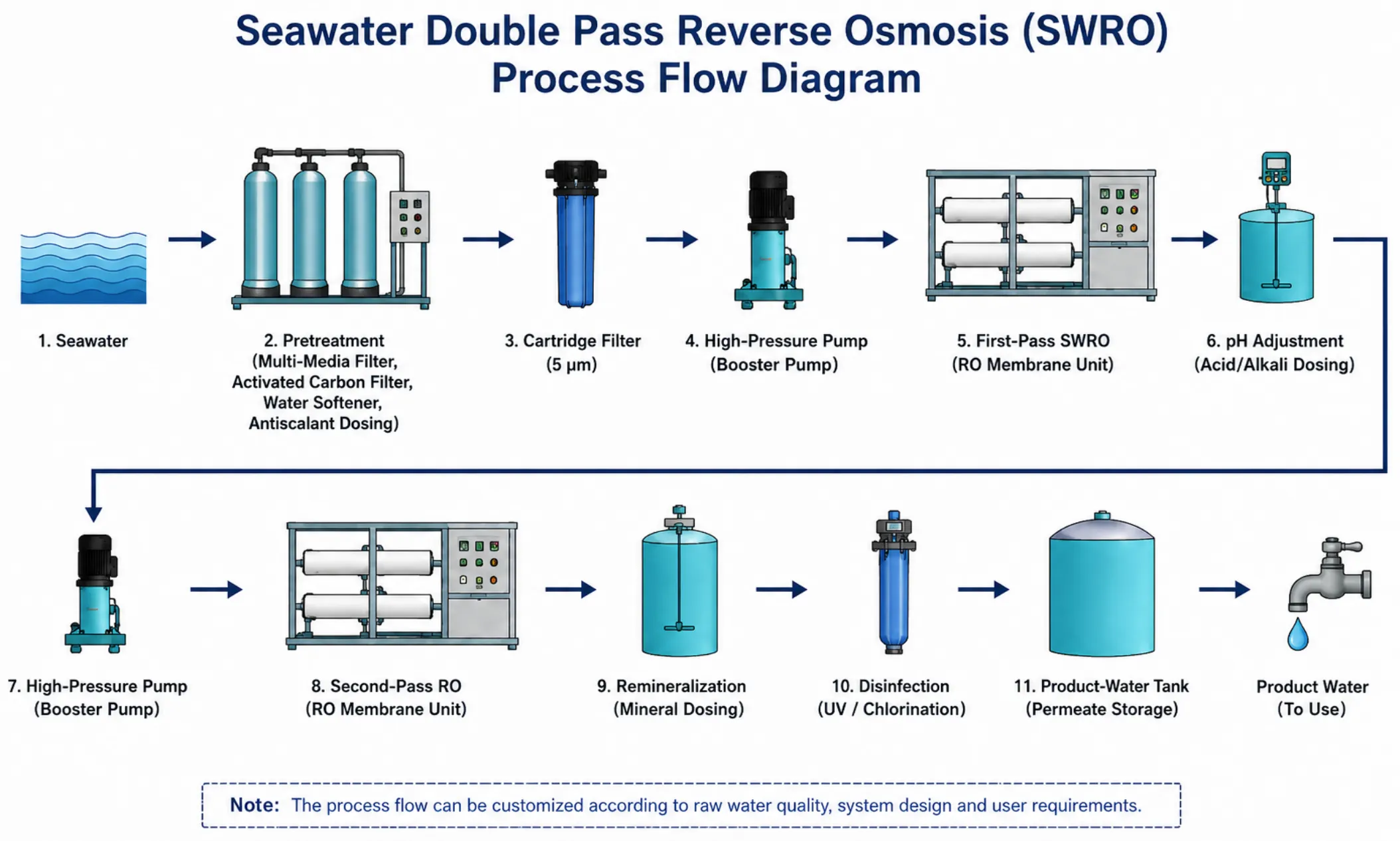
During the second pass, controlled pH adjustment converts more boric acid into charged borate ions. These ions are easier for the second RO membrane to reject.
The chemical type, pH target and dosage must be determined according to membrane limits, water composition and scaling risk. Operators should not adjust pH without a verified system design.
Single-Pass vs Double-Pass RO
| Item | Single-Pass SWRO | Double-Pass RO |
|---|---|---|
| Initial investment | Lower | Higher |
| Energy consumption | Lower | Higher |
| Boron removal | Depends strongly on conditions | More reliable |
| Product-water conductivity | Higher | Lower |
| Equipment complexity | Simpler | More pumps, membranes and controls |
| Best application | General industrial or suitable drinking-water projects | Strict boron and low-conductivity requirements |
Double-pass RO should be selected because the water-quality target requires it—not simply because it appears to be a more advanced configuration.
Explore our customizable industrial reverse osmosis systems for single-pass and double-pass treatment requirements.
Is Pretreatment Important for Boron Removal?
Conventional pretreatment cannot directly remove dissolved boric acid effectively. However, it remains essential for protecting the SWRO membranes.
Seawater pretreatment may include:
- • Screening and intake filtration
- • Coagulation and clarification
- • Multimedia filtration
- • Ultrafiltration
- • Chemical dosing
- • Cartridge filtration
An effective RO pretreatment system helps control turbidity, suspended solids, microorganisms and organic matter. Stable pretreatment allows the membranes to maintain their designed boron and salt rejection performance.
Alternatives to Double-Pass RO
Depending on the project, alternative or combined solutions may include:
- • High-boron-rejection SWRO membranes
- • Partial second-pass treatment
- • Blending treated water streams
- • Boron-selective ion-exchange resin
- • Optimized pH control
- • Seasonal operating adjustments
Partial second-pass treatment may reduce energy use when only part of the first-pass permeate requires further purification. However, the final blending ratio must consistently meet the required water standard.
What Information Is Required for System Design?
Before designing a boron-removal system, provide:
- Complete seawater analysis
- Boron concentration
- Seawater TDS and temperature range
- Required product-water capacity
- Daily operating hours
- Target boron concentration
- Product-water conductivity requirement
- Intended water use
- Installation location and local voltage
Read our guide on how to understand a water-quality report before requesting a technical proposal.
How Does Double-Pass RO Affect Project Cost?
Adding a second RO pass normally increases:
- • Membrane and pressure-vessel quantity
- • Pump and control-system requirements
- • Chemical-dosing equipment
- • Power consumption
- • Installation space
- • Maintenance requirements
However, installing an unnecessary second pass also increases lifetime operating costs. The correct configuration should balance water quality, reliability and energy consumption.
Learn more about the main factors affecting seawater desalination plant cost.
For remote or coastal projects, the complete process can also be installed inside a containerized reverse osmosis system. You can view our completed water-treatment project cases for additional application references.
Conclusion
Double-pass RO is not required for every seawater desalination project. A single-pass SWRO system may be sufficient when the first-pass permeate meets the required boron and conductivity standards.
Double-pass RO becomes necessary when the product-water specification is stricter than the reliable performance of a single pass. The decision should be based on seawater analysis, seasonal temperature, membrane projection and verified product-water testing.
Zhongnuo Water Treatment provides customized single-pass and double-pass SWRO systems. Send us your seawater analysis, required capacity, operating hours, product-water use and target boron level for a suitable technical proposal.
Frequently Asked Questions
Can an SWRO membrane remove boron?
Yes, but boron rejection is normally lower than the rejection of common dissolved salts. Actual performance depends on pH, temperature, membrane selection and operating conditions.
Is double-pass RO always required for drinking water?
No. It is required only when single-pass product water cannot reliably meet the applicable boron and overall water-quality standards.
Can ultrafiltration remove boron?
No. Ultrafiltration removes suspended solids, colloids and microorganisms but cannot effectively remove dissolved boric acid.
Does increasing pH improve boron removal?
Yes. Higher pH converts more boric acid into charged borate ions, which RO membranes can reject more effectively. However, pH adjustment must consider membrane limits and scaling risks.
Can only part of the permeate enter the second RO pass?
Yes. Partial second-pass treatment and controlled blending may reduce energy consumption, provided the final water consistently meets the required standard.
Boron is naturally present in seawater and can be more difficult to remove than common dissolved salts. A seawater reverse osmosis system may achieve excellent salt rejection while still allowing part of the boron to pass into the product water.
So, is double-pass RO always required for boron removal?
The answer is no. It depends on the raw seawater boron level, water temperature, membrane performance, operating conditions and required product-water standard.
Why Is Boron Difficult to Remove from Seawater?
At normal seawater pH, most boron exists as boric acid. Boric acid is a small, weakly ionized molecule that is more difficult for an RO membrane to reject than charged salt ions.
Boron rejection can also be affected by:
- • Seawater temperature
- • Feed-water pH
- • Membrane type and condition
- • Operating pressure
- • System recovery rate
- • Membrane age
- • Required product-water quality
Higher water temperatures may increase membrane water flow while reducing boron rejection. This is particularly important for desalination plants operating in tropical coastal regions.
Can a Single-Pass SWRO System Remove Boron?
A single-pass seawater desalination system can remove a significant portion of boron, but the remaining concentration may not always meet the project requirement.
Single-pass SWRO may be sufficient when:
- • Raw seawater boron is relatively low
- • The product water is used for applications with a less restrictive boron limit
- • High-boron-rejection SWRO membranes are selected
- • Water temperature and operating conditions support sufficient rejection
- • Product-water testing confirms compliance
System design should not rely only on the membrane’s nominal rejection data. Feed-water analysis and membrane projection software should be used before equipment selection.
When Is Double-Pass RO Required?
Double-pass RO is commonly selected when the first-pass SWRO permeate cannot reliably meet the required boron or conductivity level.
A typical process is:
Seawater → Pretreatment → Cartridge Filter → High-Pressure Pump → First-Pass SWRO → pH Adjustment → Second-Pass RO → Remineralization → Disinfection → Product-Water Tank
During the second pass, controlled pH adjustment converts more boric acid into charged borate ions. These ions are easier for the second RO membrane to reject.
The chemical type, pH target and dosage must be determined according to membrane limits, water composition and scaling risk. Operators should not adjust pH without a verified system design.
Single-Pass vs Double-Pass RO
| Item | Single-Pass SWRO | Double-Pass RO |
|---|---|---|
| Initial investment | Lower | Higher |
| Energy consumption | Lower | Higher |
| Boron removal | Depends strongly on conditions | More reliable |
| Product-water conductivity | Higher | Lower |
| Equipment complexity | Simpler | More pumps, membranes and controls |
| Best application | General industrial or suitable drinking-water projects | Strict boron and low-conductivity requirements |
Double-pass RO should be selected because the water-quality target requires it—not simply because it appears to be a more advanced configuration.
Explore our customizable industrial reverse osmosis systems for single-pass and double-pass treatment requirements.
Is Pretreatment Important for Boron Removal?
Conventional pretreatment cannot directly remove dissolved boric acid effectively. However, it remains essential for protecting the SWRO membranes.
Seawater pretreatment may include:
- • Screening and intake filtration
- • Coagulation and clarification
- • Multimedia filtration
- • Ultrafiltration
- • Chemical dosing
- • Cartridge filtration
An effective RO pretreatment system helps control turbidity, suspended solids, microorganisms and organic matter. Stable pretreatment allows the membranes to maintain their designed boron and salt rejection performance.
Alternatives to Double-Pass RO
Depending on the project, alternative or combined solutions may include:
- • High-boron-rejection SWRO membranes
- • Partial second-pass treatment
- • Blending treated water streams
- • Boron-selective ion-exchange resin
- • Optimized pH control
- • Seasonal operating adjustments
Partial second-pass treatment may reduce energy use when only part of the first-pass permeate requires further purification. However, the final blending ratio must consistently meet the required water standard.
What Information Is Required for System Design?
Before designing a boron-removal system, provide:
- Complete seawater analysis
- Boron concentration
- Seawater TDS and temperature range
- Required product-water capacity
- Daily operating hours
- Target boron concentration
- Product-water conductivity requirement
- Intended water use
- Installation location and local voltage
Read our guide on how to understand a water-quality report before requesting a technical proposal.
How Does Double-Pass RO Affect Project Cost?
Adding a second RO pass normally increases:
- • Membrane and pressure-vessel quantity
- • Pump and control-system requirements
- • Chemical-dosing equipment
- • Power consumption
- • Installation space
- • Maintenance requirements
However, installing an unnecessary second pass also increases lifetime operating costs. The correct configuration should balance water quality, reliability and energy consumption.
Learn more about the main factors affecting seawater desalination plant cost.
For remote or coastal projects, the complete process can also be installed inside a containerized reverse osmosis system. You can view our completed water-treatment project cases for additional application references.
Conclusion
Double-pass RO is not required for every seawater desalination project. A single-pass SWRO system may be sufficient when the first-pass permeate meets the required boron and conductivity standards.
Double-pass RO becomes necessary when the product-water specification is stricter than the reliable performance of a single pass. The decision should be based on seawater analysis, seasonal temperature, membrane projection and verified product-water testing.
Zhongnuo Water Treatment provides customized single-pass and double-pass SWRO systems. Send us your seawater analysis, required capacity, operating hours, product-water use and target boron level for a suitable technical proposal.
Frequently Asked Questions
Can an SWRO membrane remove boron?
Yes, but boron rejection is normally lower than the rejection of common dissolved salts. Actual performance depends on pH, temperature, membrane selection and operating conditions.
Is double-pass RO always required for drinking water?
No. It is required only when single-pass product water cannot reliably meet the applicable boron and overall water-quality standards.
Can ultrafiltration remove boron?
No. Ultrafiltration removes suspended solids, colloids and microorganisms but cannot effectively remove dissolved boric acid.
Does increasing pH improve boron removal?
Yes. Higher pH converts more boric acid into charged borate ions, which RO membranes can reject more effectively. However, pH adjustment must consider membrane limits and scaling risks.
Can only part of the permeate enter the second RO pass?
Yes. Partial second-pass treatment and controlled blending may reduce energy consumption, provided the final water consistently meets the required standard.
Get a Quote for Free
Submit this form and our sales representative will contact you soon.


ONLINE MESSAGE
Copyright © 2026 Zhongnuo Water Treatment Co., Ltd.