

SEARCH WHAT YOU WANT
Hard Borehole Water: Should You Use a Water Softener or RO?
Time:2026-09-01
Hardness is a common problem in borehole water. High calcium and magnesium levels can cause white deposits, blocked pipes, reduced heating efficiency and scale inside production equipment.
Both water softeners and reverse osmosis systems can control hardness, but they work differently. A softener is normally selected when scale prevention is the main goal, while RO is more suitable when the project also requires lower TDS, conductivity and dissolved contaminants.
What Causes Hard Borehole Water?
As groundwater moves through underground rock and soil, it dissolves calcium, magnesium and other minerals. The hardness level depends on local geology, well depth and seasonal groundwater conditions.
Common signs of hard borehole water include:
- • White scale on tanks, pipes and valves
- • Frequent blockage of nozzles or heat exchangers
- • Reduced boiler or heater efficiency
- • Soap that does not foam easily
- • Spots on glass and equipment
- • Increasing RO membrane pressure
- • Frequent equipment cleaning
A complete water analysis should be performed before selecting a borehole water treatment system.
How Does a Water Softener Treat Hardness?
A water softener uses ion-exchange resin to replace calcium and magnesium ions with sodium ions.
It is mainly used to:
- • Prevent scale in pipelines
- • Protect boilers and heat exchangers
- • Improve washing and cleaning
- • Protect downstream RO membranes
- • Reduce equipment maintenance
A softener removes hardness but does not significantly reduce TDS, conductivity, chloride, sulfate, nitrate or other dissolved salts.
Choose a Water Softener When:
- • Hardness is the main water-quality problem
- • Low conductivity is not required
- • The water is used for washing, cooling or general utility
- • Scale protection is the main objective
- • Regular salt regeneration is acceptable
A properly designed water pretreatment system can include an automatic softener, brine tank and regeneration control.
How Does RO Treat Hard Borehole Water?
Reverse osmosis uses membrane separation to reduce calcium, magnesium and many other dissolved contaminants.
RO can reduce:
- • Hardness
- • TDS and conductivity
- • Chloride and sulfate
- • Nitrate and fluoride
- • Dissolved metals
- • Other mineral salts
Choose RO When:
- • Low-TDS product water is required
- • The water is used for drinking or food production
- • The project requires process water with controlled conductivity
- • Borehole water contains several dissolved contaminants
- • Hardness reduction alone is insufficient
- • The water will supply boilers or sensitive production equipment
Explore our customizable industrial reverse osmosis systems for different borehole-water conditions.
Water Softener vs RO
| Item | Water Softener | Reverse Osmosis |
|---|---|---|
| Main function | Removes calcium and magnesium hardness | Reduces hardness and dissolved salts |
| TDS reduction | No significant reduction | Significant reduction |
| Scale control | Effective | Effective with correct design |
| Wastewater | Regeneration wastewater | Concentrate water |
| Consumables | Regeneration salt | Filters, membranes and chemicals |
| Operating pressure | Relatively low | Higher |
| Product-water conductivity | Similar to feed water | Much lower |
| Best application | Scale protection and utility water | Drinking and industrial purified water |
The correct choice depends on the final water requirement, not only on the hardness value.
Do You Need Both a Softener and RO?
In many industrial projects, the best solution is a water softener followed by RO.
A typical process is:
Borehole Water → Multimedia Filter → Activated Carbon Filter → Water Softener → Cartridge Filter → RO System → Optional UV Sterilization → Product-Water Tank
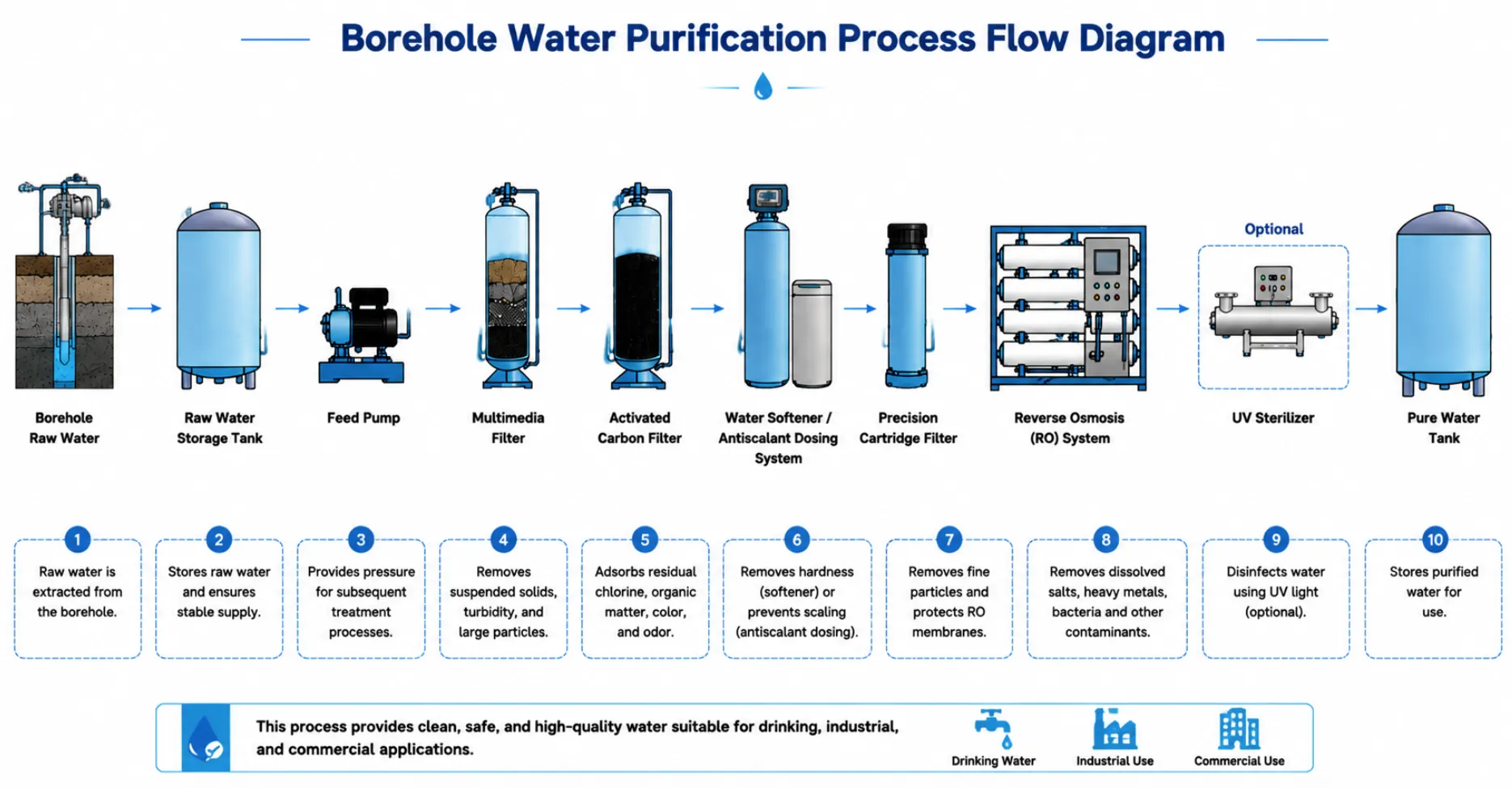
The softener removes calcium and magnesium before they reach the RO membranes. This helps reduce scaling risk and allows the RO system to operate more reliably.
For some projects, antiscalant dosing may be used instead of softening. The choice depends on:
- • Feed-water hardness and alkalinity
- • Silica concentration
- • RO recovery rate
- • Product-water capacity
- • Chemical and salt availability
- • Wastewater-discharge conditions
- • Operating and maintenance costs
A softener or antiscalant cannot correct an unsuitable RO recovery rate or incomplete water analysis.
Other Borehole-Water Problems to Check
Hardness may not be the only issue. Borehole water should also be tested for:
- • TDS and conductivity
- • Iron and manganese
- • Silica
- • Nitrate
- • Chloride and sulfate
- • Turbidity
- • pH
- • Microorganisms
Iron and manganese should normally be removed before softening or RO. Read more about how to remove iron and manganese from borehole water.
If nitrate is present, see our guide on nitrate removal from well water.
High silica also requires special recovery and scaling control. Learn more about high silica in RO feedwater.
Information Required for System Selection
To select between a water softener and RO, provide:
- Complete borehole-water analysis
- Required product-water capacity
- Daily operating hours
- Final water application
- Required conductivity or water standard
- Available installation space
- Local voltage and frequency
- Wastewater-discharge conditions
You can also read how to understand a water-quality report before requesting a quotation.
Conclusion
Use a water softener when hardness and scale are the main problems and low TDS is not required. Choose reverse osmosis when the water must also have lower conductivity, salinity and dissolved contaminants.
For hard borehole water with multiple contaminants, softening followed by RO may provide the most stable solution. The final process should always be based on a recent water analysis and the intended use of the product water.
Zhongnuo Water Treatment provides customized borehole water softening and RO systems. Send us your water report, required capacity, operating hours and product-water use for a suitable treatment proposal.
Frequently Asked Questions
Does a water softener reduce TDS?
No. A softener exchanges calcium and magnesium for sodium but does not significantly reduce the total dissolved solids.
Can RO remove borehole-water hardness?
Yes. RO membranes can significantly reduce calcium, magnesium and other dissolved salts.
Does every RO system need a water softener?
No. The decision depends on hardness, alkalinity, silica, recovery rate and the antiscalant strategy.
Is softened water the same as purified RO water?
No. Softened water has reduced hardness but still contains most other dissolved salts. RO water has much lower TDS and conductivity.
Which system is better for drinking water?
It depends on the complete water analysis. RO is usually more suitable when drinking water contains high TDS or multiple dissolved contaminants, while a softener only addresses hardness.
Hardness is a common problem in borehole water. High calcium and magnesium levels can cause white deposits, blocked pipes, reduced heating efficiency and scale inside production equipment.
Both water softeners and reverse osmosis systems can control hardness, but they work differently. A softener is normally selected when scale prevention is the main goal, while RO is more suitable when the project also requires lower TDS, conductivity and dissolved contaminants.
What Causes Hard Borehole Water?
As groundwater moves through underground rock and soil, it dissolves calcium, magnesium and other minerals. The hardness level depends on local geology, well depth and seasonal groundwater conditions.
Common signs of hard borehole water include:
- • White scale on tanks, pipes and valves
- • Frequent blockage of nozzles or heat exchangers
- • Reduced boiler or heater efficiency
- • Soap that does not foam easily
- • Spots on glass and equipment
- • Increasing RO membrane pressure
- • Frequent equipment cleaning
A complete water analysis should be performed before selecting a borehole water treatment system.
How Does a Water Softener Treat Hardness?
A water softener uses ion-exchange resin to replace calcium and magnesium ions with sodium ions.
It is mainly used to:
- • Prevent scale in pipelines
- • Protect boilers and heat exchangers
- • Improve washing and cleaning
- • Protect downstream RO membranes
- • Reduce equipment maintenance
A softener removes hardness but does not significantly reduce TDS, conductivity, chloride, sulfate, nitrate or other dissolved salts.
Choose a Water Softener When:
- • Hardness is the main water-quality problem
- • Low conductivity is not required
- • The water is used for washing, cooling or general utility
- • Scale protection is the main objective
- • Regular salt regeneration is acceptable
A properly designed water pretreatment system can include an automatic softener, brine tank and regeneration control.
How Does RO Treat Hard Borehole Water?
Reverse osmosis uses membrane separation to reduce calcium, magnesium and many other dissolved contaminants.
RO can reduce:
- • Hardness
- • TDS and conductivity
- • Chloride and sulfate
- • Nitrate and fluoride
- • Dissolved metals
- • Other mineral salts
Choose RO When:
- • Low-TDS product water is required
- • The water is used for drinking or food production
- • The project requires process water with controlled conductivity
- • Borehole water contains several dissolved contaminants
- • Hardness reduction alone is insufficient
- • The water will supply boilers or sensitive production equipment
Explore our customizable industrial reverse osmosis systems for different borehole-water conditions.
Water Softener vs RO
| Item | Water Softener | Reverse Osmosis |
|---|---|---|
| Main function | Removes calcium and magnesium hardness | Reduces hardness and dissolved salts |
| TDS reduction | No significant reduction | Significant reduction |
| Scale control | Effective | Effective with correct design |
| Wastewater | Regeneration wastewater | Concentrate water |
| Consumables | Regeneration salt | Filters, membranes and chemicals |
| Operating pressure | Relatively low | Higher |
| Product-water conductivity | Similar to feed water | Much lower |
| Best application | Scale protection and utility water | Drinking and industrial purified water |
The correct choice depends on the final water requirement, not only on the hardness value.
Do You Need Both a Softener and RO?
In many industrial projects, the best solution is a water softener followed by RO.
A typical process is:
Borehole Water → Multimedia Filter → Activated Carbon Filter → Water Softener → Cartridge Filter → RO System → Optional UV Sterilization → Product-Water Tank
The softener removes calcium and magnesium before they reach the RO membranes. This helps reduce scaling risk and allows the RO system to operate more reliably.
For some projects, antiscalant dosing may be used instead of softening. The choice depends on:
- • Feed-water hardness and alkalinity
- • Silica concentration
- • RO recovery rate
- • Product-water capacity
- • Chemical and salt availability
- • Wastewater-discharge conditions
- • Operating and maintenance costs
A softener or antiscalant cannot correct an unsuitable RO recovery rate or incomplete water analysis.
Other Borehole-Water Problems to Check
Hardness may not be the only issue. Borehole water should also be tested for:
- • TDS and conductivity
- • Iron and manganese
- • Silica
- • Nitrate
- • Chloride and sulfate
- • Turbidity
- • pH
- • Microorganisms
Iron and manganese should normally be removed before softening or RO. Read more about how to remove iron and manganese from borehole water.
If nitrate is present, see our guide on nitrate removal from well water.
High silica also requires special recovery and scaling control. Learn more about high silica in RO feedwater.
Information Required for System Selection
To select between a water softener and RO, provide:
- Complete borehole-water analysis
- Required product-water capacity
- Daily operating hours
- Final water application
- Required conductivity or water standard
- Available installation space
- Local voltage and frequency
- Wastewater-discharge conditions
You can also read how to understand a water-quality report before requesting a quotation.
Conclusion
Use a water softener when hardness and scale are the main problems and low TDS is not required. Choose reverse osmosis when the water must also have lower conductivity, salinity and dissolved contaminants.
For hard borehole water with multiple contaminants, softening followed by RO may provide the most stable solution. The final process should always be based on a recent water analysis and the intended use of the product water.
Zhongnuo Water Treatment provides customized borehole water softening and RO systems. Send us your water report, required capacity, operating hours and product-water use for a suitable treatment proposal.
Frequently Asked Questions
Does a water softener reduce TDS?
No. A softener exchanges calcium and magnesium for sodium but does not significantly reduce the total dissolved solids.
Can RO remove borehole-water hardness?
Yes. RO membranes can significantly reduce calcium, magnesium and other dissolved salts.
Does every RO system need a water softener?
No. The decision depends on hardness, alkalinity, silica, recovery rate and the antiscalant strategy.
Is softened water the same as purified RO water?
No. Softened water has reduced hardness but still contains most other dissolved salts. RO water has much lower TDS and conductivity.
Which system is better for drinking water?
It depends on the complete water analysis. RO is usually more suitable when drinking water contains high TDS or multiple dissolved contaminants, while a softener only addresses hardness.
Get a Quote for Free
Submit this form and our sales representative will contact you soon.


ONLINE MESSAGE
Copyright © 2026 Zhongnuo Water Treatment Co., Ltd.