

SEARCH WHAT YOU WANT
When Does Borehole Water Need Ultrafiltration Before RO?
Time:2026-09-04
Not every borehole water treatment system needs ultrafiltration (UF). UF is recommended when the feed water contains unstable turbidity, colloids, bacteria or fine suspended solids that conventional filters cannot control reliably.
A correctly designed UF system protects RO membranes, reduces cartridge-filter blockage and improves long-term system stability.
What Does Ultrafiltration Remove?
UF membranes can remove:
- • Suspended solids
- • Fine particles and colloids
- • Most bacteria
- • Some microorganisms and organic matter
However, UF cannot remove dissolved salts, hardness, nitrate or high TDS. These contaminants require an industrial reverse osmosis system.
When Is UF Recommended Before RO?
Consider adding ultrafiltration equipment before RO in the following situations:
1. Unstable Turbidity
Borehole water quality may change during rainy seasons, pumping or groundwater-level fluctuations. UF provides a more stable barrier against suspended solids.
2. High SDI or Colloids
High SDI indicates that fine particles may foul RO membranes. If multimedia filtration cannot maintain the required RO inlet quality, UF may be necessary.
3. Frequent Cartridge-Filter Blockage
If cartridge filters require frequent replacement, the existing pretreatment process may be insufficient. UF can reduce the particle load entering the RO system.
4. High Microbiological Risk
Bacteria and microorganisms can cause RO membrane biofouling. UF helps reduce microbial loading, although proper disinfection and system hygiene are still required.
5. Critical Water Applications
Food processing, beverage production and other continuous industrial processes require stable water quality. UF can provide more consistent RO feed water and reduce unplanned shutdowns.
Learn more about reducing RO membrane fouling.
When Is Conventional Pretreatment Enough?
UF may not be required when borehole water has:
- • Low and stable turbidity
- • Acceptable SDI
- • Low microbial contamination
- • No major seasonal water-quality changes
- • Effective multimedia and cartridge filtration
In this case, a standard RO pretreatment system may be sufficient.
Typical UF and RO Treatment Process
A common process is:
Borehole Water → Raw Water Tank → Multimedia Filter → UF System → Cartridge Filter → RO System → Disinfection → Product Water Tank
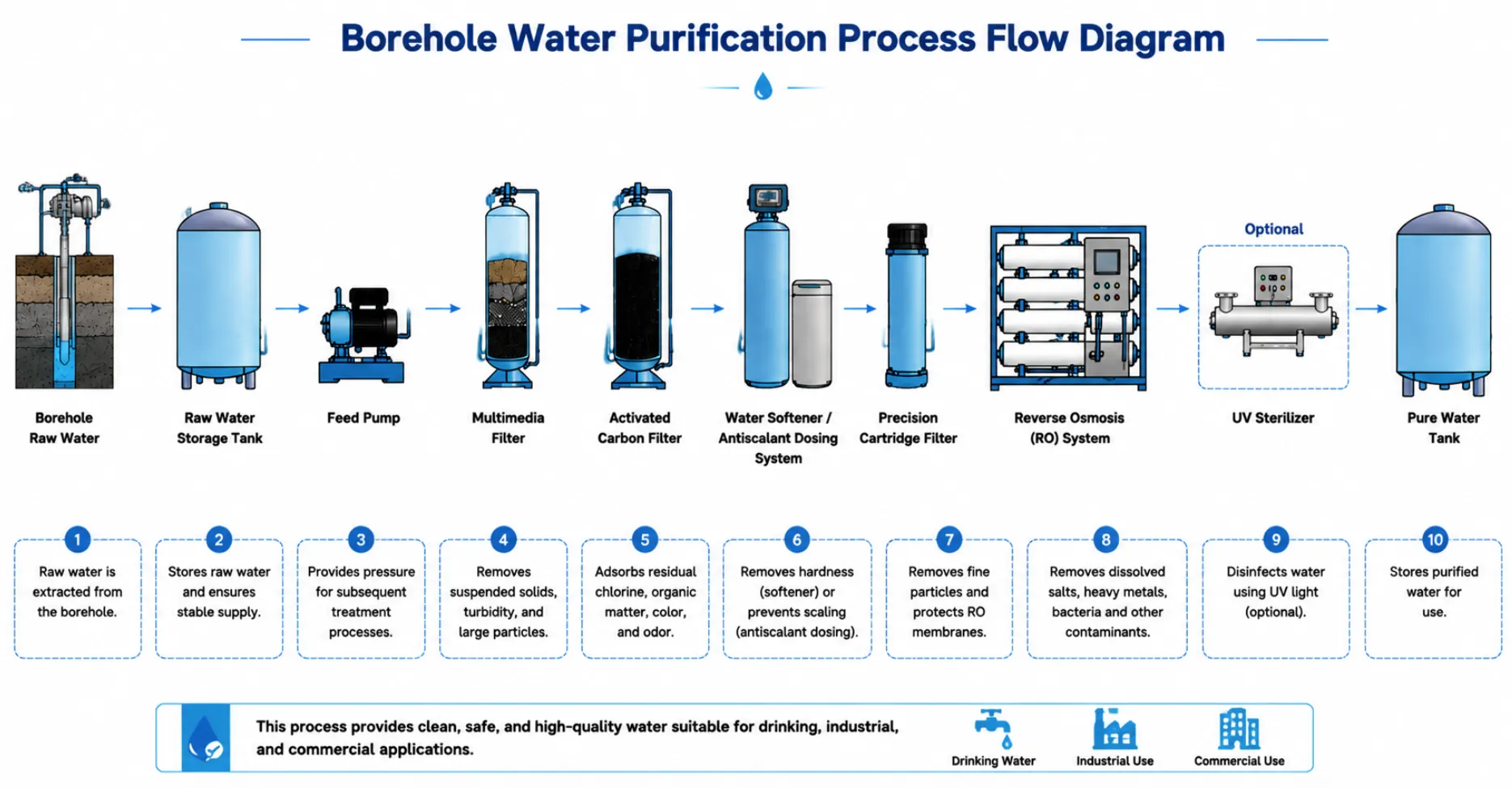
If the water contains high iron or manganese, oxidation and filtration should normally be completed before UF. Read our guide on removing iron and manganese from borehole water.
The final process must be selected according to the full water analysis rather than turbidity alone.
Information Required for System Design
Before selecting UF, provide:
- • Full borehole water analysis
- • Turbidity, SDI and microbial results
- • Iron and manganese concentrations
- • Required hourly water capacity
- • Daily operating hours
- • Product-water quality and intended use
These details help determine whether conventional filtration or a complete borehole water treatment system with UF is more suitable.
Conclusion
Borehole water needs UF before RO when turbidity, colloids, bacteria or seasonal water-quality changes cannot be controlled reliably by conventional pretreatment.
For clean and stable groundwater, multimedia filtration may be enough. For difficult or variable water sources, UF can provide stronger RO membrane protection and more stable operation.
Contact Zhongnuo Water Treatment with your water analysis, required capacity and water application for a customized treatment solution.
FAQ
Does UF reduce borehole-water TDS?
No. UF removes particles and microorganisms but cannot remove dissolved salts. RO is required for TDS reduction.
Can UF replace RO?
No. UF and RO perform different functions. UF is mainly used as pretreatment, while RO removes dissolved salts and other ionic contaminants.
Does every borehole RO system need UF?
No. The decision depends on turbidity, SDI, microorganisms, seasonal changes and operating requirements.
Where should UF be installed?
UF is normally installed after primary filtration and before the cartridge filter and RO system.
Not every borehole water treatment system needs ultrafiltration (UF). UF is recommended when the feed water contains unstable turbidity, colloids, bacteria or fine suspended solids that conventional filters cannot control reliably.
A correctly designed UF system protects RO membranes, reduces cartridge-filter blockage and improves long-term system stability.
What Does Ultrafiltration Remove?
UF membranes can remove:
- • Suspended solids
- • Fine particles and colloids
- • Most bacteria
- • Some microorganisms and organic matter
However, UF cannot remove dissolved salts, hardness, nitrate or high TDS. These contaminants require an industrial reverse osmosis system.
When Is UF Recommended Before RO?
Consider adding ultrafiltration equipment before RO in the following situations:
1. Unstable Turbidity
Borehole water quality may change during rainy seasons, pumping or groundwater-level fluctuations. UF provides a more stable barrier against suspended solids.
2. High SDI or Colloids
High SDI indicates that fine particles may foul RO membranes. If multimedia filtration cannot maintain the required RO inlet quality, UF may be necessary.
3. Frequent Cartridge-Filter Blockage
If cartridge filters require frequent replacement, the existing pretreatment process may be insufficient. UF can reduce the particle load entering the RO system.
4. High Microbiological Risk
Bacteria and microorganisms can cause RO membrane biofouling. UF helps reduce microbial loading, although proper disinfection and system hygiene are still required.
5. Critical Water Applications
Food processing, beverage production and other continuous industrial processes require stable water quality. UF can provide more consistent RO feed water and reduce unplanned shutdowns.
Learn more about reducing RO membrane fouling.
When Is Conventional Pretreatment Enough?
UF may not be required when borehole water has:
- • Low and stable turbidity
- • Acceptable SDI
- • Low microbial contamination
- • No major seasonal water-quality changes
- • Effective multimedia and cartridge filtration
In this case, a standard RO pretreatment system may be sufficient.
Typical UF and RO Treatment Process
A common process is:
Borehole Water → Raw Water Tank → Multimedia Filter → UF System → Cartridge Filter → RO System → Disinfection → Product Water Tank
If the water contains high iron or manganese, oxidation and filtration should normally be completed before UF. Read our guide on removing iron and manganese from borehole water.
The final process must be selected according to the full water analysis rather than turbidity alone.
Information Required for System Design
Before selecting UF, provide:
- • Full borehole water analysis
- • Turbidity, SDI and microbial results
- • Iron and manganese concentrations
- • Required hourly water capacity
- • Daily operating hours
- • Product-water quality and intended use
These details help determine whether conventional filtration or a complete borehole water treatment system with UF is more suitable.
Conclusion
Borehole water needs UF before RO when turbidity, colloids, bacteria or seasonal water-quality changes cannot be controlled reliably by conventional pretreatment.
For clean and stable groundwater, multimedia filtration may be enough. For difficult or variable water sources, UF can provide stronger RO membrane protection and more stable operation.
Contact Zhongnuo Water Treatment with your water analysis, required capacity and water application for a customized treatment solution.
FAQ
Does UF reduce borehole-water TDS?
No. UF removes particles and microorganisms but cannot remove dissolved salts. RO is required for TDS reduction.
Can UF replace RO?
No. UF and RO perform different functions. UF is mainly used as pretreatment, while RO removes dissolved salts and other ionic contaminants.
Does every borehole RO system need UF?
No. The decision depends on turbidity, SDI, microorganisms, seasonal changes and operating requirements.
Where should UF be installed?
UF is normally installed after primary filtration and before the cartridge filter and RO system.
Get a Quote for Free
Submit this form and our sales representative will contact you soon.


ONLINE MESSAGE
Copyright © 2026 Zhongnuo Water Treatment Co., Ltd.