

SEARCH WHAT YOU WANT
3600 Tons/Day Ultrafiltration Water Treatment System
The 3600 tons/day ultrafiltration water treatment system is a large-capacity industrial membrane filtration plant with an average output of approximately 150m³/h based on 24-hour operation.
Using hollow-fiber UF membranes, the system reduces suspended solids, turbidity, colloids, bacteria and high-molecular-weight organic matter. It is suitable for RO pretreatment, municipal water purification, industrial process water and tertiary wastewater reuse.
The 3600 tons/day ultrafiltration water treatment system is a large-capacity industrial membrane filtration plant with an average output of approximately 150m³/h based on 24-hour operation.
Using hollow-fiber UF membranes, the system reduces suspended solids, turbidity, colloids, bacteria and high-molecular-weight organic matter. It is suitable for RO pretreatment, municipal water purification, industrial process water and tertiary wastewater reuse.
Share to
Product Description
1. Product Name and Capacity
| Item | Typical Specification |
|---|---|
| Product name | 3600 Tons/Day Industrial Ultrafiltration Water Treatment System |
| Daily capacity | 3600m³/day |
| Average hourly capacity | 150m³/h based on 24-hour operation |
| Typical operating range | 140–160m³/h |
| Membrane technology | Hollow-fiber ultrafiltration |
| Operation mode | Automatic continuous operation |
| Installation | Modular skid-mounted or containerized |
The required gross filtration capacity may be higher than 150m³/h because backwashing, chemical cleaning and downtime reduce net daily production.
2. Applicable Raw Water
This 150m³/h industrial UF water treatment plant can be designed for:
- • River, lake and reservoir water
- • Municipal source water
- • Well water and groundwater
- • High-turbidity surface water
- • Industrial circulating cooling water
- • Biologically treated wastewater
- • RO system feed water
- • Industrial process-water pretreatment
| Raw-Water Problem | Recommended Pretreatment |
|---|---|
| High turbidity | Coagulation and clarification |
| Large suspended solids | Screening and multimedia filtration |
| Algae and microorganisms | Pretreatment disinfection |
| Organic matter | Coagulation or activated carbon |
| Iron and manganese | Oxidation and removal filtration |
| Oil and grease | Oil separation or flotation |
| High COD | Biological or advanced treatment |
UF does not remove dissolved salts. Reverse osmosis is required when lower TDS or conductivity is needed.
3. Typical Product-Water Quality
| Parameter | Typical Design Target |
|---|---|
| Turbidity | Typically ≤0.1 NTU |
| SDI | Suitable for downstream RO design |
| Suspended solids | Significantly reduced |
| Colloids | Effectively retained |
| Bacteria | Substantially reduced |
| Dissolved salts | Not removed |
| Product-water use | RO pretreatment, process water or further purification |
Actual outlet quality depends on feed-water conditions, membrane selection and operating parameters. Drinking-water applications require final disinfection and compliance testing.
4. Typical Treatment Process
Surface-Water Treatment
Raw Water → Screening → Coagulation/Flocculation → Clarification → Multimedia Filter → Ultrafiltration System → UF Product-Water Tank
RO Pretreatment
Raw Water → Pretreatment → Ultrafiltration System → UF Product-Water Tank → Cartridge Filter → RO System
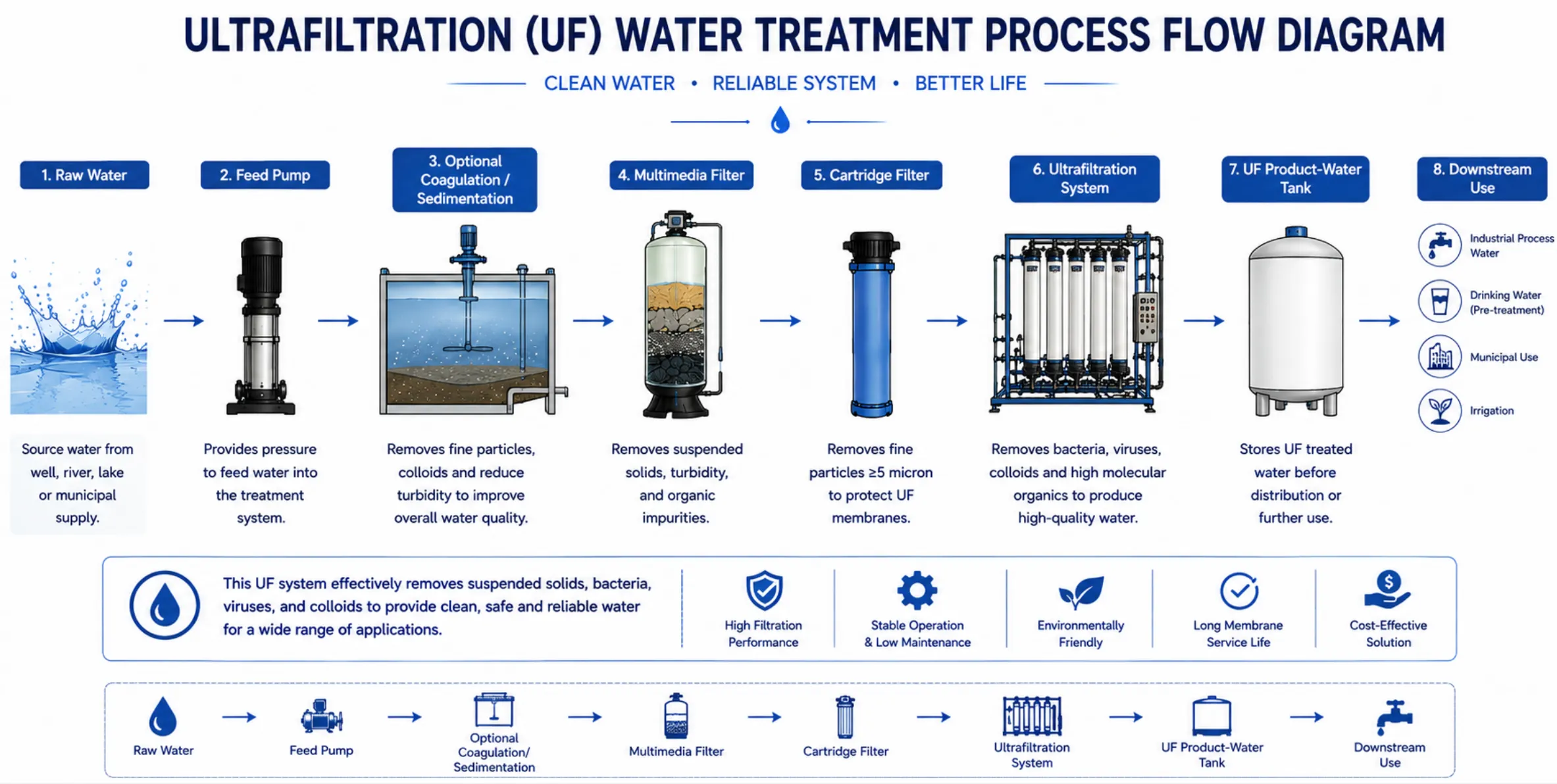
Wastewater Reuse
Biologically Treated Wastewater → Clarification → Multimedia Filter → Ultrafiltration System → UF Water Tank → RO or Reuse Point
The UF system normally includes filtration, backwashing, air scouring, chemically enhanced backwashing and periodic CIP cleaning.
5. Optional Configurations
| Optional Configuration | Main Function |
|---|---|
| Coagulation and clarification | Treats high-turbidity surface water |
| Multimedia filtration | Reduces suspended solids before UF |
| Activated carbon filtration | Reduces odor and some organic contaminants |
| Automatic air scouring | Improves membrane backwashing |
| Chemical dosing | Supports coagulation and membrane cleaning |
| CEB system | Chemically enhanced membrane backwashing |
| CIP cleaning system | Restores membrane performance |
| Online turbidity monitoring | Monitors feed and product water |
| SDI monitoring | Evaluates suitability for downstream RO |
| PLC and remote monitoring | Automates operation and fault alarms |
| Duty/standby membrane trains | Supports uninterrupted water supply |
| Containerized design | Suitable for remote or outdoor projects |
| SS304/SS316 pipelines | Provides enhanced corrosion resistance |
6. Technical Parameters
| Parameter | Typical Specification |
|---|---|
| Daily product-water capacity | 3600m³/day |
| Average net output | Approximately 150m³/h |
| Membrane type | Industrial hollow-fiber UF membrane |
| Typical pore size | Approximately 0.01μm |
| Operating mode | Dead-end or cross-flow, project-dependent |
| Operating pressure | Typically 0.1–0.3MPa |
| Recovery rate | Generally ≥90%, water-dependent |
| Operating temperature | Typically 5–45°C |
| Backwashing | Automatic |
| Chemical cleaning | CEB and CIP |
| Control system | Automatic PLC |
| Monitoring | Flow, pressure, turbidity and tank level |
| Pipeline material | UPVC, carbon steel, SS304 or SS316 |
| Power supply | 380V/415V, 50/60Hz customizable |
| Installation | Modular skid-mounted or containerized |
Final membrane quantity, design flux and recovery rate must be calculated from the complete water analysis and required net capacity.
7. Application Industries
The 3600m³/day large-scale ultrafiltration system is suitable for:
- • Municipal and community water plants
- • Industrial-park centralized water supply
- • Power-plant RO pretreatment
- • Food and beverage factories
- • Chemical and textile plants
- • Mining-water treatment
- • Electronics manufacturing
- • Cooling-water filtration
- • Surface-water purification
- • Tertiary wastewater reuse
- • Seawater desalination pretreatment
8. Frequently Asked Questions
How is 3600 tons/day converted into hourly capacity?
Based on 24-hour operation, 3600m³/day equals an average product-water output of 150m³/h. The gross system capacity may need to be higher to compensate for backwashing and cleaning.
What contaminants does ultrafiltration remove?
UF reduces suspended solids, turbidity, colloids, many bacteria and high-molecular-weight substances. It does not remove dissolved salts.
Can UF replace reverse osmosis?
No. UF is mainly used for particle and colloid removal, while RO removes dissolved salts and reduces conductivity.
Can the system treat high-turbidity river water?
Yes, but coagulation, clarification or multimedia filtration may be required before UF, especially during seasonal turbidity peaks.
Can the plant operate continuously?
Yes. Multiple membrane trains can operate alternately during filtration and backwashing. Standby capacity can be added for critical projects.
How often should UF membranes be cleaned?
Cleaning frequency depends on feed-water quality, transmembrane pressure and flux decline. Automatic backwashing is frequent, while CEB and CIP are performed according to operating data.
Can UF water be used for drinking?
UF can be part of a drinking-water treatment process, but final disinfection and laboratory verification are required.
1. Product Name and Capacity
| Item | Typical Specification |
|---|---|
| Product name | 3600 Tons/Day Industrial Ultrafiltration Water Treatment System |
| Daily capacity | 3600m³/day |
| Average hourly capacity | 150m³/h based on 24-hour operation |
| Typical operating range | 140–160m³/h |
| Membrane technology | Hollow-fiber ultrafiltration |
| Operation mode | Automatic continuous operation |
| Installation | Modular skid-mounted or containerized |
The required gross filtration capacity may be higher than 150m³/h because backwashing, chemical cleaning and downtime reduce net daily production.
2. Applicable Raw Water
This 150m³/h industrial UF water treatment plant can be designed for:
- • River, lake and reservoir water
- • Municipal source water
- • Well water and groundwater
- • High-turbidity surface water
- • Industrial circulating cooling water
- • Biologically treated wastewater
- • RO system feed water
- • Industrial process-water pretreatment
| Raw-Water Problem | Recommended Pretreatment |
|---|---|
| High turbidity | Coagulation and clarification |
| Large suspended solids | Screening and multimedia filtration |
| Algae and microorganisms | Pretreatment disinfection |
| Organic matter | Coagulation or activated carbon |
| Iron and manganese | Oxidation and removal filtration |
| Oil and grease | Oil separation or flotation |
| High COD | Biological or advanced treatment |
UF does not remove dissolved salts. Reverse osmosis is required when lower TDS or conductivity is needed.
3. Typical Product-Water Quality
| Parameter | Typical Design Target |
|---|---|
| Turbidity | Typically ≤0.1 NTU |
| SDI | Suitable for downstream RO design |
| Suspended solids | Significantly reduced |
| Colloids | Effectively retained |
| Bacteria | Substantially reduced |
| Dissolved salts | Not removed |
| Product-water use | RO pretreatment, process water or further purification |
Actual outlet quality depends on feed-water conditions, membrane selection and operating parameters. Drinking-water applications require final disinfection and compliance testing.
4. Typical Treatment Process
Surface-Water Treatment
Raw Water → Screening → Coagulation/Flocculation → Clarification → Multimedia Filter → Ultrafiltration System → UF Product-Water Tank
RO Pretreatment
Raw Water → Pretreatment → Ultrafiltration System → UF Product-Water Tank → Cartridge Filter → RO System
Wastewater Reuse
Biologically Treated Wastewater → Clarification → Multimedia Filter → Ultrafiltration System → UF Water Tank → RO or Reuse Point
The UF system normally includes filtration, backwashing, air scouring, chemically enhanced backwashing and periodic CIP cleaning.
5. Optional Configurations
| Optional Configuration | Main Function |
|---|---|
| Coagulation and clarification | Treats high-turbidity surface water |
| Multimedia filtration | Reduces suspended solids before UF |
| Activated carbon filtration | Reduces odor and some organic contaminants |
| Automatic air scouring | Improves membrane backwashing |
| Chemical dosing | Supports coagulation and membrane cleaning |
| CEB system | Chemically enhanced membrane backwashing |
| CIP cleaning system | Restores membrane performance |
| Online turbidity monitoring | Monitors feed and product water |
| SDI monitoring | Evaluates suitability for downstream RO |
| PLC and remote monitoring | Automates operation and fault alarms |
| Duty/standby membrane trains | Supports uninterrupted water supply |
| Containerized design | Suitable for remote or outdoor projects |
| SS304/SS316 pipelines | Provides enhanced corrosion resistance |
6. Technical Parameters
| Parameter | Typical Specification |
|---|---|
| Daily product-water capacity | 3600m³/day |
| Average net output | Approximately 150m³/h |
| Membrane type | Industrial hollow-fiber UF membrane |
| Typical pore size | Approximately 0.01μm |
| Operating mode | Dead-end or cross-flow, project-dependent |
| Operating pressure | Typically 0.1–0.3MPa |
| Recovery rate | Generally ≥90%, water-dependent |
| Operating temperature | Typically 5–45°C |
| Backwashing | Automatic |
| Chemical cleaning | CEB and CIP |
| Control system | Automatic PLC |
| Monitoring | Flow, pressure, turbidity and tank level |
| Pipeline material | UPVC, carbon steel, SS304 or SS316 |
| Power supply | 380V/415V, 50/60Hz customizable |
| Installation | Modular skid-mounted or containerized |
Final membrane quantity, design flux and recovery rate must be calculated from the complete water analysis and required net capacity.
7. Application Industries
The 3600m³/day large-scale ultrafiltration system is suitable for:
- • Municipal and community water plants
- • Industrial-park centralized water supply
- • Power-plant RO pretreatment
- • Food and beverage factories
- • Chemical and textile plants
- • Mining-water treatment
- • Electronics manufacturing
- • Cooling-water filtration
- • Surface-water purification
- • Tertiary wastewater reuse
- • Seawater desalination pretreatment
8. Frequently Asked Questions
How is 3600 tons/day converted into hourly capacity?
Based on 24-hour operation, 3600m³/day equals an average product-water output of 150m³/h. The gross system capacity may need to be higher to compensate for backwashing and cleaning.
What contaminants does ultrafiltration remove?
UF reduces suspended solids, turbidity, colloids, many bacteria and high-molecular-weight substances. It does not remove dissolved salts.
Can UF replace reverse osmosis?
No. UF is mainly used for particle and colloid removal, while RO removes dissolved salts and reduces conductivity.
Can the system treat high-turbidity river water?
Yes, but coagulation, clarification or multimedia filtration may be required before UF, especially during seasonal turbidity peaks.
Can the plant operate continuously?
Yes. Multiple membrane trains can operate alternately during filtration and backwashing. Standby capacity can be added for critical projects.
How often should UF membranes be cleaned?
Cleaning frequency depends on feed-water quality, transmembrane pressure and flux decline. Automatic backwashing is frequent, while CEB and CIP are performed according to operating data.
Can UF water be used for drinking?
UF can be part of a drinking-water treatment process, but final disinfection and laboratory verification are required.
Get a Quote for Free
Submit this form and our sales representative will contact you soon.


ONLINE MESSAGE
Copyright © 2026 Zhongnuo Water Treatment Co., Ltd.