

SEARCH WHAT YOU WANT
4 m³/h Industrial Ultrafiltration (UF) Water Treatment System
The 4 Tons/Day Industrial Ultrafiltration (UF) Water Treatment System is a compact, small-capacity precision filtration plant with a rated output of 4 m³ per day. It adopts high-performance hollow fiber UF membrane technology to remove suspended solids, colloids, bacteria, macromolecular organics and fine particles from raw water. It is ideal for small-scale drinking water projects, RO pretreatment, small industrial water purification and wastewater reuse scenarios.
Designed for stable automatic operation with a small footprint, the system features an integrated skid-mounted structure, quick on-site deployment and low operating cost, making it a cost-effective choice for small-flow water treatment demands.
The 4 Tons/Day Industrial Ultrafiltration (UF) Water Treatment System is a compact, small-capacity precision filtration plant with a rated output of 4 m³ per day. It adopts high-performance hollow fiber UF membrane technology to remove suspended solids, colloids, bacteria, macromolecular organics and fine particles from raw water. It is ideal for small-scale drinking water projects, RO pretreatment, small industrial water purification and wastewater reuse scenarios.
Designed for stable automatic operation with a small footprint, the system features an integrated skid-mounted structure, quick on-site deployment and low operating cost, making it a cost-effective choice for small-flow water treatment demands.
Next: No more data
Share to
Product Description
The 4 m³/h Industrial Ultrafiltration (UF) Water Treatment System is designed for the removal of suspended solids, colloids, fine particles, bacteria and high-molecular-weight organic matter from water.
Using hollow-fiber ultrafiltration membrane technology, the system provides stable and consistent filtered water for industrial water purification, drinking-water pretreatment, RO system pretreatment and selected water reuse applications.
With a compact skid-mounted design, automatic backwashing and optional PLC control, the system is suitable for continuous industrial operation while helping reduce membrane fouling and routine maintenance requirements.
1. Product Overview
| Specification | Details |
|---|---|
| Product Name | 4 m³/h Industrial Ultrafiltration Water Treatment System |
| Rated Permeate Capacity | 4 m³/h |
| Typical Operating Range | 3.6–4.4 m³/h* |
| Core Technology | Hollow-Fiber Ultrafiltration Membrane |
| Filtration Precision | Approx. 0.01 μm |
| Typical Recovery | ≥90%* |
| Control Mode | Automatic / PLC Control |
| Backwash | Automatic |
| Installation | Skid-Mounted Modular Design |
| Application | Water Purification / RO Pretreatment / Water Reuse |
*Actual capacity, recovery and membrane flux depend on raw-water quality, temperature, operating conditions and system design.
2. What Does the UF System Remove?
Ultrafiltration uses a physical membrane separation process to remove particulate and microbiological contaminants while allowing water and dissolved ions to pass through the membrane.
The system is mainly designed to reduce:
- • Suspended solids
- • Turbidity
- • Colloidal particles
- • Fine particles
- • Bacteria and microorganisms
- • High-molecular-weight organic matter
Under suitable feed-water and operating conditions, UF permeate can typically achieve low turbidity and low SDI, making ultrafiltration particularly suitable as pretreatment for reverse osmosis systems.
Important: UF Does Not Remove Dissolved Salts
Ultrafiltration is not a desalination process.
Dissolved salts, conductivity, hardness ions and other dissolved substances generally pass through UF membranes. If the project requires lower TDS or conductivity, a downstream Reverse Osmosis (RO) System should be used.
3. Suitable Raw Water Sources
The 4 m³/h UF system can be customized for different feed-water conditions, including:
- • Municipal tap water
- • Borehole and well water
- • River and lake water
- • Reservoir water
- • Process water
- • Cooling circulating water
- • Pretreated industrial wastewater
- • RO pretreatment feed water
For surface water, wastewater or other raw water with high turbidity, suspended solids or organic loading, additional pretreatment may be required before the UF membranes.
The final process configuration should therefore be determined according to the raw-water analysis report and target product-water requirements.
4. Typical Treatment Process
Main Process:Raw Water → Booster Pump → Pre-treatment Unit → Cartridge Security Filter → UF Membrane System → Permeate Water Tank → Reuse
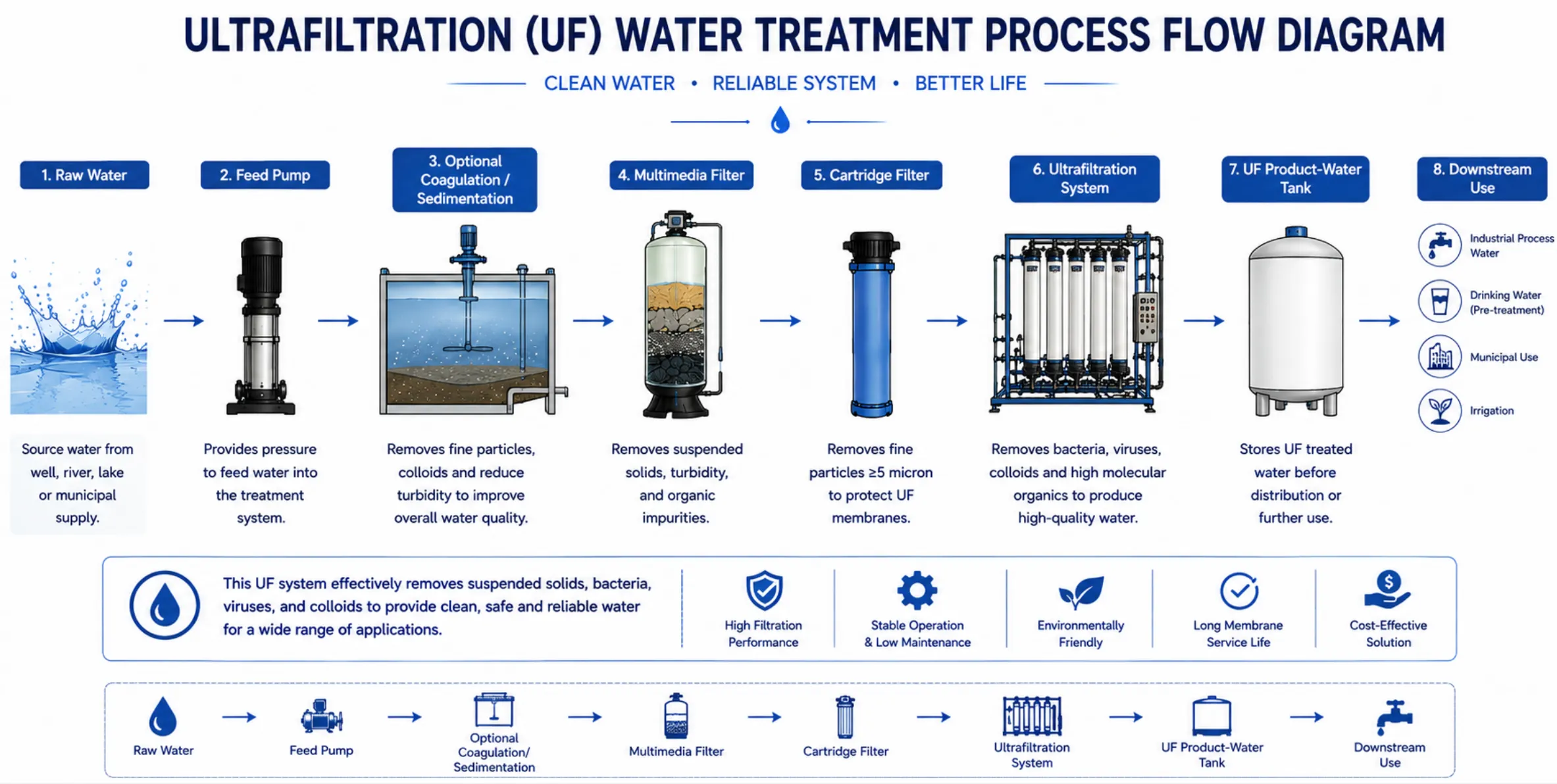
24-hour fully automatic continuous operation, effectively reduce membrane fouling and extend system service life.
UF as RO Pretreatment
Raw Water → Pretreatment → UF System → Cartridge Filter → RO System → Product Water Tank
UF can provide stable pretreatment for downstream RO membranes by reducing turbidity, suspended solids and colloidal contamination.
The actual process will be designed according to raw-water quality rather than using one fixed configuration for every project.
5. Main System Components
A typical 4 m³/h industrial UF system can include:
- • UF membrane modules
- • UF membrane housing / rack
- • Feed water pump
- • Backwash pump
- • Automatic valves
- • Flow meters
- • Pressure gauges / transmitters
- • Control panel
- • PLC and HMI touch screen
- • Chemical cleaning connections
- • Skid frame
- • Interconnecting pipelines
Pretreatment equipment, tanks, dosing systems and disinfection systems can be supplied according to project requirements.
6. Technical Specifications
| Parameter | Typical Specification |
|---|---|
| Rated Permeate Capacity | 4 m³/h |
| Membrane Type | Hollow-Fiber UF Membrane |
| Nominal Filtration Precision | Approx. 0.01 μm |
| Typical Recovery Rate | ≥90% |
| Operating Pressure | Approx. 0.1–0.3 MPa |
| Operating Temperature | Typically 5–45°C* |
| Control System | PLC Automatic Control |
| Backwash | Automatic Timed / Condition-Based |
| Chemical Cleaning | Manual or Automatic CIP Optional |
| Frame Material | Carbon Steel / SS304 / SS316 Optional |
| Pipeline Material | UPVC / SS304 / SS316 Optional |
| Power Supply | Customized to Local Standard |
| Installation | Skid-Mounted |
| Operation | Continuous / Automatic |
*Final allowable operating conditions depend on the selected membrane model.
All technical parameters are subject to final engineering design and membrane calculations based on the customer's raw-water analysis.
7. Optional Configurations
The system can be customized according to different water sources, applications and installation requirements.
Pretreatment
Available options include:
- • Multimedia filtration
- • Activated carbon filtration
- • Iron and manganese removal
- • Coagulation and flocculation
- • Sedimentation
- • Chemical dosing
- • Pre-filtration
UF Cleaning System
Optional cleaning configurations include:
- • Automatic backwashing
- • Air-assisted backwashing where applicable
- • Chemical-enhanced backwash (CEB)
- • CIP chemical cleaning system
Automation & Monitoring
The system can be equipped with:
- • PLC automatic control
- • HMI touch screen
- • Pressure monitoring
- • Flow monitoring
- • Automatic valve control
- • Alarm functions
- • Remote monitoring options
Post-Treatment
Depending on the required product-water quality, downstream treatment can include:
- • UV sterilization
- • Cartridge filtration
- • Activated carbon polishing
- • Reverse osmosis
- • Additional disinfection systems
8. Main Applications
The 4 m³/h UF water treatment system is suitable for a wide range of small and medium industrial or commercial projects, including:
RO Pretreatment
Reduce suspended solids, turbidity and colloids before reverse osmosis.
Borehole Water Treatment
Improve the physical and microbiological quality of groundwater where UF is appropriate.
Surface Water Treatment
Treat preconditioned river, lake and reservoir water.
Food & Beverage Industry
Provide pretreatment or process-water filtration.
Industrial Process Water
Supply filtered water for production processes and utility systems.
Water Reuse Projects
Further treat properly pretreated wastewater for suitable reuse applications.
Community Water Supply
Support small-scale centralized water purification projects.
9. Why Choose a Customized UF System?
UF membrane performance is closely related to feed-water quality.
Using the same membrane flux and cleaning strategy for every project may result in excessive fouling, unstable output or unnecessarily high operating costs.
For this reason, the UF system should be selected and designed according to factors such as:
- • Raw-water turbidity
- • Suspended solids
- • COD / organic loading
- • Water temperature
- • Required permeate capacity
- • Daily operating hours
- • Target water quality
- • Downstream treatment process
Based on these parameters, the membrane quantity, design flux, backwash frequency and pretreatment process can be selected for the specific project.
10. Frequently Asked Questions
Q: Can UF reduce TDS or conductivity?
No. Ultrafiltration mainly removes suspended, colloidal and microbiological contaminants. Dissolved salts require technologies such as reverse osmosis.
Q: Does 4 m³/h mean feed-water capacity or product-water capacity?
The 4 m³/h rating refers to the designed UF permeate capacity. Required feed-water flow is higher because water is also consumed during backwashing and cleaning.
Q: Can the system operate continuously?
Yes. The system can be designed for continuous industrial operation with automatic filtration and backwash cycles. The final operating program depends on the membrane design and feed-water conditions.
Q: Can river water be fed directly into the UF membranes?
This depends on the raw-water quality. High-turbidity surface water normally requires coagulation, sedimentation or other pretreatment before UF.
Q: How often does the UF membrane need cleaning?
Backwashing is performed automatically according to the operating program. Chemical-enhanced backwash or CIP frequency depends on membrane fouling and feed-water quality.
Q: Can UF be installed before an RO system?
Yes. UF is widely used as RO pretreatment because it can reduce suspended solids, colloids and turbidity before water enters the RO membranes.
Q: Can you customize the system according to our project?
Yes. Capacity, membrane configuration, pretreatment, materials, automation, electrical standards and post-treatment can be customized according to project requirements.
11. Information Required for Quotation
For an accurate technical proposal and quotation, please provide:
- • Raw water source — borehole, river, municipal water, wastewater, etc.
- • Raw water analysis report — especially turbidity, TSS, pH, COD and other relevant parameters.
- • Required product-water capacity — m³/h or m³/day.
- • Daily operating hours.
- • Required product-water quality and application.
- • Local power supply — voltage, phase and frequency.
- • Preferred equipment and piping materials.
- • Installation environment and available space.
- • Automation or remote-monitoring requirements.
With this information, our engineers can evaluate the raw water and recommend the appropriate UF membrane configuration, pretreatment process and operating parameters.
Customized 4 m³/h UF Water Treatment Solutions
Zhongnuo Water Treatment provides customized industrial ultrafiltration systems for borehole water, surface water, industrial process water, RO pretreatment and water reuse applications.
Our services cover process evaluation, system design, equipment manufacturing, factory testing, installation guidance, commissioning support and after-sales technical service.
Send us your raw-water analysis, required capacity and target water quality to receive a customized technical proposal and quotation for your project.
The 4 m³/h Industrial Ultrafiltration (UF) Water Treatment System is designed for the removal of suspended solids, colloids, fine particles, bacteria and high-molecular-weight organic matter from water.
Using hollow-fiber ultrafiltration membrane technology, the system provides stable and consistent filtered water for industrial water purification, drinking-water pretreatment, RO system pretreatment and selected water reuse applications.
With a compact skid-mounted design, automatic backwashing and optional PLC control, the system is suitable for continuous industrial operation while helping reduce membrane fouling and routine maintenance requirements.
1. Product Overview
| Specification | Details |
|---|---|
| Product Name | 4 m³/h Industrial Ultrafiltration Water Treatment System |
| Rated Permeate Capacity | 4 m³/h |
| Typical Operating Range | 3.6–4.4 m³/h* |
| Core Technology | Hollow-Fiber Ultrafiltration Membrane |
| Filtration Precision | Approx. 0.01 μm |
| Typical Recovery | ≥90%* |
| Control Mode | Automatic / PLC Control |
| Backwash | Automatic |
| Installation | Skid-Mounted Modular Design |
| Application | Water Purification / RO Pretreatment / Water Reuse |
*Actual capacity, recovery and membrane flux depend on raw-water quality, temperature, operating conditions and system design.
2. What Does the UF System Remove?
Ultrafiltration uses a physical membrane separation process to remove particulate and microbiological contaminants while allowing water and dissolved ions to pass through the membrane.
The system is mainly designed to reduce:
- • Suspended solids
- • Turbidity
- • Colloidal particles
- • Fine particles
- • Bacteria and microorganisms
- • High-molecular-weight organic matter
Under suitable feed-water and operating conditions, UF permeate can typically achieve low turbidity and low SDI, making ultrafiltration particularly suitable as pretreatment for reverse osmosis systems.
Important: UF Does Not Remove Dissolved Salts
Ultrafiltration is not a desalination process.
Dissolved salts, conductivity, hardness ions and other dissolved substances generally pass through UF membranes. If the project requires lower TDS or conductivity, a downstream Reverse Osmosis (RO) System should be used.
3. Suitable Raw Water Sources
The 4 m³/h UF system can be customized for different feed-water conditions, including:
- • Municipal tap water
- • Borehole and well water
- • River and lake water
- • Reservoir water
- • Process water
- • Cooling circulating water
- • Pretreated industrial wastewater
- • RO pretreatment feed water
For surface water, wastewater or other raw water with high turbidity, suspended solids or organic loading, additional pretreatment may be required before the UF membranes.
The final process configuration should therefore be determined according to the raw-water analysis report and target product-water requirements.
4. Typical Treatment Process
Main Process:Raw Water → Booster Pump → Pre-treatment Unit → Cartridge Security Filter → UF Membrane System → Permeate Water Tank → Reuse
24-hour fully automatic continuous operation, effectively reduce membrane fouling and extend system service life.
UF as RO Pretreatment
Raw Water → Pretreatment → UF System → Cartridge Filter → RO System → Product Water Tank
UF can provide stable pretreatment for downstream RO membranes by reducing turbidity, suspended solids and colloidal contamination.
The actual process will be designed according to raw-water quality rather than using one fixed configuration for every project.
5. Main System Components
A typical 4 m³/h industrial UF system can include:
- • UF membrane modules
- • UF membrane housing / rack
- • Feed water pump
- • Backwash pump
- • Automatic valves
- • Flow meters
- • Pressure gauges / transmitters
- • Control panel
- • PLC and HMI touch screen
- • Chemical cleaning connections
- • Skid frame
- • Interconnecting pipelines
Pretreatment equipment, tanks, dosing systems and disinfection systems can be supplied according to project requirements.
6. Technical Specifications
| Parameter | Typical Specification |
|---|---|
| Rated Permeate Capacity | 4 m³/h |
| Membrane Type | Hollow-Fiber UF Membrane |
| Nominal Filtration Precision | Approx. 0.01 μm |
| Typical Recovery Rate | ≥90% |
| Operating Pressure | Approx. 0.1–0.3 MPa |
| Operating Temperature | Typically 5–45°C* |
| Control System | PLC Automatic Control |
| Backwash | Automatic Timed / Condition-Based |
| Chemical Cleaning | Manual or Automatic CIP Optional |
| Frame Material | Carbon Steel / SS304 / SS316 Optional |
| Pipeline Material | UPVC / SS304 / SS316 Optional |
| Power Supply | Customized to Local Standard |
| Installation | Skid-Mounted |
| Operation | Continuous / Automatic |
*Final allowable operating conditions depend on the selected membrane model.
All technical parameters are subject to final engineering design and membrane calculations based on the customer's raw-water analysis.
7. Optional Configurations
The system can be customized according to different water sources, applications and installation requirements.
Pretreatment
Available options include:
- • Multimedia filtration
- • Activated carbon filtration
- • Iron and manganese removal
- • Coagulation and flocculation
- • Sedimentation
- • Chemical dosing
- • Pre-filtration
UF Cleaning System
Optional cleaning configurations include:
- • Automatic backwashing
- • Air-assisted backwashing where applicable
- • Chemical-enhanced backwash (CEB)
- • CIP chemical cleaning system
Automation & Monitoring
The system can be equipped with:
- • PLC automatic control
- • HMI touch screen
- • Pressure monitoring
- • Flow monitoring
- • Automatic valve control
- • Alarm functions
- • Remote monitoring options
Post-Treatment
Depending on the required product-water quality, downstream treatment can include:
- • UV sterilization
- • Cartridge filtration
- • Activated carbon polishing
- • Reverse osmosis
- • Additional disinfection systems
8. Main Applications
The 4 m³/h UF water treatment system is suitable for a wide range of small and medium industrial or commercial projects, including:
RO Pretreatment
Reduce suspended solids, turbidity and colloids before reverse osmosis.
Borehole Water Treatment
Improve the physical and microbiological quality of groundwater where UF is appropriate.
Surface Water Treatment
Treat preconditioned river, lake and reservoir water.
Food & Beverage Industry
Provide pretreatment or process-water filtration.
Industrial Process Water
Supply filtered water for production processes and utility systems.
Water Reuse Projects
Further treat properly pretreated wastewater for suitable reuse applications.
Community Water Supply
Support small-scale centralized water purification projects.
9. Why Choose a Customized UF System?
UF membrane performance is closely related to feed-water quality.
Using the same membrane flux and cleaning strategy for every project may result in excessive fouling, unstable output or unnecessarily high operating costs.
For this reason, the UF system should be selected and designed according to factors such as:
- • Raw-water turbidity
- • Suspended solids
- • COD / organic loading
- • Water temperature
- • Required permeate capacity
- • Daily operating hours
- • Target water quality
- • Downstream treatment process
Based on these parameters, the membrane quantity, design flux, backwash frequency and pretreatment process can be selected for the specific project.
10. Frequently Asked Questions
Q: Can UF reduce TDS or conductivity?
No. Ultrafiltration mainly removes suspended, colloidal and microbiological contaminants. Dissolved salts require technologies such as reverse osmosis.
Q: Does 4 m³/h mean feed-water capacity or product-water capacity?
The 4 m³/h rating refers to the designed UF permeate capacity. Required feed-water flow is higher because water is also consumed during backwashing and cleaning.
Q: Can the system operate continuously?
Yes. The system can be designed for continuous industrial operation with automatic filtration and backwash cycles. The final operating program depends on the membrane design and feed-water conditions.
Q: Can river water be fed directly into the UF membranes?
This depends on the raw-water quality. High-turbidity surface water normally requires coagulation, sedimentation or other pretreatment before UF.
Q: How often does the UF membrane need cleaning?
Backwashing is performed automatically according to the operating program. Chemical-enhanced backwash or CIP frequency depends on membrane fouling and feed-water quality.
Q: Can UF be installed before an RO system?
Yes. UF is widely used as RO pretreatment because it can reduce suspended solids, colloids and turbidity before water enters the RO membranes.
Q: Can you customize the system according to our project?
Yes. Capacity, membrane configuration, pretreatment, materials, automation, electrical standards and post-treatment can be customized according to project requirements.
11. Information Required for Quotation
For an accurate technical proposal and quotation, please provide:
- • Raw water source — borehole, river, municipal water, wastewater, etc.
- • Raw water analysis report — especially turbidity, TSS, pH, COD and other relevant parameters.
- • Required product-water capacity — m³/h or m³/day.
- • Daily operating hours.
- • Required product-water quality and application.
- • Local power supply — voltage, phase and frequency.
- • Preferred equipment and piping materials.
- • Installation environment and available space.
- • Automation or remote-monitoring requirements.
With this information, our engineers can evaluate the raw water and recommend the appropriate UF membrane configuration, pretreatment process and operating parameters.
Customized 4 m³/h UF Water Treatment Solutions
Zhongnuo Water Treatment provides customized industrial ultrafiltration systems for borehole water, surface water, industrial process water, RO pretreatment and water reuse applications.
Our services cover process evaluation, system design, equipment manufacturing, factory testing, installation guidance, commissioning support and after-sales technical service.
Send us your raw-water analysis, required capacity and target water quality to receive a customized technical proposal and quotation for your project.
Next: No more data
Get a Quote for Free
Submit this form and our sales representative will contact you soon.


ONLINE MESSAGE
Copyright © 2026 Zhongnuo Water Treatment Co., Ltd.