Compact Industrial RO Water Purification
500L/H Reverse Osmosis Water Treatment System
A compact skid-mounted RO plant producing 500 liters of purified water per hour. Designed for bottled-water plants, food production, hotels, schools, clinics, offices and small industrial facilities.
500L/HRated product-water capacity
12,000LMaximum daily production
97–99%Typical salt rejection
AutomaticPLC or relay control
Key Features & Advantages
Compact & Reliable
01
Stable 500L/H Output
Provides purified water for small commercial and industrial applications.
02
Compact Skid Design
Preassembled construction saves installation space and simplifies delivery.
03
High Salt Rejection
Industrial RO membranes typically achieve 97%–99% rejection under design conditions.
04
Customized Pretreatment
The process is selected according to hardness, turbidity, iron and manganese.
05
Automatic Operation
Automatic production, flushing, tank-level control and equipment protection.
06
Flexible Components
Voltage, pumps, membranes, controls and materials can be customized.
Suitable Raw Water
Feedwater Applications
A raw-water analysis is recommended when the source contains high hardness, iron, manganese, silica, turbidity or organic matter.
Municipal Tap Water
Further purification for production, drinking-water or commercial applications.
Borehole & Well Water
Pretreatment selected according to sediment, hardness, iron and manganese.
Low-Salinity Groundwater
Groundwater requiring TDS, conductivity and hardness reduction.
Rainwater
Rainwater treated after suitable collection, clarification and pretreatment.
Pre-Filtered Surface Water
River or reservoir water requiring adequate upstream treatment before RO.
Industrial Process Water
Feedwater requiring additional purification for sensitive production processes.
For high-TDS groundwater, a purpose-designed brackish water RO system may be required.
Product-Water Quality
Typical Performance
| Salt rejection |
Typically 97%–99% under design conditions |
| Product-water TDS |
Significantly reduced; final value depends on feedwater and design |
| Hardness |
Substantially reduced |
| Dissolved contaminants |
Most dissolved contaminants are reduced by RO membrane separation |
| Conductivity |
Stable output for general production applications |
| Water appearance |
Clear, low-salinity product water |
Drinking-water projects may require UV, ozone or remineralization. Final water quality should be verified against applicable local requirements.
Typical Treatment Process
RO Process Flow
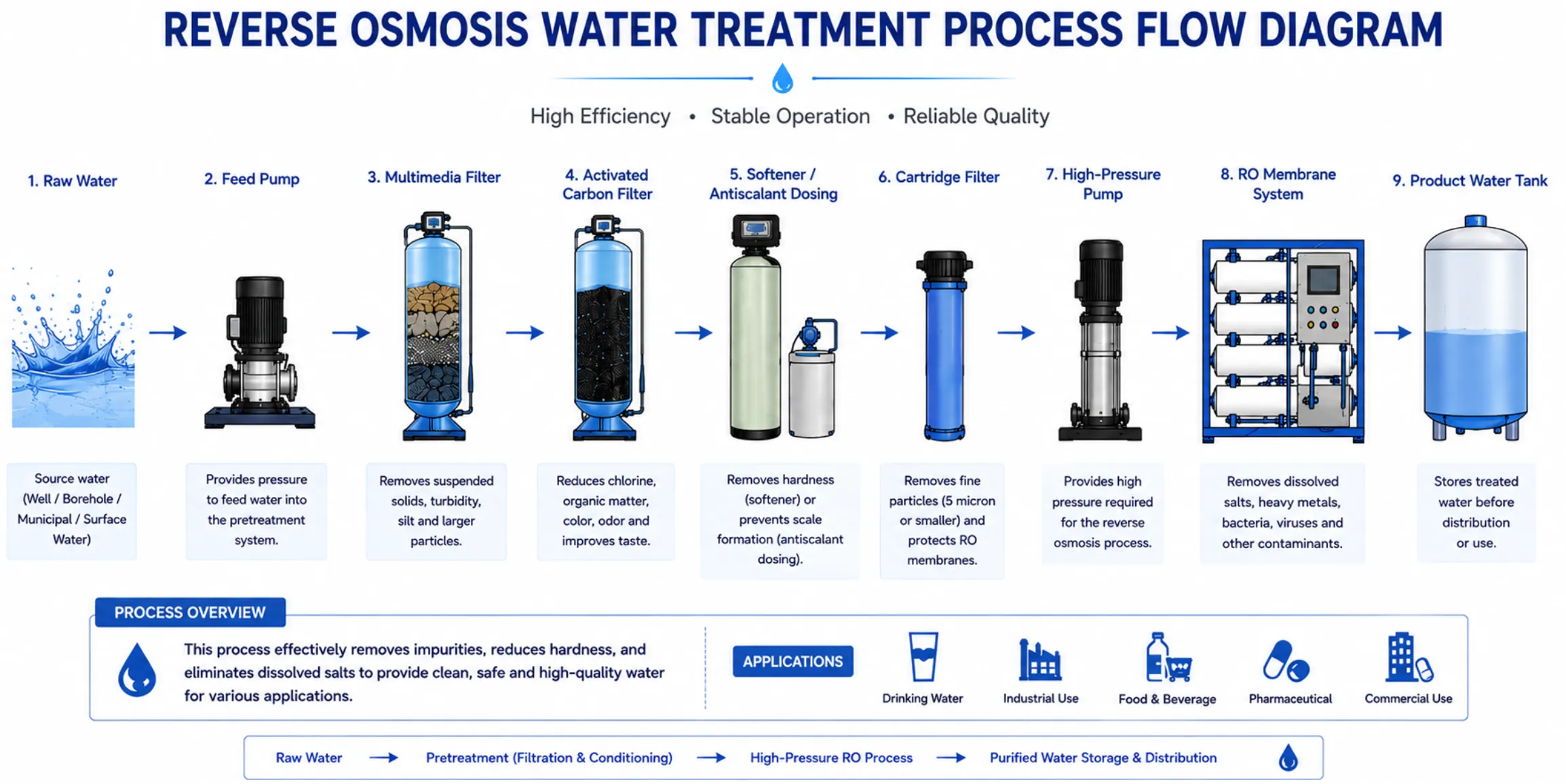
Raw Water→Raw-Water Tank→Feed Pump→Multimedia Filter→Activated Carbon→Softener / Antiscalant→5μm Cartridge Filter→High-Pressure Pump→RO Membranes→UV Sterilizer→Product-Water Tank
The final pretreatment process is adjusted according to the complete raw-water report.
Optional Configurations
Build to Requirement
Multimedia & Carbon Filters
Reduce sediment, turbidity, odor and selected organic contaminants.
Iron & Manganese Removal
Dedicated oxidation and filtration for metal-bearing groundwater.
Water Softener
Reduces hardness and scaling potential before the RO membranes.
UV or Ozone
Optional microbial control for drinking and domestic-water projects.
Remineralization
Adjusts mineral content and taste for drinking-water applications.
CIP Cleaning System
Dedicated chemical cleaning for long-term membrane maintenance.
PLC & Online Monitoring
Touchscreen control with TDS, conductivity, pressure and flow display.
Stainless-Steel Upgrade
Optional SS304 frame and stainless-steel product-water piping.
Filling Equipment
Optional tanks, delivery pumps, filling and packaging equipment.
Technical Specifications
Typical Configuration
| Product-water capacity |
500L/h (0.5m³/h) |
| Maximum daily production |
Up to 12,000L/day at 24-hour operation |
| Feedwater source |
Tap water, borehole water or low-salinity groundwater |
| Recommended feedwater TDS |
≤2,000mg/L |
| Typical salt rejection |
97%–99% |
| Typical recovery rate |
50%–70%, subject to water analysis |
| RO membrane |
Industrial 4040 membrane |
| Pretreatment |
Customized according to water quality |
| Cartridge filtration |
5μm |
| Control system |
Automatic PLC or relay control |
| Frame material |
SS304 |
| Piping material |
UPVC or stainless steel |
| Power supply |
Customized to local voltage, phase and frequency |
| Installation |
Compact skid-mounted design |
| Warranty |
One year |
Final configuration and performance depend on feedwater quality, temperature and the required product-water standard.
Applications
Industries & Projects
Bottled-Water Plants
Compact purified-water production for small filling operations.
Food & Beverage
Process-support water and equipment-cleaning applications.
Hotels & Restaurants
Centralized purified water for kitchens and guest facilities.
Schools & Offices
Reliable drinking and domestic-water purification.
Hospitals & Clinics
General purified-water supply or pretreatment for further purification.
Small Factories
Process water, boiler-feed pretreatment and production cleaning.
Frequently Asked Questions
RO System FAQ
Can this system treat borehole water?
Yes. Pretreatment for sediment, hardness, iron and manganese is selected according to the borehole-water analysis.
Can the product water be used for drinking?
Yes, when correctly designed and combined with suitable disinfection and post-treatment. Final water quality must meet local requirements.
How much feedwater is required?
At 60% recovery, producing 500L/h of purified water requires approximately 830L/h of feedwater.
Can the system operate 24 hours per day?
Yes, with adequate raw-water and product-water storage. Routine inspection and filter replacement are still required.
How often should filters and membranes be replaced?
Cartridge filters are commonly replaced every 1–3 months. RO membranes generally last 2–4 years, depending on water quality and maintenance.
Can voltage and component brands be customized?
Yes. Voltage, frequency, pumps, membranes, controls and construction materials can be selected for the project.
Information Required for Quotation
Request a Proposal
- Raw-water analysis report
- Raw-water source
- Required product-water capacity
- Final water application
- Required TDS or conductivity
- Daily operating hours
- Local voltage, phase and frequency
- Project location and destination port
- Preferred component brands
- Installation and commissioning requirements
Need a 500L/H RO Solution?
Send us your water analysis and project requirements for a suitable configuration and accurate quotation.
Compact Industrial RO Water Purification
500L/H Reverse Osmosis Water Treatment System
A compact skid-mounted RO plant producing 500 liters of purified water per hour. Designed for bottled-water plants, food production, hotels, schools, clinics, offices and small industrial facilities.
500L/HRated product-water capacity
12,000LMaximum daily production
97–99%Typical salt rejection
AutomaticPLC or relay control
Key Features & Advantages
Compact & Reliable
01
Stable 500L/H Output
Provides purified water for small commercial and industrial applications.
02
Compact Skid Design
Preassembled construction saves installation space and simplifies delivery.
03
High Salt Rejection
Industrial RO membranes typically achieve 97%–99% rejection under design conditions.
04
Customized Pretreatment
The process is selected according to hardness, turbidity, iron and manganese.
05
Automatic Operation
Automatic production, flushing, tank-level control and equipment protection.
06
Flexible Components
Voltage, pumps, membranes, controls and materials can be customized.
Suitable Raw Water
Feedwater Applications
A raw-water analysis is recommended when the source contains high hardness, iron, manganese, silica, turbidity or organic matter.
Municipal Tap Water
Further purification for production, drinking-water or commercial applications.
Borehole & Well Water
Pretreatment selected according to sediment, hardness, iron and manganese.
Low-Salinity Groundwater
Groundwater requiring TDS, conductivity and hardness reduction.
Rainwater
Rainwater treated after suitable collection, clarification and pretreatment.
Pre-Filtered Surface Water
River or reservoir water requiring adequate upstream treatment before RO.
Industrial Process Water
Feedwater requiring additional purification for sensitive production processes.
For high-TDS groundwater, a purpose-designed brackish water RO system may be required.
Product-Water Quality
Typical Performance
| Salt rejection |
Typically 97%–99% under design conditions |
| Product-water TDS |
Significantly reduced; final value depends on feedwater and design |
| Hardness |
Substantially reduced |
| Dissolved contaminants |
Most dissolved contaminants are reduced by RO membrane separation |
| Conductivity |
Stable output for general production applications |
| Water appearance |
Clear, low-salinity product water |
Drinking-water projects may require UV, ozone or remineralization. Final water quality should be verified against applicable local requirements.
Typical Treatment Process
RO Process Flow
Raw Water→Raw-Water Tank→Feed Pump→Multimedia Filter→Activated Carbon→Softener / Antiscalant→5μm Cartridge Filter→High-Pressure Pump→RO Membranes→UV Sterilizer→Product-Water Tank
The final pretreatment process is adjusted according to the complete raw-water report.
Optional Configurations
Build to Requirement
Multimedia & Carbon Filters
Reduce sediment, turbidity, odor and selected organic contaminants.
Iron & Manganese Removal
Dedicated oxidation and filtration for metal-bearing groundwater.
Water Softener
Reduces hardness and scaling potential before the RO membranes.
UV or Ozone
Optional microbial control for drinking and domestic-water projects.
Remineralization
Adjusts mineral content and taste for drinking-water applications.
CIP Cleaning System
Dedicated chemical cleaning for long-term membrane maintenance.
PLC & Online Monitoring
Touchscreen control with TDS, conductivity, pressure and flow display.
Stainless-Steel Upgrade
Optional SS304 frame and stainless-steel product-water piping.
Filling Equipment
Optional tanks, delivery pumps, filling and packaging equipment.
Technical Specifications
Typical Configuration
| Product-water capacity |
500L/h (0.5m³/h) |
| Maximum daily production |
Up to 12,000L/day at 24-hour operation |
| Feedwater source |
Tap water, borehole water or low-salinity groundwater |
| Recommended feedwater TDS |
≤2,000mg/L |
| Typical salt rejection |
97%–99% |
| Typical recovery rate |
50%–70%, subject to water analysis |
| RO membrane |
Industrial 4040 membrane |
| Pretreatment |
Customized according to water quality |
| Cartridge filtration |
5μm |
| Control system |
Automatic PLC or relay control |
| Frame material |
SS304 |
| Piping material |
UPVC or stainless steel |
| Power supply |
Customized to local voltage, phase and frequency |
| Installation |
Compact skid-mounted design |
| Warranty |
One year |
Final configuration and performance depend on feedwater quality, temperature and the required product-water standard.
Applications
Industries & Projects
Bottled-Water Plants
Compact purified-water production for small filling operations.
Food & Beverage
Process-support water and equipment-cleaning applications.
Hotels & Restaurants
Centralized purified water for kitchens and guest facilities.
Schools & Offices
Reliable drinking and domestic-water purification.
Hospitals & Clinics
General purified-water supply or pretreatment for further purification.
Small Factories
Process water, boiler-feed pretreatment and production cleaning.
Frequently Asked Questions
RO System FAQ
Can this system treat borehole water?
Yes. Pretreatment for sediment, hardness, iron and manganese is selected according to the borehole-water analysis.
Can the product water be used for drinking?
Yes, when correctly designed and combined with suitable disinfection and post-treatment. Final water quality must meet local requirements.
How much feedwater is required?
At 60% recovery, producing 500L/h of purified water requires approximately 830L/h of feedwater.
Can the system operate 24 hours per day?
Yes, with adequate raw-water and product-water storage. Routine inspection and filter replacement are still required.
How often should filters and membranes be replaced?
Cartridge filters are commonly replaced every 1–3 months. RO membranes generally last 2–4 years, depending on water quality and maintenance.
Can voltage and component brands be customized?
Yes. Voltage, frequency, pumps, membranes, controls and construction materials can be selected for the project.
Information Required for Quotation
Request a Proposal
- Raw-water analysis report
- Raw-water source
- Required product-water capacity
- Final water application
- Required TDS or conductivity
- Daily operating hours
- Local voltage, phase and frequency
- Project location and destination port
- Preferred component brands
- Installation and commissioning requirements
Need a 500L/H RO Solution?
Send us your water analysis and project requirements for a suitable configuration and accurate quotation.